Why Invest in Precious Metals?
A Smart Way to Protect
and Grow What You've Built
Every asset in your portfolio has a job to do. Gold, silver, and rare coins have historically done one job better than almost anything else: protecting the wealth you already have.
Different Assets Solve Different Problems
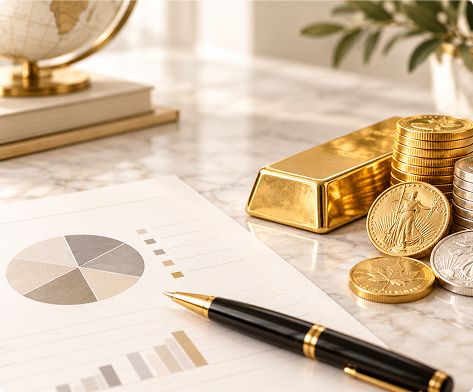
Stocks, real estate, businesses, cash, and precious metals don’t all serve the same purpose. Some are built to grow wealth. Others provide income or liquidity. Precious metals have historically played a different role, preserving purchasing power, diversifying a portfolio, and giving investors a tangible asset outside the traditional financial system.
Gold isn’t designed to make you rich quickly. It doesn’t pay dividends or generate earnings. What it has done for centuries is hold value through inflation, market instability, currency weakness, and economic uncertainty.
Think of it less as speculation and more as financial insurance.
And gold is only part of the picture. Silver offers greater industrial exposure and typically more volatility. Rare coins combine precious-metal content with scarcity, condition, and collector demand.
Understanding those differences is the first step toward deciding whether precious metals belong in your portfolio.
Why Do Investors Own Precious Metals?
Portfolio Diversification
Precious metals respond to economic conditions differently than stocks and bonds. Adding assets that don't move in lockstep with the rest of your portfolio can reduce your dependence on any single market.
Long-Term Store of Value
Gold has been recognized as a store of value across cultures and economies for thousands of years. Unlike paper currency, it can't be created through monetary policy; it exists in finite supply.
Protection During Economic Uncertainty
Financial crises, geopolitical instability, and banking concerns often push investors toward tangible assets. Physical gold doesn't depend on the performance or solvency of any company or institution.
A Hedge Against Inflation and Currency Risk
Inflation reduces what a dollar can buy over time. Gold has historically been an effective way investors preserve purchasing power as currency value declines.
Tangible Ownership
Physical precious metals are exactly that, physical. You can hold them, store them privately, and own them independent of a brokerage account or digital financial system.
Limited Supply and Global Demand
Gold and silver are finite resources; they can't be created on demand. At the same time, demand comes from investors, central banks, industry, and jewelry worldwide. That mix of scarcity and demand is a big reason precious metals have stayed relevant across generations.
Knowing gold belongs in your portfolio is one thing. Knowing how much to buy, which form makes sense for you, and how to avoid the mistakes that trip up new investors is the difficult part.
The Blanchard Investor’s Guide is a free, no-pressure resource built to help you make your first move (or your next one) with confidence, not guesswork.
Inside, you’ll learn:
- How much of your portfolio precious metals should realistically make up
- The real differences between gold and silver and when each makes sense
- Bullion vs. rare coins: what’s the difference, and which is right for you
- The most common mistakes first-time precious metals investors make
- How to think about timing your purchases (hint: it’s not about guessing the market)
- What to look for and look out for when choosing a dealer
Enter your email below, and we’ll send you a free downloadable PDF straight to your inbox.
Start With the Guide
A free downloadable PDF for investors
"*" indicates required fields