



The Coin That Preserved America’s Greatest Migration Route

Imagine standing on the edge of the American frontier.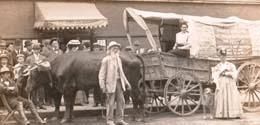
Ahead lies more than 2,000 miles of wilderness. There are no highways, no gas stations, and no guarantees. Everything you own is packed into a wooden wagon pulled by oxen. Around you are thousands of other families chasing the same dream: a new life in the West.
Some will make it. Many will not.
For generations, the Oregon Trail represented one of the greatest migrations in American history. Between the 1840s and 1860s, hundreds of thousands of pioneers traveled across mountains, deserts, rivers, and endless prairie in search of opportunity. Along the way, thousands died from disease, accidents, exposure, and exhaustion. Their stories became woven into the fabric of the American West.
Yet by the early twentieth century, those sacrifices were beginning to fade from public memory.
One man refused to let that happen.
The Pioneer Who Wouldn’t Let America Forget
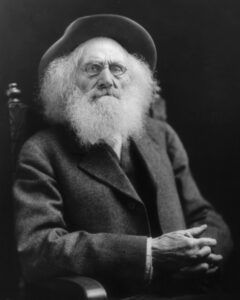
In 1852, a young Ohio farmer named Ezra Meeker loaded his wife and infant son into an ox-drawn wagon and headed west along the Oregon Trail.
The journey changed his life.
Decades later, as one of the last surviving pioneers, Meeker realized that many Americans had forgotten the people who opened the West. Historical landmarks were disappearing. Trail routes were being swallowed by farms and growing cities. The story of the pioneers was literally vanishing from the landscape.
Most people would have accepted it. Not Ezra Meeker.
In his seventies, eighties, and even nineties, he launched a one-man campaign to preserve the Oregon Trail. He retraced portions of the route in an ox-drawn wagon. He met politicians. He gave speeches. He made historical markers. He even parked his wagon in front of the White House to draw attention to his cause.
Then, at age 95, Meeker traveled to Washington, D.C., and persuaded Congress to authorize a commemorative half dollar that would help fund preservation efforts.
A Masterpiece in Silver
Released in 1926, the Oregon Trail Memorial Half Dollar was unlike anything collectors had seen before.
The coin was created by renowned sculptors James Earle Fraser, designer of the Buffalo Nickel, and his wife Laura Gardin Fraser, one of the most accomplished artists of her era. Together, they produced a coin that many collectors still consider among the most beautiful ever struck by the United States Mint.
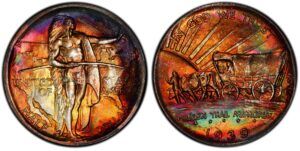
On one side, a covered wagon crests a hill as it heads west toward the setting sun. It is a scene filled with motion and hope. You can almost hear the creaking wagon wheels and the slow march of the oxen.
On the other side stands a Native American figure before a map of the United States. One hand is raised as if signaling a warning as the line of westward migration stretches across the continent behind him.
Three Oregon Trail Half Dollars Every Collector Should Know
The 1926 Oregon Trail Memorial Half Dollar
As the first issue of the series, the 1926 coin is directly tied to Ezra Meeker’s historic campaign. It represents the realization of his dream that future generations would remember the determination of the pioneers who crossed the continent.
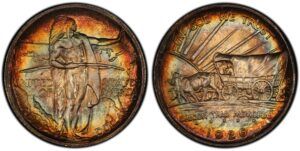
The 1933-D Oregon Trail Memorial Half Dollar
The 1933-D issue holds a unique place in U.S. Mint history.
It was the first commemorative coin ever struck at the Denver Mint, making it significant not only to Oregon Trail collectors but also to collectors of Denver coinage.
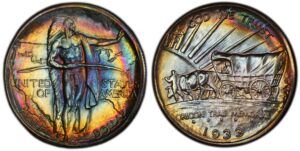
The 1939-S Oregon Trail Memorial Half Dollar
The final chapter.
Issued during the last year of the series, the 1939-S marked the end of a commemorative program that had spanned fourteen years. With only a few thousand struck, it remains one of the key dates in the collection.
The Coin That Helped End an Era
Ironically, the Oregon Trail Half Dollar became so popular that it eventually helped bring an end to the classic commemorative coin era.
Congress had authorized up to six million coins, but the Oregon Trail Memorial Association ordered relatively small quantities over many different years and mints. New varieties appeared repeatedly, encouraging collectors to buy additional issues to keep their collections complete. Many collectors grew frustrated.
What began as a fundraising effort increasingly looked like a never-ending series of special releases. The controversy sparked protests within the numismatic community and contributed to Congress shutting down many commemorative coin programs by the end of the 1930s.
In a twist of history, one of America’s most beloved commemorative coins also helped reshape the future of commemorative coinage itself.
More Than a Coin
Today, the Oregon Trail Memorial Half Dollar remains one of the crown jewels of classic U.S. commemoratives.
Collectors admire its artistry, historians appreciate its connection to one of the most important migrations in American history, and anyone who holds one can feel the story it carries. This coin represents a pioneer family chasing opportunity beyond the horizon. It is the memory of thousands who risked everything for a chance at a better future.
Nearly a century after its first appearance, the Oregon Trail Memorial Half Dollar continues to do exactly what Ezra Meeker hoped it would do: Keep the story alive.







Mother of God, those are some nicely-toned halves. Oh, my stars and garters!