Could Private Credit Defaults Trigger a 2008-Like Crisis?

Are you looking for a movie to watch this weekend? Consider the 2015 movie The Big Short, starring Brad Pitt, Steve Carell, Christian Bale, and Ryan Gosling, which outlines the triggers of the 2008 Global Financial Crisis,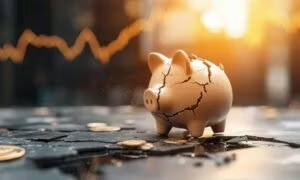 along with dark comedy and celebrity cameos. Why is this worth watching? Today, risks bubbling up in the private credit market are triggering concerns that another financial crisis could be brewing behind the scenes.
2008 financial crisis impact: Risks bubbling up in the private credit market are triggering concerns that another financial crisis could be brewing behind the scenes.
2008 financial crisis impact
By the numbers, the economic impact of the 2008 financial crisis was staggering. The stock market plunged 50%, 8.8 million Americans lost their jobs, home values fell by 30%, and over 16 million homes went into foreclosure.
Gold then and now
Looking back, gold pulled back as the 2008 financial crisis started. Why? Hedge funds, banks, and institutional investors faced margin calls and sold gold to raise cash. Gold provided liquidity in a crisis—one of the key attributes of a safe-haven asset—but then the precious metal rocketed higher. After touching $700 an ounce in October, gold soared in a multi-year bull market to a record high above $1,900 an ounce in 2011.
Today, gold is in a consolidation phase, faced with the headwinds of higher Federal Reserve interest rates to combat inflation. Gold had been priced in expectations of Fed rate cuts this year, so now we are seeing a “repricing” of interest rate expectations with a slightly lower price in gold.
The private credit story
Now getting back to private credit…Behind the scenes in recent years, private credit issuance has exploded. What is private credit?
It’s a form of lending provided by private equity firms to companies. These are loans that are not traded on the public markets. All sorts of borrowers, from insurance companies to health care firms to software technology companies, have borrowed over $40 trillion from private credit lenders. The U.S. life insurance industry has become extremely exposed, with 20% of the industry’s holdings held in the most illiquid kind of fixed-income investments, according to a new study by Moody’s Corp.
The risks?
Private credit loans are unregulated. There is no secondary market to trade this debt. As these loans have exploded in size and across industries in recent years, concerns about defaults and losses are piling up, especially if AI disruption creates more volatility in the stock market.
Just this week, alternative asset manager Apollo Global Management limited withdrawal requests from its largest non-traded private credit fund after investors asked to redeem 17% of the fund’s assets.
The bottom line
While much of this may sound arcane and complicated, just as it was in the 2008 financial crisis, stretched equity valuations leave us all vulnerable. Runs on private credit funds could freeze up credit, and spillover contagion could flow into traditional lending, stock, and bond markets. At the same time, the Federal Reserve faces less policy flexibility today than in 2008, given high inflation and the massive government debt burdens.
Time to make the popcorn
As one hedge fund manager said in the movie The Big Short: “Our investment strategy was simple. People hate to think about bad things happening, so they always underestimate their likelihood.” Many Americans today are unaware of the stress growing in the private credit sector. Others may underestimate what could happen.
When it happens (and history shows there’s always another financial crisis ahead), gold can protect and grow your wealth, just as it did for investors in 2008 when it climbed from $700 to over $1,900 an ounce. Check out the movie. And, consider how increasing your allocation to gold today at favorable pricing levels could protect and grow your wealth when the next financial crisis rolls around. Pass the popcorn.