Inside the Platinum Coin Market: From the American Eagle to the Maple Leaf

Platinum is thirty times rarer than gold. This scarcity defines the platinum coin market, where annual production measures in thousands rather than millions of pieces. Government mints began striking platinum bullion in the late 1980s, responding to investor demand for this industrial and precious metal. Today’s platinum coin market centers on a handful of government-issued programs offering investment-grade purity in multiple fractional sizes. This article examines platinum coins from major government mints, how platinum compares to gold and silver, and practical strategies for adding platinum to investment portfolios.
Understanding Platinum as a Precious Metal
Platinum occupies a unique position among precious metals, combining industrial utility with investment demand and extreme rarity. Watch this documentary to learn more about platinum’s mining, industrial applications, and historical significance.
Platinum’s Unique Properties
Industrial Applications and Baseline Demand
Platinum’s catalytic properties allow it to convert harmful vehicle emissions into less toxic gases without being consumed in the process. This makes platinum essential in catalytic converters, which maintain demand for the metal regardless of investment sentiment. Automotive manufacturing consumes roughly 40% of annual platinum production. When car sales decline during recessions, platinum prices typically fall more sharply than gold. Jewelry production and specialized manufacturing applications including petroleum refining and electronics add additional demand that supports floor prices but increases price volatility compared to monetary metals.

Image: Automotive catalytic converter containing platinum catalyst
Source: Schmidt’s Auto Recycling
Rarity and Mining Production
Platinum occurs in commercially viable concentrations in only a few locations worldwide. South Africa’s Bushveld Complex contains the world’s largest deposits, producing approximately 70% of global supply, while Russia’s Norilsk region provides most remaining production. Annual platinum production totals roughly 6 million ounces compared to approximately 100 million ounces of gold, making platinum genuinely thirty times scarcer by mining output.

Image: Platinum mining operations at Chernogorskoye deposit in Siberia
Source: Mining.com
Investment Characteristics
Platinum prices demonstrate higher volatility than gold due to smaller market size and stronger industrial demand correlation. Economic downturns affect platinum more severely than gold since automotive and manufacturing demand declines impact prices alongside investment flows. This volatility creates both risk and opportunity for investors.
Purity Standards
Government platinum bullion maintains .9995 fineness (99.95% pure), an exceptionally high and consistent standard across all major minting programs. This near-absolute purity ensures uniform metal content whether buying a platinum Eagle coin, Canadian Maple Leafs, or other government-issued platinum.
Platinum vs. Gold and Silver
Supply Concentration
Platinum’s geographically concentrated production creates supply vulnerability that gold and silver avoid through more diversified global mining. Labor strikes or political disruptions at major mines can significantly reduce global supply, affecting prices rapidly.
Historical Price Relationships
Platinum historically traded at premiums to gold, reflecting its industrial utility and extreme rarity. However, economic downturns invert this relationship when automotive production collapses and investors flee to gold’s safe-haven stability. These periodic inversions create tactical opportunities for investors monitoring relative valuations between the two metals.
Market Liquidity Considerations
The platinum investment market remains substantially smaller than gold or silver markets. Fewer dealers maintain large platinum inventories, and bid-ask spreads typically exceed those for gold. 1 oz platinum coin value tracking remains more straightforward than fractional sizes due to higher trading volumes, though liquidity still lags behind gold. This reduced liquidity affects both purchase premiums and resale ease.
Portfolio Diversification Role
Platinum provides diversification within precious metal holdings through its distinct demand drivers. Industrial exposure offers different economic sensitivity than gold’s monetary role, while platinum’s scarcity provides rarity characteristics exceeding even gold.
American Platinum Eagle Coin: The U.S. Mint Flagship
The United States Mint introduced platinum bullion in 1997, establishing the platinum American Eagle coin as the nation’s official platinum investment coin.
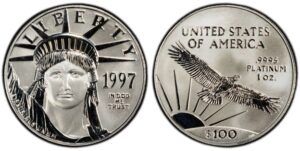
Image: 1997 American platinum Eagle coin obverse and reverse showing first year of issue
Source: PCGS
Program History and Background
Launch and Legal Tender Status
Congress authorized platinum Eagles in 1996, with production beginning the following year. These coins carry legal tender face values from $10 to $100 depending on size, though their platinum content determines actual market value. The face value designation distinguishes government-issued bullion from private mint rounds.
Bullion and Proof Programs
The U.S. Mint produces two distinct platinum Eagle versions. Bullion strikes serve investors seeking precious metal content at lower premiums than proof editions, featuring consistent designs year to year. Proof versions target collectors with mirror finishes, changing reverse designs annually, and substantially higher premiums over platinum spot prices.
Production Interruptions
Unlike gold and silver Eagles with continuous production since their launches, platinum Eagles experienced multiple suspensions. US Mint platinum coin mintages dropped to zero during 2009-2013 and again from 2015-2017, primarily due to platinum planchet supply constraints. These interruptions created scarcity for specific years, affecting collectible premiums.
Design Elements
John Mercanti’s Statue of Liberty portrait dominates the obverse across all platinum Eagle sizes. Bullion versions feature a consistent reverse showing an eagle soaring over a sunrise with rays. Inscriptions include “UNITED STATES OF AMERICA,” weight (“1 OZ. PLATINUM” or fractional equivalent), “.9995 PLATINUM,” and face value denomination.
Fractional Sizes and Specifications
Platinum Eagles are struck in four sizes: the 1 oz platinum coin ($100 face value), 1/2 oz ($50), 1/4 oz ($25), and 1/10 oz ($10). All maintain .9995 fine platinum content. The U.S. Mint produced fractional sizes sporadically, with 1/10 oz platinum coin pieces more consistently available than 1/2 oz or 1/4 oz options.
The Canadian Maple Leaf Platinum Coin
The Royal Canadian Mint pioneered platinum bullion coinage in 1988, predating the American Eagle platinum coin by nine years.
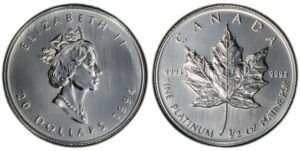
Image: 1994 half-ounce Canadian Maple Leaf platinum coin obverse and reverse
Source: PCGS
Royal Canadian Mint Production
Program Launch and Design Consistency
Canada’s platinum Maple Leaf debuted in 1988 as the world’s first .9995 fine platinum coin, establishing the purity standard that American and other mints would later adopt. Unlike proof platinum Eagles with annually changing reverses, Maple Leafs maintain the iconic maple leaf design introduced at launch, providing visual consistency that collectors and investors recognize immediately.
Security Features and Availability
Recent platinum Maple Leafs incorporate radial line patterns on both obverse and reverse surfaces, creating visual texture that deters counterfeiting. Micro-engraved security elements add authentication features without affecting the coin’s platinum content or dimensions. Production volumes remain modest compared to gold and silver Maple Leafs, with annual mintages typically measured in thousands rather than hundreds of thousands of pieces.
Technical Specifications
Platinum Maple Leafs contain .9995 fine platinum in a standard platinum 1 oz coin size measuring 30mm diameter. The Royal Canadian Mint occasionally produces fractional weights but focuses primarily on one-ounce coins. Each carries $50 Canadian legal tender face value, though platinum content determines actual market worth. The consistent specifications across production years simplify authentication and trading.
Other Notable Platinum Coins
Beyond the American Eagle platinum coin and Canadian Maple Leafs, several mints produce platinum bullion with varying availability and collector appeal.
Australian Platinum Issues (Perth Mint)
Perth Mint has produced multiple platinum bullion and collectible programs over the years, not limited to a single design. While platinum production is sporadic, the mint has issued platinum versions of iconic Australian series including the Platypus, Koala, and Kangaroo, often in limited quantities and with changing designs across different years. Among these, the platinum Platypus coin is one of the best-known modern issues, featuring annually changing designs that distinguish it from the consistent imagery used on Maple Leafs.
Lower mintages across Perth Mint platinum programs create numismatic interest beyond metal content, with premiums often exceeding standard bullion pricing. Because platinum issues are released irregularly rather than annually, availability varies significantly, and specific years can become difficult to acquire on the secondary market.
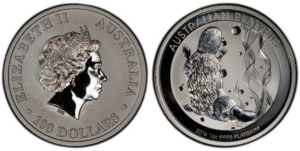
Image: 2016 Australian platinum Platypus coin obverse and reverse from Perth Mint
Source: PCGS
International Platinum Programs
Several mints outside North America produce platinum bullion coins that offer investors additional design options but typically with more limited availability. Austria’s platinum Philharmonic represents Europe’s most established platinum bullion coin, featuring the Vienna Philharmonic’s orchestral instruments. Britain’s Royal Mint issues platinum Britannias, extending its flagship design into the platinum category, while the Isle of Man produces platinum Nobles in fractional weights, including the unusual 1/3 oz platinum coin size rarely offered by other mints.
China has issued platinum versions of its popular Panda series on a sporadic basis. These coins appear irregularly in Western markets and are often difficult to source consistently. When available, platinum Pandas frequently command collector premiums driven by limited mintages and strong demand in Asian markets.
Compared to American Platinum Eagles and Canadian Maple Leafs, these international platinum coins offer greater design variety but generally trade with wider bid-ask spreads and lower dealer inventory levels, which can affect both purchase availability and resale liquidity.
Fractional Platinum Coin Investment
Fractional platinum coins provide entry points to platinum investing without full-ounce capital requirements, though premium trade-offs require consideration.
Advantages of Fractional Sizes
Fractional platinum coins allow investors to access the platinum market at lower capital thresholds. A 1/10 oz platinum coin requires roughly one-tenth the investment of a full ounce, making platinum accessible to smaller budgets. This sizing flexibility enables partial liquidation: selling one-quarter ounce from a position rather than a full ounce provides better control over realized gains and portfolio adjustments.
Fractional pieces suit dollar-cost averaging strategies where investors build platinum positions through regular smaller purchases rather than lump-sum commitments. The 1/10 oz size particularly accommodates this approach.
Smaller denominations also work better for gifts or intergenerational transfers where full-ounce pieces exceed intended value.
Premium Considerations
Fractional platinum carries substantially higher per-ounce premiums than full-ounce coins. Manufacturing costs remain relatively fixed regardless of coin size, meaning minting expenses consume a larger percentage of a 1/10 oz coin’s metal value. Dealers also maintain wider bid-ask spreads on fractional pieces due to lower trading volumes.
Investors must balance fractional convenience against these premium costs. Building positions entirely through fractional purchases increases total acquisition costs significantly compared to accumulating full-ounce pieces when capital permits.
Platinum Coin Values and Pricing
Platinum coin prices reflect spot metal value plus premiums determined by minting costs, market conditions, and collectible factors.
Market Price Determinants
Spot platinum price establishes the baseline value for all platinum coins, fluctuating during trading hours based on global supply, demand, and economic conditions. Premiums over spot cover minting expenses, distribution costs, and dealer margins. These premiums vary by coin type, size, and market conditions: American Eagles typically command different premiums than a Canadian Maple Leaf platinum coin despite identical platinum content.
Condition also affects value significantly. A Brilliant Uncirculated platinum coin for sale trades at standard premiums, while circulated or damaged pieces may sell at discounts to typical bullion pricing. Proof coins and key-date pieces from years with production suspensions carry numismatic premiums well above platinum melt value, appealing to collectors rather than pure bullion buyers.
Current Market Dynamics
Limited platinum coin production creates supply constraints that affect availability and premiums. Dealer inventory fluctuates more dramatically than gold or silver, with some sizes experiencing periodic shortages. Buyback spreads, i.e. the difference between dealer purchase and sale prices, run wider for platinum than gold due to smaller market size.
Authentication also matters critically in platinum markets. Counterfeit platinum coins exist, and proper verification ensures genuine pieces command appropriate values when selling.
Investing in Platinum Coins
Platinum coins require strategic planning around allocation, authentication, and understanding platinum’s distinct investment characteristics.
Building a Platinum Position
Platinum typically represents a smaller allocation within precious metal portfolios compared to gold or silver, often ranging from 5-15% of total precious metals holdings. This reflects platinum’s higher volatility and smaller market size. Investors can enter through lump-sum purchases when prices appear favorable or accumulate positions gradually through dollar-cost averaging, which smooths entry points across platinum’s price cycles.
Working with established precious metals dealers ensures access to genuine coins at competitive premiums. American Eagle platinum coin value reflects spot platinum prices plus premiums for government backing and dealer margins, with established dealers offering transparent pricing on both purchases and buybacks. Dealers like Blanchard maintain authentication standards and provide liquidity for eventual sales.
Platinum vs. Other Precious Metals
Platinum’s industrial demand component creates stronger economic sensitivity than gold’s monetary role. Automotive production cycles directly affect platinum prices, generating larger price swings than gold experiences. Recent market performance demonstrates this volatility and opportunity, with geopolitical factors and economic uncertainty driving precious metals demand. This volatility requires higher risk tolerance but provides diversification benefits within precious metal portfolios since platinum doesn’t move in lockstep with gold or silver.
Long-term supply constraints from concentrated South African production may support prices, though industrial demand shifts toward alternatives could weaken fundamentals.
Authentication and Quality
Genuine platinum coins meet precise weight specifications: 1 oz pieces should weigh exactly 31.103 grams. Reputable dealers verify weights and purity before sales. Visual inspection confirms proper mint marks, edge reeding, and strike quality matching known authentic examples. Third-party grading through services like PCGS makes sense for proof platinum or key-date pieces where condition premiums justify certification costs.
Conclusion
Platinum coins are among the rarest government-issued precious metal bullion, with annual production measured in thousands rather than millions of pieces. American Platinum Eagles and Canadian Platinum Maple Leafs dominate the market, offering .9995 fine platinum in fractional sizes from 1/10 oz to 1 oz that accommodate different investment budgets. These coins combine precious metal diversification with exposure to industrial demand drivers distinct from gold’s monetary role. Platinum’s extreme scarcity and volatility suit investors seeking alternatives to traditional gold and silver holdings. Explore Blanchard’s selection of platinum bullion to add this rare precious metal to your investment portfolio.
FAQs
1. What is a platinum coin?
A platinum coin is a bullion piece containing .9995 fine platinum, typically struck by national mints like the U.S. Mint or Royal Canadian Mint.
2. How much is a platinum coin worth?
Platinum coins are valued at spot platinum prices plus premiums covering minting costs and dealer margins. Proof versions, key dates, and coins from production suspension years may command additional numismatic premiums.
3. How much does a platinum coin weigh?
Platinum coins are available in fractional sizes ranging from one-tenth troy ounce to full one troy ounce, with each size weighing exactly its stated platinum content plus minimal alloy.
4. What are the best platinum coins to buy?
American Platinum Eagles and Canadian Platinum Maple Leafs offer the best liquidity and recognition among platinum bullion. These government-issued coins maintain consistent availability and dealer acceptance for both purchases and eventual resales.
5. Are platinum coins a good investment?
Platinum coins provide precious metal diversification with exposure to industrial demand, though higher volatility compared to gold requires greater risk tolerance. Platinum’s extreme rarity and concentrated supply create both opportunity and risk for investors.