The Forgotten Masterpiece: The Story of the 1936 Columbia, South Carolina Sesquicentennial Half Dollar

A Celebration Cast in Silver
Some coins commemorate presidents. Others honor military victories, world expositions, or great moments in American history.
Then there are coins like the 1936 Columbia, South Carolina Sesquicentennial Half Dollar.
At first glance, it may seem like just another silver commemorative from the 1930s. Yet behind its intricate design lies a fascinating story of state pride, artistic controversy, congressional politics, and one of the most remarkable collecting booms in American numismatic history.
Released during the height of the classic commemorative era, the Columbia Half Dollar celebrates the 150th anniversary of the designation of Columbia as South Carolina’s capital city. Today, nearly ninety years after its release, it remains one of the most attractive and historically significant coins of the entire commemorative series.
Its story begins long before the coin itself was struck.
Why Columbia Became South Carolina’s Capital
In the years immediately following the American Revolution, South Carolina faced a challenge shared by many young states. Charleston served as the capital, but its location on the coast made it inconvenient for residents living inland.
Travel was difficult. Roads were primitive. Political leaders increasingly believed the state’s government should be located closer to its geographic center.
In 1786, the South Carolina General Assembly selected a site near the confluence of the Broad and Saluda Rivers to become the state’s new capital. Unlike many American cities that evolved organically over decades, Columbia was deliberately planned from the beginning.
Wide streets, organized blocks, and public spaces reflected the optimism of a new nation still defining itself. Columbia became one of America’s earliest purpose-built capital cities.
Over the next century and a half, the city grew into the political and cultural heart of South Carolina. By the 1930s, local leaders sought a fitting way to commemorate the 150th anniversary of that historic decision.
A commemorative coin seemed like the perfect choice.
The Great Commemorative Coin Boom
To understand the Columbia Half Dollar, it helps to understand the era in which it was born.
The mid-1930s represented the peak of America’s classic commemorative coin movement. Congress authorized dozens of commemorative issues between 1892 and 1954, but no year was busier than 1936. Communities across the country sought commemorative coins to celebrate anniversaries, historical figures, expositions, and local milestones.
Collectors eagerly purchased every new release. Coin clubs flourished. Numismatic publications expanded. Demand for commemorative coins reached unprecedented levels.
In 1936 alone, collectors saw issues honoring the Oregon Trail, Texas Centennial, Bay Bridge, Albany Charter, Elgin Centennial, Bridgeport Centennial, Long Island Tercentenary, and many others.
The Columbia Sesquicentennial Half Dollar entered the market at precisely the moment collectors were most enthusiastic about commemorative coinage.
On March 18, 1936, Congress passed legislation authorizing 25,000 silver half dollars to commemorate the 150th anniversary of Columbia becoming South Carolina’s capital. The proceeds would help support the city’s sesquicentennial celebration.
The Young Sculptor Who Refused to Quit
Most commemorative coins of the era were designed by established artists with national reputations.
The Columbia Half Dollar took a different path.
The Columbia Sesquicentennial Commission selected Abraham Wolfe Davidson, a young sculptor associated with Clemson College, to create the coin’s design. Davidson was talented, ambitious, and deeply committed to the project.
His selection immediately created friction. The Commission of Fine Arts, which reviewed proposed coin designs, strongly criticized Davidson’s original models. Officials questioned the artistic quality of his work and suggested substantial revisions. At one point, there were discussions about replacing him entirely. Davidson refused to walk away. Instead, he revised his designs, worked through criticism, and continued refining his vision until approval was finally granted in July 1936.
The result would become one of the most distinctive commemorative designs of the decade.
A Design Filled With Meaning
Unlike many commemorative coins that focus on a single portrait or event, the Columbia Half Dollar tells a layered story through symbolism.
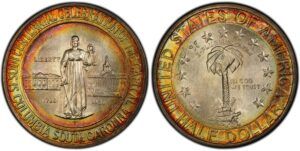
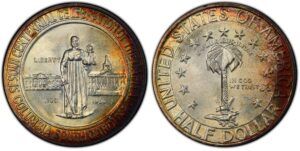
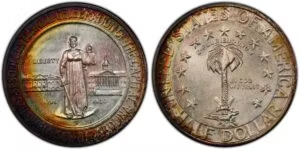
The obverse features a standing figure of Justice holding scales and a sword. She stands between Columbia’s original State House and the modern State House, symbolizing the city’s evolution from a frontier capital to the center of South Carolina government. This is not simply a city anniversary. It is a celebration of government, civic progress, and the enduring role Columbia has played in South Carolina’s history.
The reverse is the palmetto tree, one of South Carolina’s most recognizable symbols. The palmetto represents the state’s Revolutionary War heritage after palmetto-log fortifications helped absorb British cannon fire during the defense of Sullivan’s Island. Below the tree rests a broken oak branch, representing British defeat and American resilience. Arrows tied together symbolize strength through unity, while thirteen stars surrounding the tree honor the original thirteen colonies.
Every element contributes to a larger narrative about independence, state identity, and national unity.
Three Mints, One Coin, Endless Excitement
The legislation authorizing the Columbia Half Dollar included language allowing production at multiple United States Mint facilities. Meaning instead of a single commemorative coin, they would have an opportunity to assemble a three-coin set featuring examples from Philadelphia, Denver, and San Francisco.
The final mintages totaled approximately 9,007 coins from Philadelphia, 8,009 from Denver, and 8,007 from San Francisco, including assay pieces. None were melted, meaning virtually the entire authorized mintage entered the collector market.
The commission sold individual coins for $2.15 or complete three-coin sets for $6.45. At a time when many Americans were still struggling through the Great Depression, those prices were steep. Collectors nevertheless lined up with excitement to buy them.
Frustrating Dealers and Creating Demand
The Columbia Sesquicentennial Commission took an unusual approach to distribution.
Rather than allowing large dealers to acquire substantial quantities, the commission limited purchases in an effort to prevent speculation and distribute the coins more broadly among collectors.
The strategy worked—but not everyone was happy about it.
Collectors appreciated the opportunity to obtain coins directly. Dealers, however, often complained that acquiring inventory became unnecessarily difficult.
The controversy reflected a larger issue facing commemorative coin programs during the 1930s.
As more commemorative issues entered the market, debates emerged about mintages, distribution practices, and the growing influence of speculation.
Ironically, those very debates helped make classic commemorative coins one of the most fascinating areas of American numismatics today.
A Snapshot of 1930s America
The Columbia Half Dollar represents more than a city anniversary. It serves as a snapshot of America during the Great Depression. Despite economic hardship, communities across the nation continued celebrating their history. Local leaders recognized that historical anniversaries could strengthen civic pride, attract visitors, and remind Americans of the resilience that had carried previous generations through difficult times.
The Columbia Sesquicentennial celebration reflected that spirit. It connected citizens of the 1930s with the optimism of 1786, when South Carolina’s leaders envisioned a new capital city in the heart of the state.
The coin transformed that connection into something tangible, a piece of history that could be held in the hand.
Why the Columbia Half Dollar Still Matters
Some coins become famous because they are rare. Others become famous because they are expensive.
The 1936 Columbia Sesquicentennial Half Dollar endures for a different reason.
It tells the story of a young nation establishing new centers of government. It tells the story of South Carolina’s growth over 150 years. It tells the story of artistic perseverance in the face of criticism. And it tells the story of one of the most exciting periods in American coin collecting.
For collectors, these connections are what make classic commemorative coins special. They are more than silver and more than mintage figures. They are miniature historical documents preserved in metal.
The Columbia Half Dollar may not receive the same attention as the Oregon Trail Memorial Half Dollar or the Texas Centennial Half Dollar, but that only adds to its appeal.
It remains one of the hidden gems of the classic commemorative series, a beautifully designed reminder that America’s history is often found in places collectors least expect.