The Million-Dollar Coin That Shouldn’t Exist: The Mystery of the 1870-S Seated Liberty Dollar

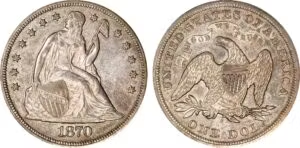 Every great rare coin has a story. Some were minted in tiny quantities. Others survived wars, economic crises, or government recalls. A select few achieved legendary status through a combination of rarity, historical significance, and collector demand.
Then there is the 1870-S Seated Liberty Dollar.
Few coins in American numismatics have inspired more debate or generated more questions than this elusive silver dollar. While many famous rarities can trace their origins through mint records and historical documents, the 1870-S exists in a world of uncertainty. Its creation was never properly documented, its original purpose remains the subject of speculation, and its survival continues to puzzle researchers more than 150 years after it was struck.
Today, only a handful of examples are known. Each is worth a fortune. Yet the true appeal of the 1870-S extends beyond its rarity. Collectors are fascinated by the coin because it represents one of the greatest unsolved mysteries in American coinage.
A City Built on Gold and Silver
To understand the story of the 1870-S Seated Liberty Dollar, it helps to understand San Francisco in the decades following the California Gold Rush. By the mid-nineteenth century, the city had become one of the nation’s most important financial centers. Gold and silver from mines flowed throughout the American West into the region, creating an enormous demand for coinage.
The San Francisco Mint was established to meet that demand. Its role was critical. Rather than shipping precious metals across the country for coinage, the mint allowed bullion to be converted into money closer to its source. As western commerce expanded, so did the importance of the facility.
In 1870, a new mint building was completed in San Francisco. The structure was intended to symbolize the city’s growing importance and the economic strength of the American West. Officials planned a cornerstone ceremony to commemorate the occasion. Historical documents, newspapers, and examples of current coinage would be placed inside the cornerstone as a record for future generations.
Somewhere within the preparations for that ceremony, the mystery of the 1870-S Seated Liberty Dollar appears to have begun.
The Problem with the Official Records
Most United States coins leave a paper trail. Mintages are recorded. Production figures are documented. Annual reports detail what was struck and where. For historians and collectors, these records provide a roadmap that explains how a coin came into existence.
The 1870-S Seated Liberty Dollar breaks that pattern.
Researchers examining mint records discovered a startling problem. There was no documented circulation mintage for silver dollars struck at the San Francisco Mint in 1870. Official records failed to provide a clear explanation for the existence of the coin, despite the fact that genuine examples eventually surfaced.
This contradiction launched one of the longest-running debates in American numismatics. If no silver dollars were officially struck, how did the surviving examples come to exist?
One theory suggests that a small number of dollars were produced specifically for placement in the cornerstone of the new mint building. Another proposes that additional examples were struck as presentation pieces for important officials. Some researchers believe mint employees may have produced a few extra specimens outside normal accounting procedures.
Despite decades of research, no theory has completely solved the puzzle.
A Rare Coin Becomes a Legend
The uncertainty surrounding the coin’s origins would be fascinating on its own, but the rarity of the 1870-S elevates the story to another level. Only a tiny number of examples are known today, making it one of the rarest and most coveted silver dollars in American numismatics.
Unlike more common issues that can be found at major coin shows or auctions each year, the appearance of an 1870-S Seated Liberty Dollar is a significant event. Advanced collectors track the known examples individually, studying their provenance and tracing their ownership through generations.
Many of America’s greatest rarities have dozens or even hundreds of surviving examples. The 1870-S exists within a much smaller circle.
Why Collectors Remain Captivated
Collectors often pursue rare coins because of scarcity, condition, or historical significance. The 1870-S Seated Liberty Dollar offers all three. Yet what truly distinguishes the coin is the fact that it continues to raise questions that have never been fully answered.
Who authorized its production? How many examples were originally struck? Were all of them connected to the cornerstone ceremony? Could additional examples still exist undiscovered in old collections or forgotten estates?
These questions have fueled research for generations and continue to attract some of the most advanced collectors in the hobby. The 1870-S is not simply a rare coin. It is an active historical puzzle.
The Enduring Appeal of the 1870-S
More than a century and a half after it was struck, the 1870-S Seated Liberty Dollar remains one of the most intriguing coins ever produced by the United States Mint. Its rarity is extraordinary, its value is substantial, and its place in numismatic history is secure. Yet the mystery surrounding its origins remains perhaps its most compelling feature.
Most rare coins tell a complete story. The 1870-S Seated Liberty Dollar leaves important chapters unwritten. That uncertainty has transformed it from a simple collectible into a genuine numismatic legend.
For collectors, historians, and students of American coinage, the search for answers continues. Until those answers are found, the 1870-S Seated Liberty Dollar will remain exactly what it has been for generations: a million-dollar coin that seemingly should not exist at all.