1915-S $50 Panama Pacific Gold Coin: The Round Masterpiece from the Panama Expo

In 1915, the U.S. Mint produced one of the most ambitious early U.S. commemorative coin programs to mark San Francisco’s Panama-Pacific International Exposition. The centerpiece was a $50 gold piece containing 2.4186 troy ounces of gold, sold at the fair for $100, double its face value. At that price, few fairgoers could afford one, and when the exposition closed, the vast majority of unsold coins were melted. Of the 1,510 round pieces struck, only 483 were distributed to the public, with survival today estimated at around 350 to 400 examples. That scarcity, combined with Robert Aitken’s exceptional Athena design, has kept the round Panama-Pacific $50 among the most coveted coins in American numismatics. This guide covers the exposition’s historical background, the Panama-Pacific commemorative coin series, the design and rarity of the 1915 S $50 Panama Pacific gold coin, and its place in the modern collector market.
The 1915 Panama Pacific International Exposition
San Francisco’s 1915 world’s fair was built around two things America wanted to celebrate: the completion of the Panama Canal and the city’s own recovery from the 1906 earthquake.

The Palace of Fine Arts at the 1915 Panama-Pacific International Exposition.
Source: San Francisco Silent Film Festival
Historical Context
The 1915 Panama Pacific International Exposition had two founding reasons. The first was the completion of the Panama Canal in 1914, which cut 50 miles through Central American terrain to connect the Atlantic and Pacific Oceans and eliminate the lengthy voyage around Cape Horn. The second was San Francisco’s determination to show the world a city fully rebuilt from the devastation of the 1906 earthquake and fire, which had destroyed an estimated 28,000 buildings. The exposition ran from February to December 1915 across 635 acres in the Marina District, with 25 countries participating and attendance reaching over 18 million visitors.
Fair Significance
The Panama Canal was widely regarded as the defining engineering achievement of the era, reshaping global shipping routes and extending American influence across the Western Hemisphere. That made the exposition more than a celebration. It was a statement of national capability, and San Francisco leaned into that framing by positioning itself as America’s gateway to the Pacific. The fairgrounds reflected that ambition through large-scale Beaux-Arts architecture, monumental sculpture, and significant displays of art, technology, and innovation from around the world.
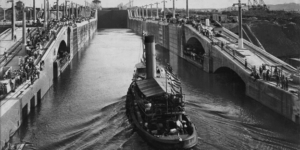
A vessel passing through the locks of the Panama Canal at its opening in 1914.
Source: History.com
Panama Pacific Commemorative Coin Program
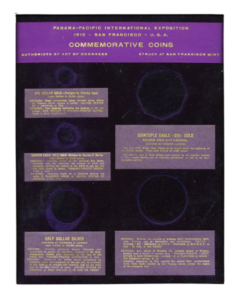
Original 1915 Panama-Pacific commemorative coin display board.
Source: Coin Talk
Congress passed special legislation authorizing a commemorative coin program tied to the exposition. The resulting lineup was unprecedented in American numismatic history, spanning four denominations in gold alongside a silver half dollar. The coins were sold primarily at the fair and through subscription, with proceeds supporting the exposition directly. That limited distribution model, combined with the high face value of the $50 pieces, meant that relatively few coins actually changed hands before the fair closed.
The Complete Panama-Pacific Coin Lineup
The Panama Pacific Exposition commemorative coin program covered four gold denominations and one silver, ranging from a $1 gold piece up to the $50 slugs, with each coin carrying its own design and its own story of limited production.
Silver Half Dollar
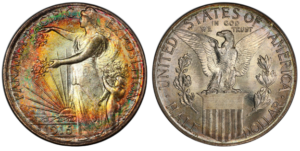
Obverse and reverse of the 1915-S Panama-Pacific commemorative silver half dollar.
Source: PCGS
The half dollar was the most widely sold coin in the series, making it the most commonly encountered commemorative 1915 Panama Pacific International Exposition coin today. Charles Barber designed the obverse, which depicts Columbia scattering flowers from a cornucopia held by a child, with the Golden Gate and rays of the sun in the background. George Morgan designed the reverse, showing an eagle with outstretched wings perched on the Union Shield. Sold individually for $1 at the fair, double its face value, it was still the most affordable coin in the program and reached a far broader audience than any of the gold issues.
Gold Dollar ($1)
The gold dollar was the most accessible 1915 Panama Pacific gold coin in the series and the one most fairgoers could realistically afford. Designed by Charles Keck, the obverse shows the head of a Panama Canal laborer, a direct reference to the workforce that built the waterway. Of the 15,000 struck, many survive in Mint State today as collectors set them aside from the beginning. It remains the entry point for collectors building a Panama-Pacific set.
Quarter Eagle ($2.50)
The quarter eagle stepped up in both size and artistic ambition. Charles Barber designed the obverse, which depicts Columbia riding a hippocampus, a mythological sea creature chosen to symbolize the joining of the Atlantic and Pacific Oceans. Columbia holds a caduceus in her left hand, acknowledging the medical advances that made canal construction possible by defeating yellow fever among the workforce. George Morgan designed the reverse with a heraldic eagle. Of 10,017 pieces struck, 3,251 unsold examples were melted in 1916, leaving a net distribution of 6,749.
The $50 Gold Pieces
The $50 coins were produced in two formats simultaneously, round and octagonal, making this the only time the U.S. Mint has issued the same denomination in two different shapes. Both were designed by New York sculptor Robert Aitken, who was commissioned specifically for the project. With net distributions of 483 round and 645 octagonal pieces, they represent the undisputed centerpiece of the series and among the greatest rarities in all of American numismatics.
The Round and Octagonal $50: Format, Design, and Rarity
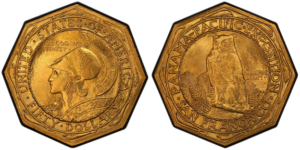
Obverse and reverse of the 1915-S Panama-Pacific octagonal $50 gold coin.
Source: PCGS
Both formats of the 1915 S $50 Panama Pacific gold coin share the same basic Robert Aitken design, but the decision to produce them in two shapes was deliberate, rooted in history and intended to broaden appeal among the small pool of collectors who could afford them at $100 each.
Why Two Formats
The decision to produce the 1915 S $50 Panama Pacific gold coin in two shapes came down to two things: historical precedent and commercial logic. During the early 1850s, Augustus Humbert struck octagonal $50 gold slugs for the U.S. Assay Office in San Francisco, while the Wass-Molitor firm produced round versions of the same denomination. The 1915 exposition organizers looked back to both of those Gold Rush era coins when making the case for a dual format, giving the new $50 pieces a deliberate connection to California’s pioneer coinage tradition. That historical resonance made the proposal an easy sell to Congress, which specified in the enabling legislation that of the 3,000 authorized $50 pieces, half were to be round and half octagonal. Offering both formats also gave collectors and fairgoers a reason to acquire two coins instead of one, which suited the fundraising goals of the 1915 Panama Pacific Exposition.
Round vs. Octagonal: The Differences
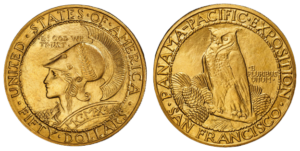
Obverse and reverse of the 1915-S Panama-Pacific round $50 gold coin.
Source: PCGS
$50 Panama Pacific Commemorative Coin Design
The two coins share the same basic central design but are not identical. The 1915 Panama Pacific octagonal gold coin features dolphins in the eight angles between the inscriptions and the points of the border on both sides, symbolizing the unbroken water passage created by the Panama Canal. The round version omits the dolphins entirely, presenting a cleaner and more traditional circular format. Both bear the date in Roman numerals as MCMXV, following a precedent set by Saint-Gaudens’ 1907 double eagle.
Mintage and Survival
Of the 1,510 round pieces struck, only 483 were distributed to the public, with the remaining 1,017 melted. Of the 1,509 octagonal pieces struck, 645 were distributed before the remainder met the same fate. The round is therefore the scarcer coin, with survival today estimated at roughly 350 to 400 examples compared to a somewhat higher population for the 1915 Panama Pacific octagonal gold coin.
Round 1915 S $50 Panama Pacific Gold Coin Design and Specifications
Aitken designed the 1915 S Panama Pacific Exposition $50 round coin to express the exposition’s intellectual themes through classical imagery, using Athena and her owl to represent wisdom, skill, and the achievements on display at the fair.
Before exploring the design in detail, this short video walks through the coin’s key features and gives a sense of its scale and presence in hand.
Obverse
The obverse depicts Athena wearing a crested war helmet pushed back on her head, exposing her face. She holds a shield in front of her torso, and the date appears in Roman numerals as MCMXV along the shield’s upper edge. The motto “IN GOD WE TRUST” appears above her helmet, with “UNITED STATES OF AMERICA” and “FIFTY DOLLARS” running around the border.
Reverse
The reverse shows an owl perched on a branch of western pine surrounded by pinecones, a deliberate California reference chosen by Aitken to root the design in the state’s natural landscape. The owl is sacred to Athena and serves as a symbol of wisdom. “E PLURIBUS UNUM” appears behind the bird, with “PANAMA-PACIFIC EXPOSITION” and “SAN FRANCISCO” running around the border.
Physical Specifications
The round 1915 S $50 Panama Pacific gold coin weighs 83.59 grams and measures 44mm in diameter, making it one of the largest coins ever struck by the U.S. Mint. It is composed of .900 fine gold with a 10% copper alloy, containing 2.4186 troy ounces of actual gold weight. The S mintmark, denoting the San Francisco Mint, appears on the reverse.
Mintage and Survival
The scarcity of the round 1915 Pan Pacific $50 gold coin is a direct result of how poorly it sold at the fair. Of the 1,510 pieces struck, 10 were set aside for assay purposes and 483 were sold to the public. The remaining 1,017 went to the melting pot in November 1916 when it became clear that demand had dried up. That left a net distribution of 483 coins, the smallest net distribution among classic commemorative gold types.
Population Reports
Both PCGS and NGC track certified examples of the round $50, and combining their census figures with estimates for unsubmitted raw coins puts the total surviving population at roughly 350 to 400 examples. The condition census is dominated by a small number of MS-65 and MS-66 examples, with gems being genuinely rare at any level. Most certified examples grade between MS-62 and MS-64.
Rarity Context
Within the classic commemorative series, the round $50 sits at the extreme end of the scarcity spectrum. For a high-denomination gold coin, the surviving population is extraordinarily small, and the coin is an essential component of any complete Panama-Pacific set. That combination of genuine rarity, gold content, and historical importance places it firmly in the category of museum-quality numismatic investments pursued by advanced collectors with long-term horizons.
Grading and Condition
The round 1915 Panama Pacific Exposition gold coin is a difficult coin to find in problem-free condition. Its large size means more surface area exposed to contact marks, and the relatively soft gold alloy picks up friction easily.
Typical Grades
Most surviving examples grade between MS-62 and MS-64. The cheek of Athena and the breast of the owl are the first places to show wear and the key areas to examine when assessing any example.
Gem and Condition Rarity
MS-65 gems are genuinely scarce and command significant premiums over MS-64 examples. MS-66 and above are condition rarities in the truest sense, appearing infrequently at auction and attracting serious competition when they do.
What to Watch For
Cleaned examples are common in this series given the coins’ age and the temptation to improve their appearance over more than a century of ownership. CAC approval indicates a coin that is solid for its assigned grade and adds meaningful value and liquidity in this market.
Round vs. Octagonal Panama Pacific Commemorative Coin Value
Despite being the scarcer 1915 Panama Pacific gold coin by net distribution, the round $50 does not always command higher prices than the octagonal. The market for these coins is driven as much by collector preference as by raw rarity figures.
Why Octagonal Often Costs More
The octagonal format is simply more memorable. Its unusual shape, its connection to Gold Rush history, and the added detail of the dolphins make it the more visually distinctive of the two. Many collectors building a type set choose the octagonal specifically for those reasons, which sustains strong demand despite its larger surviving population.
Grade by Grade
At lower grades both formats trade in the strong five figures, with the gap between them relatively narrow. As condition improves the spread can widen, though this varies by sale. Gems in either format cross reliably into six-figure territory. CAC-approved examples of both types command meaningful premiums, and because sales are infrequent, current auction records should always be consulted before any transaction.
Collecting Panama-Pacific Commemoratives
The Panama-Pacific series attracts two distinct types of collector: those building a complete set of all five coins and those pursuing a single $50 piece as a standalone type coin.
Complete Set Strategy
A complete set comprises the silver half dollar, gold dollar, quarter eagle, and both $50 formats. The half dollar and gold dollar are the accessible entry points, and most collectors acquire those first before working toward the quarter eagle and ultimately the $50 pieces. Assembling a matched set in consistent grades across all five coins is a multi-year undertaking that requires patience and access to the right material.
Type Collecting
For collectors pursuing a single $50 as a type coin, the choice between round and octagonal comes down to budget, personal preference, and which format appears in acceptable condition at the right moment. Both represent the denomination equally well within a broader classic commemorative collection.
Investment Focus
Collectors focused on long-term value tend to prioritize the finest problem-free examples they can afford, with CAC approval as an additional filter. The fixed and finite population of both $50 formats, combined with persistent demand from advanced collectors worldwide, has historically supported values over time.
Historical Significance and Legacy
The Panama-Pacific $50 pieces were the highest denomination coins the U.S. Mint had ever struck for general sale. They were produced at a moment of genuine national achievement, designed by a serious artist at the height of his craft, and issued in numbers so small that scarcity was effectively built in from the start.
Numismatic Impact
The Panama-Pacific series remains a landmark of the classic commemorative era, recognized as much for its artistic ambition as for its rarity. The $50 pieces in particular are frequently cited among the finest achievements of early twentieth century American coinage, and examples appear in major institutional collections around the world.
Cultural Legacy
The Panama Canal remains one of the great engineering achievements of the twentieth century. San Francisco’s 1915 Panama Pacific International Exposition has its own enduring place in the city’s history, and the Palace of Fine Arts, the only surviving structure from the fairgrounds, still stands in the Marina District today.
Conclusion
The Panama Pacific Exposition of 1915 gave the United States a rare opportunity to celebrate two genuine achievements at once, and the commemorative coin program it inspired remains one of the most significant in American numismatic history. At the center of that program sits the round $50, a coin struck in tiny numbers, returned largely to the melting pot when the fair closed, and survived in a population small enough that acquiring one requires genuine effort and significant capital. Robert Aitken’s Athena design gives it artistic credentials that hold up against any coin of its era. The round Panama-Pacific $50 appears on the market infrequently and in limited grades. View Blanchard’s current offering here and speak with a specialist about adding it to your collection.
FAQs
1. What’s the difference between round and octagonal Panama Pacific $50s?
Both coins share the same basic Robert Aitken design, but the octagonal version features dolphins in the eight angles of the border symbolizing the Panama Canal’s unbroken water passage, while the 1915 S Panama Pacific Exposition $50 round version omits them entirely. The round coin is the scarcer of the two by net distribution, with 483 sold versus 645 for the octagonal.
2. What is a 1915 S $50 Panama Pacific gold coin worth?
Value depends heavily on grade and whether the coin is problem-free and certified by PCGS or NGC. Most examples trade in the strong five figures, with gems crossing into six-figure territory.
3. Are Panama Pacific commemoratives a good investment?
The $50 pieces in particular have effectively fixed and finite surviving populations, and persistent demand from advanced collectors worldwide has supported values over time. As with any rare coin purchase, condition, authenticity, and timing all play a role.