The $5 Bechtler Gold Coin: A Rare Survivor of America’s First Gold Rush in North Carolina

Before California, there was North Carolina. Decades before the 1848 gold rush that defined an era, the American South was already deep in a gold boom, and a German immigrant named Christopher Bechtler was meeting a need the federal government had ignored. His family’s private mint in Rutherfordton turned raw miners’ gold into reliable coinage that circulated across the Southeast for nearly two decades. The Bechtler $5 half eagle is what that era left behind: private gold, struck outside any official mint, that now ranks among the most historically significant coins in early American numismatics. This article explores who the Bechtlers were, why their coinage mattered, and what makes surviving Bechtler gold coin examples so sought after today.
America’s First Gold Rush
North Carolina’s gold story predates California by half a century. It shaped the economy of an entire region and created the conditions that made a private mint not just viable but necessary.
North Carolina Before California
In 1799, twelve year old Conrad Reed pulled a seventeen pound gold nugget from Little Meadow Creek on his father’s farm in Cabarrus County. The family used it as a doorstop for three years before realizing what it was. Once the find became known, it set off the nation’s first documented gold rush. Mining spread from the Reed farm west across the Piedmont into the foothills, through a gold bearing arc that extended from Cabarrus County toward Rutherford County and beyond. At the peak of operations, at least 56 mines were active across western North Carolina. The state led the nation in gold production from the early 1800s until California eclipsed it in 1848.
The Currency Problem
Despite sitting atop one of the richest gold deposits in the country, the Carolina backcountry had almost no reliable circulating coin. The only U.S. Mint in operation was in Philadelphia, and transporting raw gold that far north was expensive, slow, and dangerous. In the meantime, miners and merchants made do with gold dust, nuggets, and crude measurements of weight and purity that made everyday commerce difficult. Regional leaders pushed for a solution. Samuel Carson, a Rutherford County congressman, introduced a bill to establish a branch mint in Rutherfordton, but it never came to a vote. The federal government did not open southern branch mints until 1838. In the years between, Christopher Bechtler filled the gap himself.
For a closer look at how the Carolina gold rush unfolded and the role the Bechtler family played in it, this short video traces the story.
Christopher Bechtler and His Mint
Christopher Bechtler was not a banker or a government official. He was a German metalworker with a reputation for precision, and that turned out to be exactly what the Carolina backcountry needed.
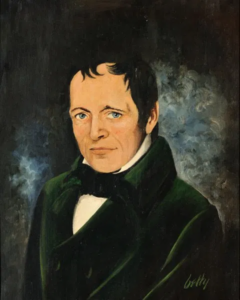
Portrait of Christopher Bechtler Sr., the German immigrant metalworker who established the private mint in Rutherfordton, North Carolina in 1831.
Source: Immigrant Entrepreneurship
A German Metalworker in the Backcountry
Origins in Baden
Christopher Bechtler Sr. was born in Pforzheim in the Grand Duchy of Baden in 1782, a city long known for its jewelry and watchmaking industries. According to accounts documented in the UNC-TV production Gold Fever and the Bechtler Mint, he attended a technical institute in Pforzheim to learn the trade. In October 1829 he arrived in New York with his sons Augustus and Charles and a nephew, Carl Christ Bechtler, who soon renamed himself Christopher Jr. The family moved immediately to Philadelphia, where Bechtler opened a jewelry business and applied for citizenship.
Settling Near Rutherfordton
Within months they had relocated again, this time to Rutherford County, North Carolina. By July 1830 Bechtler had placed an advertisement in the local paper announcing he was open as a clock and watchmaker and jeweler in Rutherfordton. He purchased land outside town and set up a farm, though as a non-citizen he had to hold the title through a trusted local contact until he was naturalized in 1832.
A Reputation for Integrity
Bechtler’s honest assaying and reliable craftsmanship built trust quickly across the region. His coins were accepted not just in North Carolina but across the broader Southeast, a testament to a reputation earned through consistency rather than any official backing.
Solving a Regional Crisis with Bechtler Gold
The Miners’ Request
By 1831 local miners and merchants had grown frustrated with the absence of reliable coinage and began urging Bechtler to do something about it. He was already assaying gold for customers, so coining Bechtler gold was the logical next step. On July 2, 1831, he advertised in the North Carolina Spectator and Western Advertiser that he had established the Bechtler Gold Coin Mint at Rutherfordton N.C, and was ready to convert raw gold into coin for a fee of two and a half percent.
Homemade Equipment
The Bechtlers built their own roller, screw press, and dies. Their coins carried no portraits, no allegory, and no elaborate imagery. The design was purely functional: the Bechtler name, the denomination, the fineness, and the location. What the Bechtler gold coins lacked in artistry they made up for in trustworthiness, and that was what the region needed. The first pieces struck were $2.50 and $5 half eagles, launched in 1831 and immediately accepted across the region as reliable substitutes for official coinage.
The First Private U.S. Gold Dollar
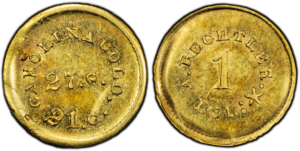
Obverse and reverse of a Bechtler dollar gold coin, showing the “CAROLINA GOLD 27G 21C” inscription on the obverse and “A. BECHTLER 1 DOL.” on the reverse.
Source: PCGS
A year after the $2.50 and $5 pieces went into circulation, Bechtler added a third denomination. In 1832 he struck the first gold dollar coin produced in the United States. It was a private issue, not an official government coin, but the precedent it set was real. The U.S. Mint would not produce its own gold dollar until 1849, seventeen years later. That single fact elevates the entire series beyond regional curiosity, and it’s a major reason Christopher Bechtler one dollar gold coin value has held up so strongly among collectors of early American coinage.
Understanding the $5 Bechtler Gold Coin
The $5 Bechtler gold coin is straightforward by design and complex by variety. Reading it correctly requires understanding both what its inscriptions mean and how the series evolved over time.
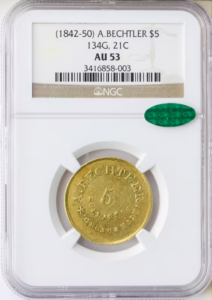
An Augustus Bechtler $5 gold coin graded AU53 by NGC with CAC approval, showing the obverse with the “A. BECHTLER” and “5 DOLLARS RUTHERFORD” inscriptions, 134 grains at 21 carats.
Reading the Coin
The Bechtler gold coins carried no portraits and no allegory. On most Christopher Sr. issues, the obverse stated the weight and fineness of the gold, and the reverse identified the maker and location with legends such as “C. BECHTLER AT RUTHERF:”. The inscription “CAROLINA GOLD” indicated the metal’s origin. Pieces struck from Georgia gold, which the Bechtlers also accepted as their reputation spread across the Southeast, carried “GEORGIA GOLD” instead. The exact layout varied across series and varieties, but the functional clarity was consistent throughout.
Weight, Fineness, and Variety
Three Fineness
Bechtler $5 pieces were struck at 20, 21, and 22 carats. The $5 Bechtler gold coins were of honest weight throughout, and the fineness was documented directly on each coin. Any variation between issues was a known and stated characteristic of the pieces, not a hidden inconsistency.
Grain Weight Inscriptions
The half eagle stated its own weight on the coin. The earliest issues, confirmed in auction records and PCGS documentation as the K-14 and K-15 varieties, carried 150 grains at 20 carats and were struck from 1831 to 1834. After the U.S. Coinage Act of 1834 reset federal gold coin weights, Bechtler adjusted his output, reducing the $5 piece to 140 grains at 20 carats and later to 134 grains at 21 carats. Stars were reintroduced into the design during this later period.
Identifying the Series
The $5 Bechtler gold series encompasses multiple distinct issues across Christopher Sr. and Augustus, distinguished by weight, carat, inscription wording, star placement, and edge type. Specialists use Don Kagin’s cataloging system, which assigns K numbers to each variety, to classify pieces precisely. The difference between a Christopher Sr. issue and an Augustus piece matters both historically and in terms of market value, making variety identification an essential part of evaluating any Bechtler $5.
Decline and Legacy
The Bechtler mint did not end with a dramatic closure. It wound down gradually, outlasting the crisis that created it and leaving behind a documented record that few private minting operations in American history can match.
The Arrival of Federal Competition
The opening of branch mints in Charlotte, North Carolina and Dahlonega, Georgia in 1838 marked the beginning of the end for Bechtler gold production. Raw gold that had been coming to Rutherfordton now had official federal destinations closer to the mines. Output declined steadily through the late 1830s. In July 1840 Christopher Sr. formally transferred his shop, tools, and land to Augustus and stepped back from the operation. He died two years later. Augustus continued striking coins, and after his death Christopher Jr. took over, keeping the mint running until around 1850. By that point the U.S. Mint had begun producing its own gold dollars, and the original purpose of the Bechtler operation had been fully absorbed by federal institutions.
Bechtler Gold Coins: A Documented Output
Unlike many private mints of the nineteenth century, the Bechtler operation left behind a remarkably detailed record of its activity. In 1840 Christopher Bechtler Sr. submitted a report to the U.S. Treasury Department stating that his mint had coined $2,241,840 in gold between 1831 and early 1840. The figure illustrates just how important the operation had become to the economy of the Carolina goldfields. At a time when much of the region’s gold never reached a federal mint, Bechtler provided a trusted local alternative that transformed raw metal into standardized coinage for everyday commerce. Most of those coins circulated heavily and were eventually lost, melted, or worn out. The surviving Bechtler gold coins for sale seen today represent only a small fraction of the original output, helping explain their scarcity and enduring appeal among collectors.
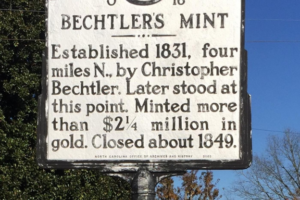
Historical marker for the Bechtler Gold Coin Mint at Rutherfordton N.C, noting its establishment in 1831 by Christopher Bechtler and its output of more than $2.25 million in gold before closing around 1849.
Source: North Carolina Department of Natural & Cultural Resources
Collecting and Valuing the Bechtler $5
The Bechtler $5 occupies a specific and well defined place in American numismatics. For collectors looking to add tangible assets with genuine historical significance to their portfolios, few pieces make a stronger case.
Why Collectors Pursue Them
Pioneer and territorial gold draws collectors who want coins with genuine historical weight rather than manufactured scarcity. The Bechtler $5 delivers both. It is a working artifact of America’s first gold rush, struck outside any government facility by a family that filled a real economic gap. That combination of historical significance, Southern heritage, and private mint status gives Bechtler gold coins crossover appeal among numismatists, collectors of Americana, and students of early American economic history.
Grade and Condition Factors
Most surviving Bechtler $5 pieces show genuine commercial wear. Examples above EF45 to AU50 are uncommon, and mint state examples are rare across most varieties. The handmade nature of the operation means planchet irregularities, rotated dies, and off center strikes are frequently encountered and are considered normal characteristics of the series rather than damage. Eye appeal, surface quality, and originality of color all factor into Bechtler gold dollar value, and matter considerably when evaluating any example.
Authentication and Caution
Bechtler gold coins were counterfeited even during the period of their original circulation, and the risk has not disappeared. The weight and fineness inscriptions on the coin itself provide a useful starting diagnostic, and die study against documented variety references is the standard authentication method. Third party certification from PCGS or NGC is strongly recommended for any purchase at a meaningful price point, both for authenticity confirmation and accurate variety attribution.
Conclusion
The $5 Bechtler gold coin is not one that needs embellishment. A German immigrant built his own press, earned the trust of an entire region, and struck gold coins that circulated across the Southeast for two decades, beating the federal government to the first gold dollar in the process. Surviving examples carry that history in every detail, from the weight inscriptions on the coin’s face to the handmade irregularities that reflect how they were made. The Bechtler home and mint site in Rutherfordton are preserved today on the National Register of Historic Places, a recognition of how much this private operation shaped early American commerce. Explore Blanchard’s selection of Bechtler and other early American coins to add a genuine piece of that history to your collection.
FAQs
1. Who was Christopher Bechtler?
Christopher Bechtler was a German immigrant metalworker who established a private mint in Rutherford County, North Carolina in 1831 and produced gold coins that circulated across the Southeast for nearly two decades.
2. What is a Bechtler gold coin?
Bechtler coins are private gold pieces struck outside the U.S. Mint in denominations of one dollar, two dollars and fifty cents, and five dollars. They carry no portraits or allegory, only the maker’s name, denomination, fineness, and location, and were accepted as reliable currency across the region during America’s first gold rush.
3. Are Bechtler coins valuable?
Yes. Genuine examples in problem free condition are scarce, and Bechtler gold coins value varies significantly by denomination, variety, and grade. The $5 half eagle is among the most sought after issues in the series, with rarer varieties commanding substantial premiums at auction.