Three-Cent Silver Coins: The Trime’s Legacy from 1851 to 1873
Posted on — Leave a commentAt just 0.80 grams, the three-cent silver piece was the lightest and thinnest coin ever struck for circulation by the United States Mint. Created in 1851 to address everyday commerce challenges – most notably the need to purchase three-cent postage stamps without making change – this unusual denomination circulated for more than two decades before its discontinuation. During that time, the three-cent silver passed through multiple design changes, creating distinct collecting categories that range from common to exceptionally rare. This article examines why the 3 cent coin was created, how its designs evolved, which dates and varieties matter most, and what drives values in today’s numismatic market.
Why America Needed a 3 Cent Coin
The 3 cent piece emerged from a convergence of postal reform and economic disruption that made existing denominations impractical for everyday commerce.
Postal Rate Changes of 1851
The Five-Cent Problem
Before 1851, mailing a first-class letter cost five cents. This rate forced Americans purchasing stamps to use half dimes (five-cent pieces) or fumble with combinations of larger denominations requiring change. Congress reduced the postal rate to 3 cents on March 3, 1851, immediately creating a problem: no U.S. coin matched the new stamp price.
The California Gold Rush Effect
Simultaneously, the California Gold Rush flooded markets with gold while draining silver eastward to purchase Western goods. Silver coins increasingly disappeared from circulation as their metal value exceeded face value, leaving Americans struggling with large copper cents and scarce silver half dimes as their only small-change options. The gap between a one-cent piece and a five-cent piece left no convenient way to conduct 3 cent transactions.
Congressional Solution
Congress authorized the 3 cent coin on the same day it reduced postal rates, creating America’s smallest silver denomination specifically to facilitate stamp purchases without requiring change.
Watch this video to see examples of three-cent silver coins and learn more about their design symbolism and historical context.
Practical Commerce Solutions
The new US 3 cent coin solved multiple problems beyond postage. Single stamp purchases no longer required making change from larger denominations, speeding transactions at post offices nationwide. The 3 cent piece also filled the awkward gap between large cents and half dimes, making small retail purchases more practical.
Banks welcomed the denomination because it reduced reliance on worn Spanish fractional silver still circulating decades after American independence. The public adapted quickly despite the unusual denomination, as the practical benefits outweighed the oddity of a 3 cent coin. Americans soon nicknamed these tiny silver pieces “trimes,” a collector term formed as a portmanteau of “three” and “dime,” which later helped distinguish them from the three-cent nickel introduced in 1865. Within months of its introduction, millions of three-cent silvers circulated throughout the Eastern states, where postal commerce was most concentrated.
The Three Types of Three-Cent Silver
During its 23-year production run, the 3 cent coin underwent two major design modifications, creating three distinct types that define how collectors organize and value these coins.
Type I (1851-1853): No Outline to Star
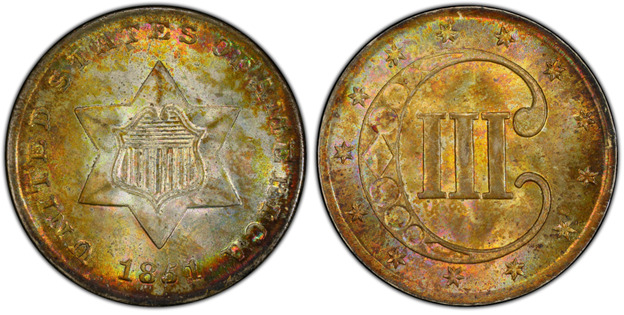
Image: 1851 Type I three-cent silver obverse and reverse showing star with shield and Roman numeral III
Source: PCGS
Original Design
The first 3 cent silver coin featured a six-pointed star on the obverse with no border outline surrounding it. The reverse displayed a large “C” enclosing the Roman numeral “III” within a circular border. This design prioritized simplicity for the new denomination.
Reduced Silver Content
Type I coins contained only 75% silver and 25% copper, the lowest fineness of any U.S. silver coin. The Mint intentionally reduced silver content below the standard 90% to discourage melting during the ongoing silver shortage. At 0.80 grams, these coins were deliberately light to keep their metal value below face value.
High Production Numbers
The initial years saw massive mintages as Americans embraced the new denomination. The Mint struck over 36 million Type I 3 cent pieces in 1851-1852 alone, making most dates from this period relatively affordable in circulated grades today.
Type II (1854-1858): Three Outlines to Star
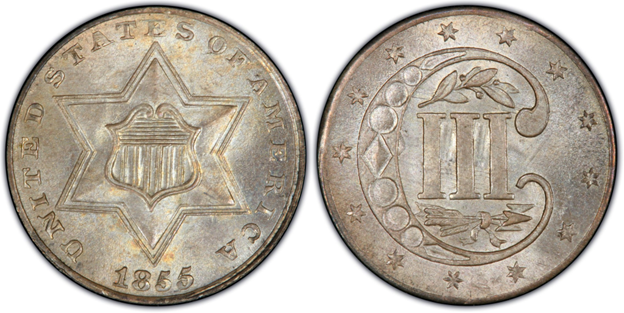
Image: 1855 Type II three-cent silver obverse and reverse showing three outlines around star
Source: PCGS
Design Modification
In 1854, the Mint added three raised lines surrounding the obverse star, creating a more elaborate appearance. This design change coincided with significant composition adjustments.
Increased Silver Standard
Type II examples of the trime 3 cent coin matched the 90% silver, 10% copper standard used in other U.S. silver coinage. The weight decreased slightly to 0.75 grams while maintaining the same diameter. These changes eliminated the melting incentive that had driven the original composition.
Notable Scarcity
Mintages dropped dramatically compared to Type I. The lowest regular circulation issue, the 1855, saw just 139,000 pieces struck. All Type II dates are substantially scarcer than Type I issues, making them the most challenging type for collectors to acquire in any grade.
Type III (1859-1873): Two Outlines to Star
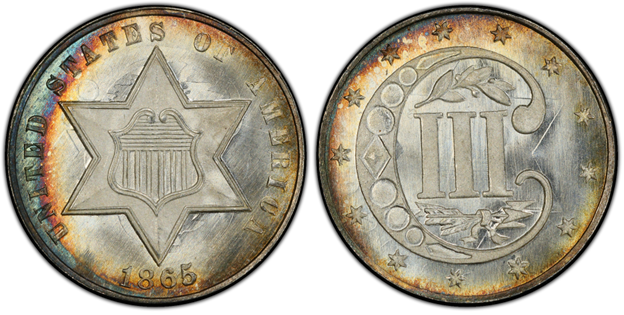
Image: 1865 Type III three-cent silver obverse and reverse showing two outlines around star
Source: PCGS
Final Design Evolution
The Mint simplified the star border to just two lines in 1859, maintaining this design through the denomination’s final year. Specifications remained unchanged from Type II at 90% silver and 0.75 grams.
Civil War and Proof-Only Years
Production of the trime 3 cent coin continued through the Civil War despite silver hoarding that removed most coins from circulation. The years 1863 and 1864 saw no circulation strikes, with only proof coins produced for collectors at approximately 460-470 pieces each year.
Late-Date Rarities
Post-1865 issues carried increasingly low mintages as the denomination fell out of favor. Many late-date Type III coins command significant premiums despite being more available than Type II issues, particularly in higher grades where survival rates were poor.
Key Dates and Varieties
Certain three cent coin issues command substantial premiums due to rarity, while others provide affordable entry points for collectors building type sets or date collections.
Major Rarities
1851-O New Orleans Issue
The only 3 cent piece silver struck outside Philadelphia came from the New Orleans Mint in 1851. The New Orleans facility produced a small trial quantity during the denomination’s first year, but production centralized at Philadelphia afterward as demand concentrated in Eastern postal markets. This issue ranks among the series’ greatest rarities, with fewer than 50 examples believed to survive today. Even heavily worn specimens command five-figure prices.
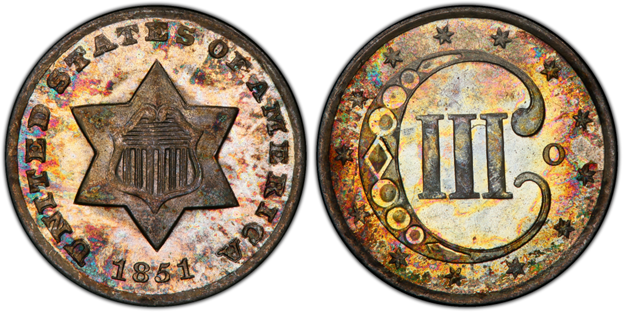
Image: 1851-O Type I three-cent silver obverse and reverse showing New Orleans Mint mark
Source: PCGS
1855 Low Mintage
The 1855 represents Type II’s scarcest regular circulation strike. Mintage figures indicate approximately 139,000 pieces produced, substantially lower than any other Type II date.
Proof-Only Years
The years 1863 and 1864 saw no circulation strikes. The Mint produced only proof coins for collectors, with mintages around 460-470 pieces each year. These proof-only issues are essential for completing date sets but remain prohibitively expensive for many collectors.
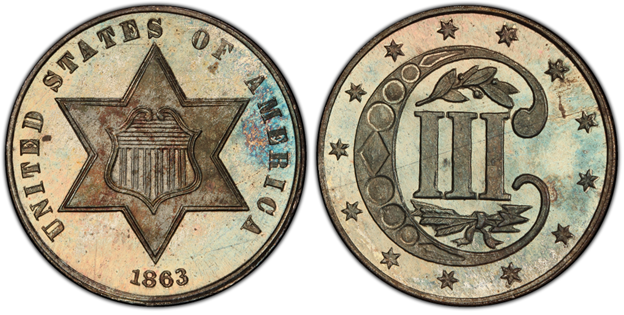
Image: 1863 proof-only Type III three-cent silver obverse and reverse
Source: PCGS
Condition Rarities
High-grade examples of common dates often prove scarcer than low-grade rarities. Type I coins rarely survive in Mint State due to their thin planchets wearing quickly. Any Mint State Type II significantly outvalues Type I in the same grade. Post-1865 Type III dates seldom appear in gem condition, making MS-65 or better specimens genuinely rare.
Affordable Entry Points
Collectors can acquire Type I common dates from 1851-1852 in circulated grades for modest sums. Type III circulation strikes from 1865-1872 offer more availability than Type II issues. Good through Fine grades provide budget-friendly options for building type sets, particularly when focusing on problem-free, original coins rather than cleaned examples.
Understanding 3 Cent Coin Value
3 cent silver coin value depends on multiple factors beyond simple date rarity, with grading challenges and market dynamics creating significant price variations.
Grading Challenges
Thin Planchet Wear Patterns
The exceptionally thin planchets show wear differently than thicker silver coins. High points flatten quickly, making accurate grade assessment difficult. What appears as weak strike detail may actually be circulation wear, requiring expertise to distinguish original production characteristics from damage.
Strike Quality Issues
Many 3 cent silvers left the Mint with incomplete strikes due to the shallow dies and thin planchets. Collectors must differentiate between original strike weakness and post-production wear when evaluating condition.
Cleaning Detection
Improper cleaning dramatically reduces value. The tiny size makes cleaning damage harder to detect in photographs, emphasizing the importance of in-hand examination or professional certification. Third-party grading from PCGS or NGC provides authentication and grade consensus that protects buyers.
Market Price Factors
Type II coins command higher premiums than Type I or Type III in equivalent grades due to their overall scarcity. Key dates within each type carry substantial premiums over common issues. Grade dramatically impacts value, with Mint State examples trading at multiples of circulated pieces. Eye appeal factors including original surfaces, strong strikes, and attractive toning significantly affect prices independent of technical grade.
Building a Three Cent Coin Collection
Collectors approach the 3 cent silver coin through various strategies depending on budget, interest level, and numismatic goals.
Type Set Approach
Three-Type Goal
The most accessible strategy involves acquiring one example of each design type. This approach provides representative coverage of the denomination’s evolution without requiring every date.
Grade Consistency
Matching condition levels across all three types creates aesthetic coherence in a display. Collectors typically aim for similar grades rather than mixing Mint State with heavily circulated examples.
Budget Allocation
Smart collectors spend more on the scarcer Type II while economizing on readily available Type I common dates. This strategy acknowledges scarcity differences while maintaining presentable examples across the set.
Display Considerations
The tiny size requires appropriate holders and presentation methods. Standard coin albums work poorly for 3 cent pieces, making specialized capsules or custom displays necessary to showcase these coins effectively.
Date Set Strategy
Complete Series Challenge
Assembling all dates of the American 3 cent coin from 1851 through 1873 requires significant commitment and resources. The proof-only years 1863-1864 present the greatest obstacles, as these coins carry substantial premiums even in the lowest proof grades.
Long-Term Project
Complete date sets typically require years to assemble as key dates appear infrequently at auction and through dealers. Patient collectors willing to wait for properly graded examples often achieve better results than those rushing to fill holes.
Investing in Key Dates
Serious collectors focus on genuinely scarce dates with sustainable premiums rather than common issues. Pursuing finest-known examples of key dates provides both collecting satisfaction and potential appreciation as rare numismatic assets. Authentication priority matters critically when acquiring rare dates, as counterfeits exist for valuable issues. Market timing allows opportunistic purchases when key dates become available through estate sales or collector dispersals.
Authentication and Preservation
Protecting investments in three-cent coins requires understanding counterfeit detection methods and proper storage techniques.
Counterfeit Detection
Weight and Size Verification
Genuine three-cent pieces weigh 0.80 grams for Type I or 0.75 grams for Type II and III. Digital scales accurate to hundredths of a gram reveal wrong-metal fakes immediately. Diameter measures exactly 14mm across all types. Pieces deviating significantly from these specifications are counterfeit.
Strike Characteristics
An authentic 3 cent silver coin displays production qualities consistent with U.S. Mint standards from the 1850s-1870s. Genuine pieces show proper die alignment, appropriate metal flow, and period-correct striking techniques.
Cast Counterfeits
The most common counterfeit method involves casting rather than striking. Cast fakes display telltale pitting, porosity, and mushy details that distinguish them from struck coins. Edge examination often reveals seams or irregularities absent from genuine pieces.
Proper Storage
Individual Protection
The tiny size of the American 3 cent coin requires specialized capsule holders. Standard capsules designed for larger coins allow movement that damages delicate surfaces. Properly fitted holders prevent contact while displaying both sides.
Environmental Control
Inert holders protect against toning and environmental damage. Stable temperature and humidity prevent accelerated deterioration of silver surfaces. Avoiding PVC-containing flips preserves original coin surfaces from chemical damage.
Handling Minimization
The thin planchets show fingerprints and handling marks easily. Minimizing physical contact preserves surfaces. When handling becomes necessary, edge-holding prevents contact with obverse and reverse designs.
Conclusion
Three-cent silver pieces are one of America’s most unusual circulating denominations, spanning three distinct design types from 1851 through 1873. These coins remain the thinnest US coin and lightest silver piece ever produced by the country for general circulation. Collectors value trimes for their accessible entry points into 19th-century U.S. silver, with Type I common dates available affordably in circulated grades. Type II issues present greater challenges due to their overall scarcity, while key-date Type III coins provide genuine numismatic rarities for advancing collectors. The denomination’s brief lifespan and practical origins make these tiny coins compelling additions to American type sets and specialized collections. Explore Blanchard’s selection of rare coins, including certified three-cent silver pieces, to add distinctive pieces of American numismatic history to your collection.
FAQs
1. What is a trime coin?
A trime is the collector nickname for the three-cent silver piece, formed as a portmanteau of “three” and “dime.” The United States Mint struck these tiny coins from 1851 through 1873 in three distinct design types.
2. Why did the U.S. make three-cent coins?
Congress created the 3 cent coin to match the new three-cent postal rate established in 1851, allowing Americans to purchase stamps without requiring change. The denomination also filled the gap between large cents and half dimes during a period when silver coins were scarce.
3. How much is a 3 cent coin worth?
3 cent silver coin value varies dramatically based on type, date, and condition. Common Type I dates in circulated grades offer affordable entry points, while Type II issues and key dates command substantial premiums due to their scarcity.
4. When was the 3 cent coin discontinued?
The three-cent silver was discontinued in 1873 after Congress passed the Coinage Act, which eliminated several denominations including the two-cent piece and half dime alongside the three-cent silver.