Italian Coins: The 20 Lira Gold Standard That Tied Rome to the Latin Monetary Union
Posted on — Leave a commentFor centuries, Italian money reflected division: dozens of city-states, dozens of currencies, no shared identity. Then modern Italy struck the coins that finally ended the fragmentation. In the late 19th century, the newly unified Kingdom of Italy signaled its arrival on the European stage with the 20 lira gold coin. More than currency, it was a declaration: Italy was now part of the continent’s gold-based economy and a full participant in the Latin Monetary Union. From the denarius to the euro, Italian coins have chronicled the country’s shifting power, politics, and aspirations. This article follows that evolution, revealing how the 20 lira became Italy’s benchmark of monetary stability and why Italian issues remain essential to both seasoned collectors and precious-metal investors.
Ancient Italian Coins: The Roman Foundation
The story of Italian coinage begins with Rome, whose monetary innovations established standards that would endure long after the empire’s collapse.
Pre-Unification Context
Roman Monetary Legacy (c. 300 BCE – 476 CE)
Ancient Rome established the monetary framework that would influence Western coinage for millennia. The silver denarius served as the empire’s primary currency, while the gold aureus represented high-value transactions and the bronze sestertius handled everyday commerce. These coins didn’t just facilitate trade: they set standards for weight, purity, and design that subsequent Italian states would reference when creating their own monetary systems centuries later. Today, these old Italian coins from the Roman era remain highly collectible, with values determined by rarity, condition, and historical significance.
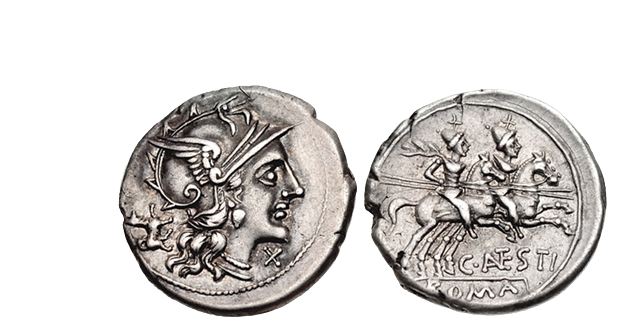
Image: Ancient Roman denarius showing the classical design that influenced Italian coinage for centuries.
Image source: Coin World
Medieval City-State Independence (c. 1000-1861)
After Rome’s fall, the Italian peninsula fractured into competing city-states, each asserting independence through its own coinage. Venice, Florence, Genoa, and Milan operated independent mints from the medieval period forward, producing distinctive coins that reflected their commercial power and political autonomy. A merchant traveling from Venice to Florence in the 1400s needed to exchange currency at every border, with rates determined by precious metal content and the political relationships between competing city-states. This monetary fragmentation would persist for centuries, with Italian mint coins from each city-state developing unique designs and specifications.
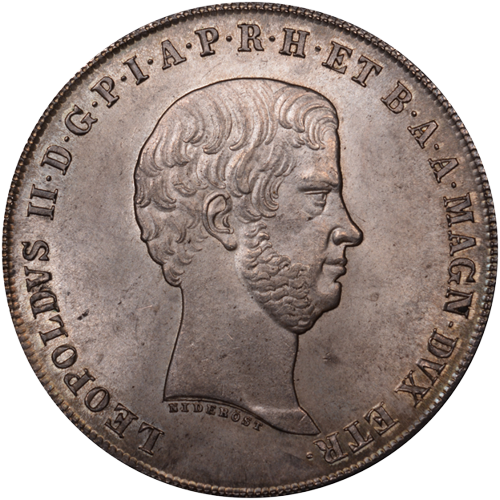
Image: Pre-unification Tuscan silver coin from the Grand Duchy of Tuscany.
Image source: NGC
Papal States and Vatican Authority (756-1870)
Throughout this same period, the Papal States maintained separate coinage, striking coins that combined religious imagery with temporal political power. These papal issues circulated within Vatican-controlled territories and carried unique status as currency issued by ecclesiastical rather than secular authority, making them particularly distinctive within the broader Italian monetary landscape.
The Kingdom of Italy Era (1861-1946)
Italy’s unification in 1861 demanded more than political consolidation: it required a single, standardized monetary system to replace centuries of regional fragmentation.
Unification and Monetary Standardization
From Risorgimento to Common Currency
Italian unification, known as the Risorgimento, culminated in 1861 when most of the peninsula united under the Kingdom of Italy. This political achievement created an immediate practical problem: how to merge the disparate currencies of formerly independent states into a coherent national system. The new Kingdom adopted the decimal lira, subdivided into 100 centesimi, as its official currency in 1862. This system replaced the bewildering array of regional monies – Venetian lire, Tuscan fiorini, Neapolitan ducati – with a unified standard that could facilitate trade across the newly connected nation.
Royal Portraits and National Identity
Italian coins now bore the profiles of the House of Savoy monarchs who had unified the peninsula. Vittorio Emanuele II, Italy’s first king, appeared on the earliest issues, followed by his successors Umberto I and Vittorio Emanuele III. These royal portraits served a purpose beyond identification: they visually reinforced the new national identity, replacing the diverse imagery of city-states and papal authority with a single, recognizable sovereign. The Rome and Milan mints became the primary facilities for producing this national coinage, with Rome handling the bulk of precious metal issues.
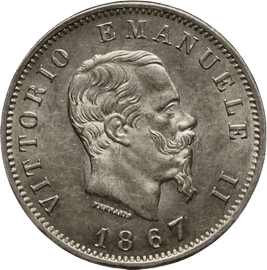
Image: Early Kingdom of Italy coin featuring Victor Emmanuel II from the year of unification.
Image source: Numista
The Latin Monetary Union Connection
Italy’s monetary ambitions extended beyond national borders through participation in Europe’s most ambitious 19th-century currency experiment.
The 1865 Agreement and Cross-Border Currency
France, Belgium, Italy, and Switzerland formalized the Latin Monetary Union in 1865, creating Europe’s first major currency standardization zone. The agreement established common specifications for precious metal coinage: Italy’s 20 lira gold matched France’s 20 franc and Switzerland’s 20 franc in weight and fineness, i.e. 6.45 grams of .900 fine gold. The union operated on a bimetallic standard where both silver and Italian gold coins served as legal tender with fixed exchange relationships. An Italian merchant could pay with 20 lira gold in Paris or Geneva, accepted at face value just like domestic coinage, facilitating trade and travel across member states decades before the Italian euro coins.
Collapse After World War I
The First World War destroyed the economic foundations that kept the Latin Monetary Union functioning. Member states suspended gold convertibility to finance military spending, silver prices collapsed relative to gold, and governments began issuing paper money that no longer matched the union’s fixed metal ratios. With the bimetallic balance broken and inflation surging across Europe, the LMU’s standardized coinage system could no longer operate. The union was formally dissolved in 1927, though in practice it had stopped functioning during the war, leaving Italy’s 20 lira gold as a vestige of Europe’s first attempt at monetary integration.
Watch this video for a comprehensive look at Italian lira coins from their 1861 introduction through the 2002 euro transition.
Italian Gold and Silver Coins: The Kingdom’s Precious Metal Standards
Italy’s adherence to the Latin Monetary Union resulted in a standardized series of Italian gold coins and silver issues that defined the Kingdom’s monetary identity and remain cornerstones of Italian numismatics.
The 20 Lire Gold: Italy’s Monetary Benchmark
Specifications and Design
The 20 lire gold coin established Italy’s monetary credibility on the international stage. Each piece contained exactly 6.45 grams of .900 fine gold (0.1867 troy ounces actual gold weight), with a diameter of 21mm and a reeded edge. The obverse featured the reigning monarch’s profile (first Vittorio Emanuele II, then Umberto I, and finally Vittorio Emanuele III), while the reverse displayed the Italian coat of arms with value denomination. Design variations occurred with each monarch, making the coins readily identifiable by period.
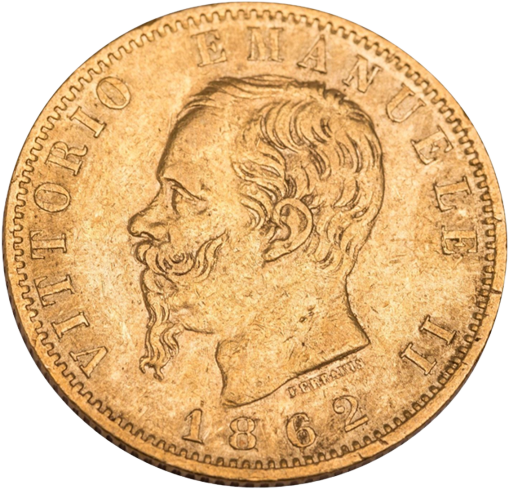
Image: Italian 20 lire gold coin from the Kingdom era showing King Victor Emmanuel II.
Image source: Numista
Production and Collectability
Rome and Milan mints produced 20 lire gold throughout the Kingdom period, with production concentrated in years of economic stability and international trade. Certain dates command premiums due to lower mintages or historical significance, while common dates remain accessible to collectors seeking Italian gold coins at prices near precious metal value. The coins’ Latin Monetary Union status means they circulated widely across Europe, resulting in survival rates that keep them available in today’s market.
Other Gold Denominations
Italy struck additional gold denominations within the Latin Monetary Union framework. The 100 lire gold, containing five times the gold of the 20 lire, served large transactions and wealth storage. Mid-range denominations included 50 lire and 10 lire gold pieces, while the compact 5 lire gold provided the series’ smallest precious metal option. These denominations saw more limited production than the 20 lire, making them scarcer in today’s collector market.
Italian Silver Coins of the Kingdom
The 5 Lire Silver Crown
Italy’s largest silver coin, the 5 lire, matched the dimensions and weight standards common to European crown-sized silver pieces. Containing 25 grams of .900 fine silver in a 37mm diameter, these substantial coins featured royal portraits on the obverse with various reverse designs celebrating Italian unity and heritage. High survival rates, particularly for later issues, keep 5 lire silver crowns accessible to collectors, making them popular type coins for world crown specialists.
Smaller Silver Denominations
The Kingdom produced fractional silver in 2 lire, 1 lira, 50 centesimi, and 20 centesimi denominations, all maintaining the .900 fineness standard during the precious metal era. These mid-range coins facilitated everyday commerce while providing meaningful silver content. As Italy faced economic pressures in the early 20th century, silver gradually gave way to base metals like nickel for smaller denominations, marking the transition from precious metal to token coinage that would accelerate after World War I.
Republican Era Coinage (1946-2001)
The Kingdom of Italy continued producing lira coinage through the interwar period and World War II, but the monarchy itself would not survive the war’s aftermath. Italy’s 1946 constitutional referendum abolished the monarchy by a narrow margin, transforming the nation’s coinage along with its government.
Post-Monarchy Transition: New Designs for a New Republic
Royal portraits disappeared from Italian coins, replaced by allegorical figures, agricultural imagery, and symbols of Italian culture and industry. The lira remained Italy’s currency, but its buying power eroded steadily through decades of inflation. This economic reality forced Italy to introduce increasingly large denominations: 1,000, 2,000, 5,000, and even 10,000 Italian lira coins by the 1990s. Precious metals gave way to practical base metals: aluminum for small change, stainless steel and aluminum-bronze for mid-range denominations, and eventually bi-metallic constructions for high-value pieces.
Notable Collector Issues
Despite the shift to base metal, Italy maintained its artistic coinage tradition through 500 lire silver commemoratives starting in 1958. These large Italian silver coins marked national events and anniversaries, offering collectors accessible precious metal pieces with attractive designs. Certain low-mintage years and proof sets command premiums, while the final Italian coins before euro conversion, i.e. the 2001 lira issues, attract collectors seeking the currency’s concluding chapter.
Italian Euro Coins (2002-Present)
On January 1, 2002, Italy abandoned the lira after 140 years and adopted the euro as part of the European Union’s common currency initiative.
Euro Transition and Italian Designs
Italian euro coins feature unique national designs on their reverse sides while maintaining standard European obverse specifications. The Italian Mint chose iconic cultural symbols for its denominations: the Colosseum for the 5-cent piece, Botticelli’s Birth of Venus for the 10-cent, and Dante Alighieri for the 2-euro. These designs ensure Italian euro coins remain distinctively identifiable even within the standardized European monetary system.
Collector Interest and Special Issues
First-year 2002 euros attract type collectors seeking the currency’s inaugural issues. Italy regularly produces commemorative 2-euro coins celebrating national events, artistic anniversaries, and historical milestones, with certain low-mintage releases commanding premiums. Current Italian coins in circulation use the euro system, but collectors particularly prize Vatican City and San Marino microstate variants produced with severely limited mintages, making these parallel series especially valuable. Vatican euros command strong premiums due to their ecclesiastical imagery and the territory’s unique status as an independent state within Rome.
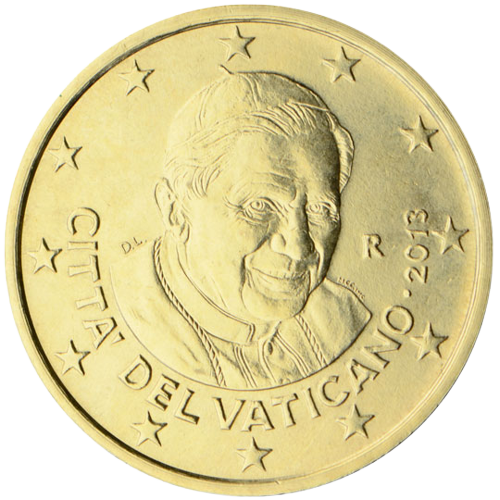
Image: Modern Vatican euro coin featuring Pope Francis from the microstate’s limited-mintage series.
Image source: European Central Bank
Building an Italian Coin Collection
Italian coinage offers collectors multiple pathways, from affordable Italian gold coins to specialized historical sets, with the 20 lire gold serving as the natural entry point
Starting with the 20 Lire Gold
The Accessible Gold Standard
For collectors new to Italian coinage or European gold, the 20 lire represents an ideal starting point. Struck in substantial quantities during the Kingdom period, these coins remain readily available at prices close to their gold content value. With 0.1867 troy ounces of pure gold, they offer meaningful precious metal weight in a compact, historically significant format. Various dates and monarchs appear in Italian coins for sale from dealer inventories (Victor Emmanuel II, Umberto I, and Victor Emmanuel III), allowing collectors to select based on personal preference or historical interest without confronting prohibitive scarcity premiums.
Latin Monetary Union Cross-Collecting
The 20 lire’s identical gold content to French 20 francs, Swiss 20 francs, and Belgian 20 francs creates natural collecting synergies. Assembling a Latin Monetary Union gold set, i.e. one coin from each member nation, demonstrates the 19th-century monetary integration experiment while building a diversified European gold portfolio. This approach combines historical narrative with precious metal accumulation. Collectors seeking rare Italian coins should focus on low-mintage Kingdom dates or exceptional condition examples that command premiums beyond standard issues.
Specialized Collection Strategies
Type Set Approaches
Collectors can pursue Italian coinage by historical period, i.e. one coin representing ancient Rome, medieval city-states, Kingdom era, Republic, and modern euro. Alternatively, focusing on a single monarch like Victor Emmanuel II or Umberto I creates a manageable specialized collection. Denominational type sets, assembling one example of each Kingdom gold or silver value, offer another coherent approach.
Silver and Commemorative Focus
The 5 lire silver crowns provide large-format coins at accessible prices, particularly for common Kingdom dates. When searching for valuable Italian coins, both Kingdom-era precious metal issues and select Republican commemoratives offer strong opportunities. Republican-era 500 lire silver commemoratives from 1958 onward combine artistic merit with silver content, offering modern Italian numismatics without Kingdom-era price points.
Budget Considerations
Italian coins value spans a wide spectrum depending on era, metal content, and rarity. Entry-level collectors can acquire common-date 20 lire gold or 5 lire silver crowns near precious metal value. Mid-range budgets open access to scarcer dates, better-preserved examples, and multiple denominations. Investment-grade collectors pursue key-date rarities, medieval city-state gold, or exceptional condition Kingdom pieces where scarcity and historical importance drive substantial premiums. Italian coins fit within a broader precious metal investment strategy that can include both bullion and numismatic pieces across different asset categories. Complete set assembly faces its greatest challenge with early Renaissance gold ducats and specific low-mintage Kingdom dates, though most Italian collecting goals remain achievable without confronting unobtainable rarities.
Conclusion
Italian coinage chronicles more than two thousand years of monetary evolution, from Rome’s foundational denarius through the Latin Monetary Union’s 20 lira gold standard to today’s euro. This extraordinary span offers collectors accessible entry points, such as common-date 20 lire gold coins available near precious metal value, alongside specialized pursuits like medieval city-state ducats or complete Kingdom sets. Italian coins uniquely combine artistic excellence with substantial precious metal content and deep historical significance, appealing equally to world coin collectors and precious metals investors seeking tangible assets rooted in European monetary history. Explore Blanchard’s selection of Italian and other world coins to build a collection grounded in enduring monetary legacy, backed by precious metal content and centuries of numismatic tradition.
FAQs
1. What are Italian coins called?
Italian coins have carried different names throughout history, including the denarius in ancient Rome, ducats and florins in the medieval city-states, and the lira from 1861 until Italy adopted the euro in 2002.
2. What are Italian lira coins made of?
Italian lira coinage varied by era and denomination. Kingdom-era issues were struck in gold or silver, while most Republican-era coins used base metals such as aluminum, stainless steel, and aluminum-bronze.
3. Are Italian lira coins worth anything?
Italian lira coins value varies significantly by era: Kingdom precious metal issues command premiums while Republican-era base metal lira have minimal monetary value, though certain commemorative silver issues and low-mintage dates attract collector interest.