The Norfolk Half Dollar and the Power of Civic Memory
Posted on — Leave a commentIn the early decades of the United States, coinage was more than a medium of exchange. It was a statement of identity. Long after independence had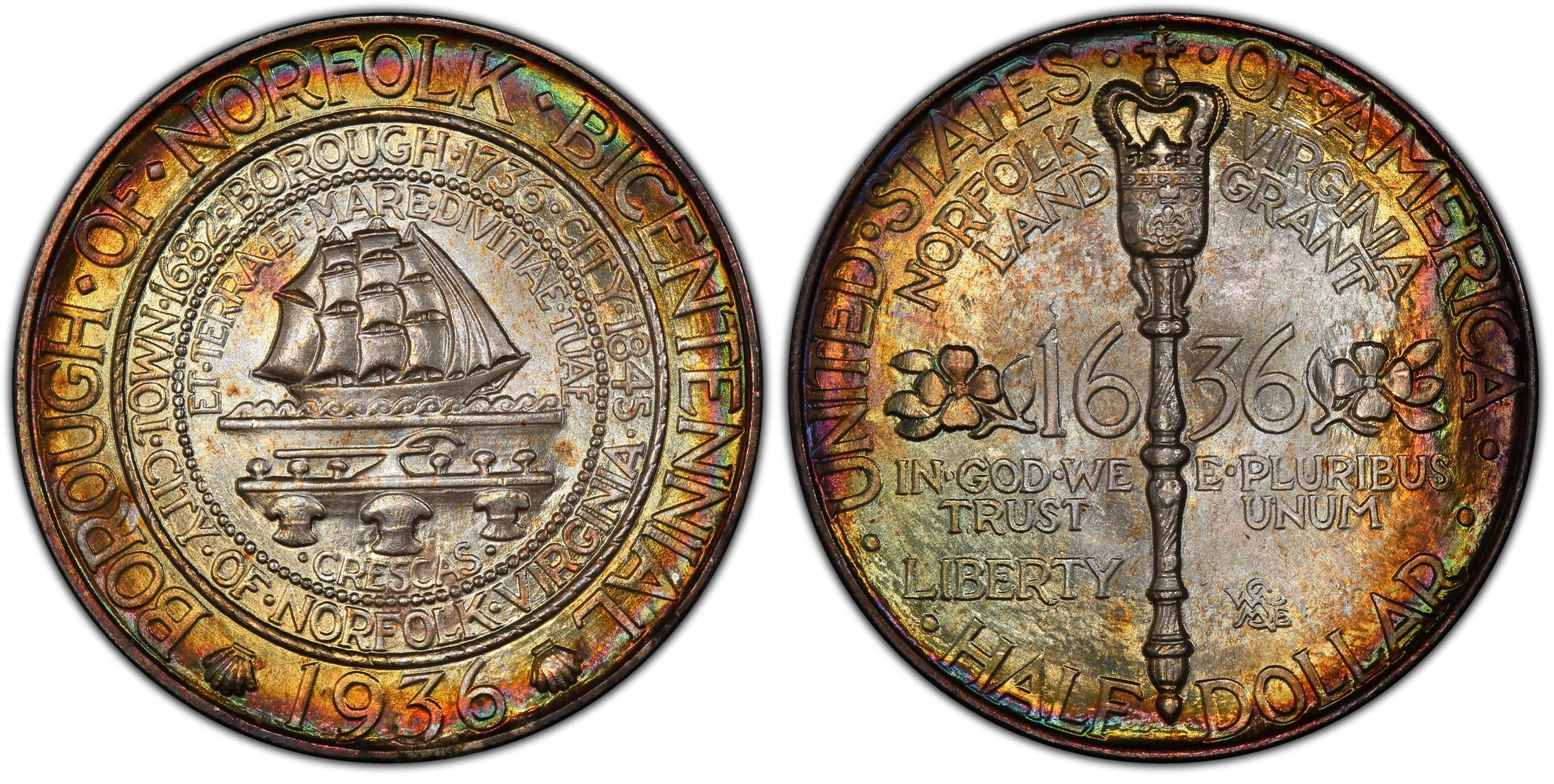 been secured, Americans continued to use coinage to define who they were, where they came from, and what they chose to remember. The 1936 Norfolk Bicentennial Half Dollar stands as one of the clearest examples of this tradition, using silver not simply to mark value, but to preserve the legacy of one of America’s oldest port cities.
Struck during the height of the classic commemorative era, the Norfolk Half Dollar reflects a mature nation looking backward. It commemorates a city whose roots predate the United States itself, and it does so with symbolism that reaches deep into the colonial period. This is not a coin about expansion or conquest. It is a coin about continuity.
A City Older Than the Nation
Norfolk, Virginia traces its origins to the early 17th century, long before independence was imagined. Officially designated a borough in 1736, the city grew as a center of maritime trade, shipbuilding, and transatlantic commerce. Its location along the Chesapeake Bay made it a vital link between the American colonies and the wider world.
By the 1930s, Norfolk had become a modern American city, but its leaders sought to commemorate the deep historical roots that shaped its identity. The bicentennial of its borough charter provided the opportunity. Congress authorized a commemorative half dollar to mark the occasion, formally linking local history with federal coinage.
Commemorative Coinage Comes of Age
The Norfolk Half Dollar was authorized at a time when commemorative coins had become a popular means of funding celebrations and memorializing regional milestones. Unlike the experimental coinage of the 1790s, these issues were struck by an established Mint using standardized processes. Yet they retained a sense of purpose beyond commerce.
Although the coin bears the date 1936, it was struck in 1937, a reflection of the legislation that required all pieces to display the anniversary year. This detail, seemingly minor, reinforces the commemorative intent. The date on the coin is not about when it was made, but about what it was meant to remember.
Design as Historical Narrative
The design of the Norfolk Half Dollar functions as a visual history lesson. Every element was chosen to communicate the city’s economic foundations and civic authority. Rather than relying on abstract imagery, the designers embedded Norfolk’s story directly into the coin.
Obverse: The obverse features the official seal of Norfolk. At its center is a three-masted sailing ship under full sail, symbolizing the city’s maritime strength and its dependence on trade and navigation. Beneath the ship appear a plow and sheaves of wheat, representing agriculture and the wealth of the surrounding land. The Latin motto, translated as “Riches from land and sea,” ties these elements together. It is a concise statement of how Norfolk prospered, and why it mattered within the broader colonial and early American economy.
Reverse: The reverse presents one of the most striking and unusual symbols ever placed on a United States coin: the Norfolk Royal Mace. This ceremonial object, a symbol of municipal authority, dates back to the city’s colonial governance and prominently features a British crown. Its inclusion was intentional and provocative. Rather than erasing colonial history, the coin acknowledges it. The mace serves as a reminder that American cities did not emerge in isolation, but evolved from earlier systems of law and order that shaped their institutions.
Mintage, Distribution, and Survival
Congress authorized up to 25,000 Norfolk Half Dollars, but public demand proved softer than anticipated. Many unsold coins were eventually returned to the Mint and melted, leaving an estimated net distribution of approximately 16,900 pieces.
This limited survival places the Norfolk Half Dollar among the scarcer issues of the classic commemorative series. Unlike heavily circulated early federal coins, however, many examples were preserved in uncirculated condition, having been sold directly to collectors rather than released into commerce.
Why the Norfolk Half Dollar Still Matters
The Norfolk Bicentennial Half Dollar matters not because it filled a monetary need, but because it filled a cultural one. It represents a moment when Americans chose to honor local history through national coinage, embedding memory into metal.
For modern collectors, the coin offers more than silver content or aesthetic appeal. It provides a tangible link between colonial America and the federal era, between British authority and American independence, and between a city’s past and its continued presence.
Like the earliest coins of the Republic, the Norfolk Half Dollar tells a story. It reminds us that coinage has always been about more than commerce. At its best, it is about identity, continuity, and the decision to remember where we came from.