The 1795 Flowing Hair Half Dime: America’s First Silver Coinage in Miniature
Posted on — Leave a commentIn the earliest days of the United States, coinage was not simply a matter of commerce. It was a declaration of independence. When the young nation struck the 1795 Flowing Hair Half Dime, it did so with limited resources, immense ambition, and a clear desire to prove that America could stand on its own. Small in size but immense in historical importance, this coin represents the birth of federal silver coinage and the fragile optimism of a country still defining itself.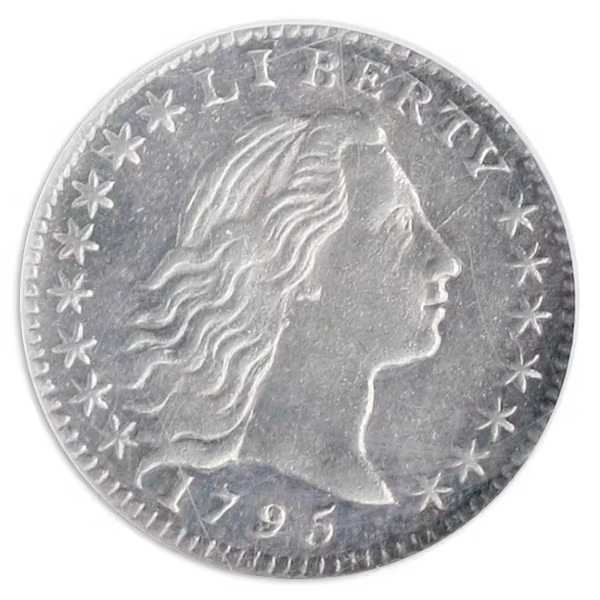
A Nation Learning to Mint Money
Following the passage of the Coinage Act of 1792, the United States authorized its first official coinage system. The law established denominations, standards of weight and fineness, and the Philadelphia Mint as the center of production. What it did not provide was an easy path forward. Equipment was primitive, skilled engravers were scarce, and bullion supplies were inconsistent. Even so, by 1794 and 1795, the Mint began striking silver coins for circulation.
The half dime held a special role. As the smallest silver denomination authorized by law, it was intended for everyday transactions. In a time when foreign coins circulated freely and barter was still common, a federally issued silver coin signaled stability and trust. The 1795 Flowing Hair Half Dime became one of the earliest tangible expressions of that trust.
The Flowing Hair Design and Its Meaning
The design of the Flowing Hair Half Dime closely mirrors the motifs seen on other early silver coins. Liberty appears facing right, her hair long and loose, flowing freely behind her. This was not accidental. Early American artists avoided rigid or crowned imagery, choosing instead to depict Liberty as natural and unrestrained. The flowing hair symbolized freedom, youth, and a break from Old World traditions.
On the reverse, a simple wreath encircles the denomination. There is no eagle on the half dime at this time, which underscores how experimental early coin designs could be. The emphasis was not on grandeur but on function. This was a coin meant to circulate, to be handled daily by merchants, farmers, and laborers.
A Coin Born of Scarcity
One of the most fascinating aspects of the 1795 Flowing Hair Half Dime is how it was produced. Unlike later issues struck from refined domestic silver, these coins were minted using silver supplied directly by private citizens. Depositors brought silver bullion or foreign coinage to the Mint, which was then melted and struck into United States coinage. In return, depositors received newly minted coins, minus a small fee.
This process meant that production numbers were limited and inconsistent. It also meant that every half dime represented a collaborative effort between the government and its citizens. In a very real sense, Americans were helping to create their own money supply.
Circulation in an Uncertain Economy
The late 1790s were economically volatile. The United States had no central bank for much of this period, and confidence in paper money remained shaky after the inflationary experiences of the Revolutionary War. Silver coins like the half dime were trusted precisely because their value was intrinsic.
These coins circulated alongside Spanish reales, Dutch silver, and other foreign issues. Many were heavily worn through years of use, which is why well preserved examples are especially prized today. Each surviving coin carries the marks of early American commerce, passed from hand to hand in taverns, markets, and general stores.
Rarity and Survival
The 1795 Flowing Hair Half Dime had a relatively small mintage, and survival rates are low. Many examples were lost, melted, or worn beyond recognition. Those that remain offer collectors a rare opportunity to hold a piece of the nation’s earliest monetary history.
Collectors are often drawn to this coin not for its size or flash, but for its authenticity. It is a coin from a time before mass production, before steam presses, and before standardized dies. Every example shows subtle variations that reflect the handmade nature of early Mint operations.
Why the 1795 Half Dime Still Matters
Today, the 1795 Flowing Hair Half Dime stands as more than a numismatic rarity. It is a reminder of how fragile and determined the early United States truly was. This small silver coin helped establish confidence in federal coinage and laid the groundwork for everything that followed.
Holding one is like holding a chapter of American history. It connects the modern collector to a moment when the nation was young, uncertain, and hopeful, striking silver coins not just to facilitate trade, but to prove that the experiment of American independence could endure.