U.S. Gold Commemorative Coins: 130+ Years of American Numismatic History
Posted on — Leave a commentNot every coin is made to circulate. U.S. gold commemoratives exist for a different purpose entirely: to mark moments in American history that the government deemed worth preserving in precious metal. The program spans over a century, from the World’s Fair issues of the early 1900s through the sophisticated limited-mintage releases of today. Over that period, it has produced some of the most notable and artistically significant coins in American numismatics. This article covers the full history of U.S. gold commemorative coins, the key series that define the program, what drives value, and how collectors approach building a meaningful collection.
What Are U.S. Commemorative Coins?
Official U.S. gold commemoratives are a distinct category of government-issued coinage. They are legally mandated, strictly limited in production, and designed to be collected rather than circulated.
Congressional Authorization and the Surcharge Model
No commemorative coin can be produced without an act of Congress. Each program requires its own enabling legislation, which specifies the subject being honored, the denominations, and the mintage limits. It also establishes a surcharge, i.e. a fixed amount added to the sale price that is distributed to a designated beneficiary organization once the Mint recoups its production costs. Surcharges have funded everything from national monuments to museums. That legislative foundation is what separates official issues from the private medallions and novelty pieces frequently marketed using similar language.
Legal Tender With Numismatic Value
Gold commemorative coins carry a face value – typically $5 or $10 for modern issues – that technically makes them legal tender, though they are rarely spent. That face value bears little relationship to what the coins are actually worth. A $5 gold commemorative contains nearly a quarter ounce of gold, placing its melt value alone well above its denomination, before any numismatic premium is factored in.
Why Mintage Limits Matter
Each commemorative program is authorized with a maximum mintage set by Congress, though the Mint frequently strikes fewer coins than that ceiling if demand falls short. Once the sales window closes, production ends and there is no mechanism to reopen it. That finite supply is one of the structural reasons US Mint commemorative coins can appreciate over time in ways that open-ended bullion products cannot. When collector demand for a particular issue grows after the program has closed, the only available coins are those already in existence, which is precisely the dynamic that has driven significant premiums on lower-mintage issues over the years.
For a closer look at standout issues across the series, CoinWeek editor Charles Morgan shares his picks in this video.
The Classic Era (1903-1926)
The classic gold commemorative series is compact but historically rich: just 13 different issues across three denominations, all struck in .900 fine gold, with mintages so small that several border on genuinely rare.
The First Issues: Louisiana Purchase and Lewis & Clark Gold Dollars
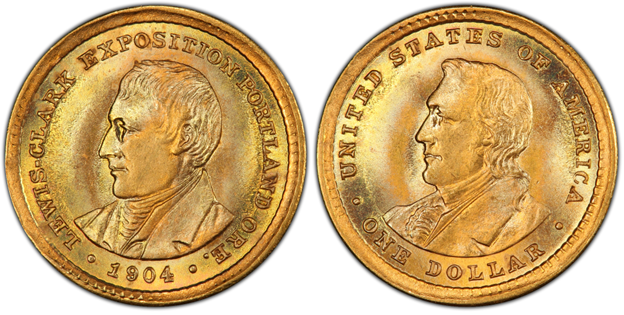
Image: Obverse and reverse of the 1904 Lewis and Clark Exposition gold dollar
Source: PCGS
The series began in 1903 with two gold dollar designs for the Louisiana Purchase Exposition in St. Louis – one depicting Thomas Jefferson, the other William McKinley. Despite an authorized mintage of up to 250,000 pieces, only around 17,500 of each actually sold, with the remainder melted in 1914. That gap between authorized and actual mintage is a recurring feature of the classic era, and it is precisely why surviving populations are often far smaller than the original authorizations suggest. Gold dollars for the Lewis and Clark Exposition followed in 1904 and 1905, with distributions of roughly 10,000 each, making them among the scarcer entries in the series.
McKinley and Grant Memorial Dollars
Two further gold dollar programs rounded out the $1 denomination. The McKinley Memorial issues of 1916 and 1917 were struck to help fund a memorial in the president’s birthplace of Niles, Ohio. The 1922 Grant Memorial dollar came in two varieties: with and without a small incuse star on the obverse – the starred version being considerably scarcer and a well-known key date among classic gold collectors.
The Panama-Pacific Set: America’s Most Ambitious US Mint Commemorative Coins Program
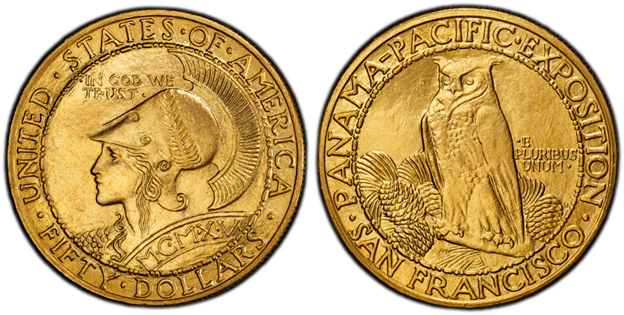
Image: Obverse and reverse of the 1915 Panama-Pacific Exposition round $50 gold piece
Source: PCGS
The 1915 Panama-Pacific Exposition produced the most ambitious gold commemorative program the U.S. Mint has ever undertaken. Issued to mark the completion of the Panama Canal, the set comprised four gold pieces: a dollar, a quarter eagle, and two $50 coins struck in both round and octagonal formats. These $50 pieces remain the largest coins ever produced by the U.S. Mint, with mintages of just 483 and 645 respectively. They are the undisputed keys to the classic gold series and typically trade well into five or six figures.
Closing the Era: The 1926 Sesquicentennial Quarter Eagle
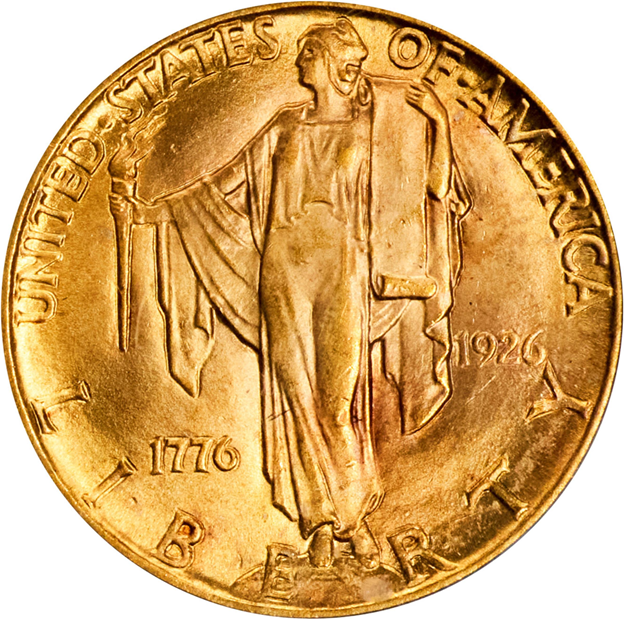
Image: Obverse of the 1926 Sesquicentennial of American Independence $2.50 gold quarter eagle
Source: PCGS
The final classic gold commemorative was a $2.50 quarter eagle issued for the 150th anniversary of the Declaration of Independence. At just over 46,000 pieces struck – the highest mintage of any classic gold issue – it is the most accessible entry point into the series, and for many collectors the natural starting place.
The Modern Era Begins (1984-Present)
After a 58-year absence – the result of America abandoning the gold standard in 1933 – gold commemorative coins returned with the 1984 Los Angeles Olympics, establishing a template the program still follows today.
1984 Olympic $10 Gold: The First in 58 Years
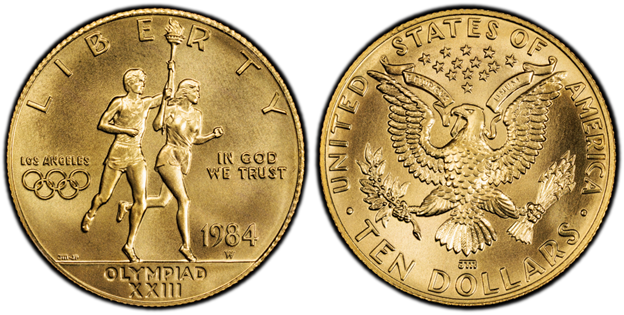
Image: Obverse and reverse of the 1984 Los Angeles Olympics commemorative $10 gold coin
Source: PCGS
The 1984 $10 gold piece was the first monetized gold coin struck by the U.S. Mint since 1933 and the first coin ever to carry the West Point “W” mintmark. Designed by John Mercanti, the obverse depicts two torch runners; the reverse shows the Great Seal. Most modern gold issues that followed adopted the $5 half eagle denomination containing just under a quarter ounce of .900 fine gold.
1986 Statue of Liberty: Establishing the Modern Format
The 1986 centennial introduced the three-coin format (clad half dollar, silver dollar, and gold $5) that defines the modern program. The gold half eagle, the first $5 coin struck since 1929, featured an upward view of Liberty’s crowned head on the obverse. The program proved highly popular and demonstrated a strong public appetite for the revived commemorative series.
1987 Constitution Bicentennial: Confirming the Model
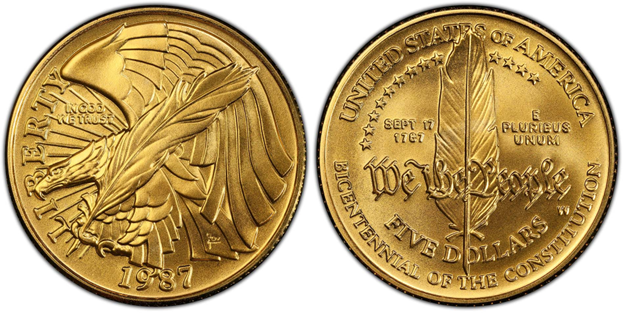
Image: Obverse and reverse of the 1987 Constitution Bicentennial commemorative $5 gold coin
Source: PCGS
The Constitution Bicentennial $5, designed by Marcel Jovine, features a stylized eagle clutching a quill pen on the obverse and the words “We the People” on the reverse. With nearly 866,000 gold pieces sold across both finishes, it remains one of the highest-mintage issues in the modern gold series and stands as confirmation that the revived US commemorative coins program had found a sustainable collector audience.
Congress Caps the Program and the Market Responds
By the early 1990s the proliferation of issues was creating collector fatigue, pushing secondary market prices below issue price for many programs. Congress responded in 1999 by capping production at two commemorative programs per year. That cap, combined with variable demand, is why actual mintages often fall well short of authorized ceilings, and why those gaps produce the series’ most significant key dates. The 1997 Jackie Robinson $5 uncirculated, which sold just 5,174 pieces against an authorized maximum of 100,000, remains the starkest example.
Collecting Modern Gold Commemorative Coins: Key Series and Programs
Modern gold commemoratives cluster into some of the most popular commemorative coins series in the program’s history, each with its own depth and logic.
Olympic Issues
Early Olympic Commemoratives (1984-1992)
Commemorative gold coins were produced for the 1984, 1988, 1992, and 1996 Olympic Games, spanning both $5 and $10 denominations with designs reflecting each host city’s character. The designs frequently incorporated athletic imagery and national symbolism, and many collectors assemble Olympic sets across multiple programs as a way of tracing the evolution of the modern commemorative series.
The Atlanta Olympics Expansion (1995-1996)
The 1996 Atlanta program was the most expansive. Ultimately, it was also the most damaging to collector confidence, with 16 coins across three denominations flooding a market that couldn’t absorb them.
Presidential Commemorative Coins and Military Themes
Presidential Anniversaries
Presidential anniversaries and military commemorative coins represent two of the program’s most consistent threads. Issues honoring Washington, Lincoln, and the Constitution bicentennial have drawn strong sales, and more recent programs, such as the 2016 Ronald Reagan Presidential commemoratives, show that collectors remain strongly drawn to coins tied to major figures in American political history.
Military commemorative coins
Programs covering World War II, the Korean War, and Vietnam veterans have built a dedicated collector base drawn as much to the subject matter as the coins themselves. Coins such as the 1991 Mount Rushmore anniversary issues and the 1995-1996 Civil War Battlefield commemoratives illustrate how military and national heritage themes frequently overlap within the modern commemorative program.
The First Spouse Gold Coin Program (2007-2016)
Program Structure
Issued alongside the Presidential $1 coin series, the First Spouse program honored the spouses of U.S. presidents on half-ounce .9999 fine gold coins with a $10 face value. For presidents who served without a spouse, the Mint substituted a Liberty design drawn from coinage of their era.
Low-Mintage Late Issues
Early issues sold reasonably well, but as the series progressed and gold prices rose sharply, participation dropped dramatically – several later uncirculated issues sold fewer than 2,000 pieces. Those low late-series mintages are precisely what makes the program compelling for forward-looking collectors. Issues like the Eleanor Roosevelt uncirculated, with just 1,886 pieces struck, trade near spot today despite populations that rival classic-era rarities.
Understanding Commemorative Coins Value
Value in this series is never determined by a single factor. Gold content sets a floor, but everything above that floor is driven by mintage, theme, condition, and market demand working in combination.
What Determines Numismatic Value
Mintage is the most fundamental variable: lower production means fewer coins competing to satisfy whatever collector demand develops over time. Theme matters considerably; coins tied to subjects with broad cultural resonance consistently outperform technically scarcer issues that lack appeal. Design quality is a genuine factor too, with artistically ambitious pieces attracting collectors who might otherwise ignore the series. Original government packaging and certificates of authenticity add meaningful premiums on the secondary market, particularly for modern issues where intact sets are increasingly hard to find.
Common vs. Rare Issues
The modern series spans a wide value spectrum. Many high-mintage issues trade at or near melt, offering an accessible entry point but limited upside. Classic gold issues from the 1903-1926 era command substantial premiums rooted in genuine scarcity and proven long-term demand. Between those extremes sits a middle ground of moderately scarce modern pieces, i.e. low-mintage issues that have not yet found their collector audience but whose fixed populations make them worth attention.
Grading and Condition
Proof vs. Uncirculated
Modern gold commemorative coins are issued in both proof and uncirculated finishes. Proof coins are struck with specially polished dies producing mirror fields and frosted devices. Uncirculated business strikes carry a more subdued finish but are typically produced in smaller quantities, meaning for many issues the uncirculated version is often the scarcer and ultimately more valuable of the two.
Condition Rarity and Eye Appeal
For classic gold issues, condition rarity is acute. Coins common in lower grades become genuinely scarce at MS-65 and above, where strike quality, luster, and eye appeal all factor beyond the numeric grade. Registry set competition drives consistent demand for the finest known examples, creating price premiums at the top of the population that can be dramatically higher than coins just one or two grades below.
Building a Commemorative Gold Coins Collection
There is no single correct approach to collecting gold commemorative coins. The series is broad enough to accommodate very different goals and budgets.
The Type Set Approach
Assembling one representative example of each design across both the classic and modern eras gives a collector historical breadth without the pressure of chasing every date and mintmark. For the classic gold series, a type set excluding the two $50 Panama-Pacific pieces runs to roughly eleven coins depending on how varieties like the Grant with and without star are treated – an achievable goal that spans the full range of the program’s denominations and themes.
Focused Series and Thematic Collections
Collectors who prefer depth over breadth often build around a single program, such as the complete Olympic gold series, the First Spouse program, or a military theme running across multiple decades. These focused collections have a natural endpoint and a clear collecting logic that makes acquisition decisions straightforward.
Balancing Numismatic and Investment Goals
The most practical approach for most collectors combines elements of both. Modern issues near melt value offer an accessible entry point with meaningful gold content; genuinely scarce classic issues and low-mintage modern key dates provide the numismatic upside. The two ends of the spectrum complement each other well within a single collection.
Conclusion
Gold United States commemorative coins span more than a century of American history, from the World’s Fair issues of 1903 through the sophisticated limited-mintage programs of today. What makes them enduring as a collecting category is the combination of factors that underpin their value: actual gold content setting a floor, congressionally capped mintages creating genuine scarcity, and collector demand for subjects that connect tangibly to American heritage. That combination has driven appreciation in the classic series and continues to create opportunity in the modern one. Explore Blanchard’s selection of U.S. gold commemorative coins for sale, from classic rarities to modern issues, and find the pieces worth adding to your numismatic collection or precious metals portfolio.
FAQs
Are commemorative coins worth anything?
Yes. U.S. gold commemoratives carry intrinsic value from their gold content, and many command significant numismatic premiums above melt based on scarcity, theme, and condition.
Are commemorative coins legal tender?
Yes. Every U.S. Mint commemorative coin is authorized by Congress as legal tender, though their actual market value far exceeds their stated face value.
What are the most popular commemorative coins?
Among U.S. gold commemoratives, the most widely collected include the classic-era issues from 1903-1926, particularly the Panama-Pacific and Grant Memorial coins, as well as modern series such as the Olympic gold commemoratives and the First Spouse gold program.