Austrian Corona Gold and the Legacy of an Empire: The Story Behind the 100 Corona

Nearly every Austrian 100 Corona gold coin you can buy today is dated 1915. Despite that, most of these coins were struck decades after the empire that made them had already collapsed. The Austria 100 Corona was the largest gold denomination of the Austro-Hungarian Empire and bears the portrait of Franz Joseph, the emperor whose 68-year reign made him the third-longest-reigning monarch in European history. The Austrian Mint later retained the 1915 date for its restrikes, preserving the coin’s historic design while distinguishing the modern issues from the scarcer originals. This guide explores the empire behind the currency, why the date never changed, how original coins differ from restrikes, and what those distinctions mean for investors and collectors today.
The Austro-Hungarian Empire and Its Coinage
Before the Corona could carry an empire’s legacy, that empire had to build the currency system behind it.
An Empire at Its Height
By the late 19th century, Austria-Hungary stood among the largest states in Europe by both area and population, spanning a patchwork of territories from Bohemia to the Balkans. Industrialization took hold across the empire during this period, with factories, railways, and banking systems expanding alongside its borders, even as Britain, Germany, and France remained the true engines of Europe’s industrial age. At the center of it all sat Franz Joseph I, the emperor whose portrait would eventually anchor the Corona coinage. He ascended to the Austrian throne in 1848 and ruled until his death in 1916, a reign of 68 years that made him the third longest reigning monarch in European history.
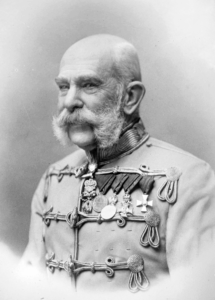
A black and white photographic portrait of Emperor Franz Joseph I in military uniform, wearing several medals and decorations, with his distinctive mutton chop whiskers and mustache.
Source: Royal Titles
The Corona Currency System
In 1892, the empire adopted the gold standard and introduced the Corona, or Krone, as its new currency, replacing the older silver based gulden. Gold coins were struck in three denominations: 10, 20, and 100 Corona, all produced by the Austrian Mint in Vienna. The 20 Corona became the workhorse of the system, the coin most people actually used and carried, with the 10 Corona also seeing wide circulation. The 100 Austrian Corona told a different story. It arrived later than its smaller siblings and circulated for a far shorter stretch, a detail that shapes much of what makes it interesting to collectors and investors today.
For the full story of how the Austrian Mint came to be, watch this video by CoinTelevision
The Austrian 100 Corona Gold Coin
The Austria 100 Corona stands apart from its smaller siblings in the Corona family, both in size and in how briefly it actually circulated.
Origins of the Largest Corona
The Austria 100 Corona gold coin was introduced in 1908 to mark the Diamond Jubilee, the 60th anniversary of Franz Joseph’s ascension to the Austrian throne. It was a fitting way to commemorate the occasion, a coin nearly an ounce in gold bearing the emperor’s own image. The design work fell to sculptor Stefan Schwartz, who created both the imperial portrait on the obverse and the double headed eagle on the reverse.
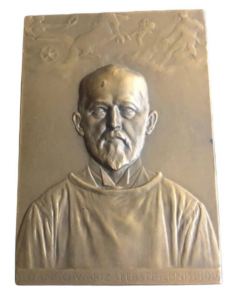
A bronze relief self-portrait plaque of sculptor Stefan Schwartz, dated 1919, showing his bust with a decorative frieze of classical figures above and his name inscribed below.
Source: Numista
Production ran from 1908 to 1914, a brief span compared to the decades the 10 and 20 Corona had already been in circulation. The outbreak of World War I brought that run to a close. On 28 June 1914, the assassination of Archduke Franz Ferdinand set off the chain of events that led to war, and gold coin production wound down across the empire as the conflict took hold, the Austrian 100 Corona gold coin included. What began as a jubilee coin became one of the shortest lived denominations in the entire Corona series.
Reading the Design
The design of the Austria gold 100 Corona has barely changed since 1908, which is part of why it reads so clearly as a product of its era.
The Obverse: Franz Joseph I
The obverse carries a profile bust of Franz Joseph, instantly recognizable by his distinctive mutton chop whiskers. Around him runs a Latin inscription listing his full imperial and royal titles, Emperor of Austria, King of Bohemia, King of Hungary, and more, a reminder of just how many territories the Habsburg crown held together.
The Reverse: The Double-Headed Eagle
The reverse is dominated by the Reichsadler, the crowned double headed eagle of the Habsburg dynasty, its wings spread wide. It holds a sword in one talon and a globe topped scepter in the other, with the national shield resting on its chest. Flanking the eagle are the numeral “100” and the abbreviation “COR” for Corona. Above the crown runs the Latin inscription “CORONÆ” paired with the date rendered in Roman numerals, “MDCCCCXV,” while the standard Arabic “1915” appears at the bottom of the coin.
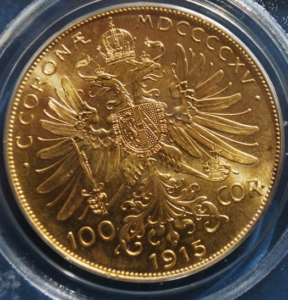
A close-up photograph of the reverse of a graded 100 Corona Austrian gold coin, showing the crowned double headed eagle holding a sword and scepter, with “CORONÆ MDCCCCXV” above and “1915” at the bottom.
Source: Numista
Specifications
The 100 Austrian Corona contains just under a full ounce of gold – 0.9802 troy ounces to be precise – struck in 0.900 fine gold, the standard purity for European coinage of the era. The coin’s total weight comes to roughly 33.88 grams, making it a substantial piece both to hold and to look at. That size is a large part of the coin’s appeal today. Investors get a near ounce of gold in a single recognizable piece, without needing to track fractional weights across smaller coins.
The 1915 Austria 100 Corona Gold Coin Mystery: Originals vs. Restrikes
Almost all Austria gold 100 Coronas in circulation today carry the same date, and that repetition is not a coincidence. It is a deliberate choice that turned one calendar year into a permanent identifier.
Why Almost Every Coin Says 1915
When the Austrian Mint resumed striking 100 Coronas decades after production had ended, it settled on 1915 as the fixed date for every coin going forward. That year happens to be the last full year of Franz Joseph’s reign before his death in 1916, though the Mint has never stated that as its reason for the choice, so it is best treated as a notable coincidence rather than a confirmed motive.
What the date does do is identify the coin as a modern restrike. Original production ended in 1914, so no genuine original carries the 1915 date. Any 1915 Austria 100 Corona coin is a restrike by definition, while coins dated 1908 to 1914 require closer inspection to confirm whether they are genuine originals or later fakes struck with an earlier date.
The Restrike Story
The modern restrike program began in the mid-1970s, entering the market as a direct rival to the South African Krugerrand. At the time, private ownership of gold bullion had only just become legal again in the United States after more than four decades of restrictions. The Corona’s historic 1915 date also allowed it to be marketed as a collectible rather than simply as a modern bullion coin, broadening its appeal during a period of renewed interest in physical gold. As newer bullion coins entered the market, the Corona’s share naturally declined, though it never disappeared.
Original Coins vs. Restrikes
Genuine originals, dated 1908 to 1914, are rare and carry substantial collector premiums. Restrikes, for their part, faithfully match the original specifications in weight, purity, and design, which is why they remain popular with bullion investors today. For collectors, however, identifying an original is an important distinction, as genuine pre-restrike coins occupy a very different place in the numismatic market.
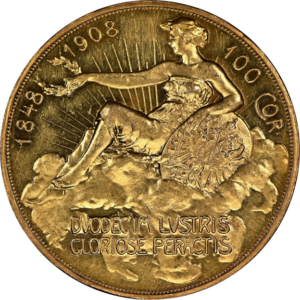
The reverse of a gold 100 Corona coin from 1908 commemorating Franz Joseph’s Diamond Jubilee, showing a reclining allegorical female figure and the dates 1848 and 1908 with a Latin inscription marking sixty years of his reign.
Source: NGC
Investing in Austrian Corona Gold
The 100 Corona’s appeal today has less to do with its imperial backstory and more to do with simple practicality. It is an efficient, recognizable way to hold one of the more accessible tangible assets available to investors.
The Bullion Appeal
Nearly a full ounce of gold in a single coin makes the Austria 100 Corona easy to value and easy to trade. Because restrikes are so widely available, premiums tend to sit close to melt value, which makes the coin an efficient form of gold ownership rather than a purely numismatic play. The historic design adds something the bare metal cannot, a tangible link to a vanished empire, and the Austrian Mint’s long standing reputation gives the coin solid liquidity in markets worldwide.
Smaller Denominations as Alternatives
For those who want the same heritage at a lower entry point, the 20 Corona offers a smaller, more affordable option, with the 10 Corona available for even smaller incremental purchases. Some collectors build across all three denominations to get a fuller picture of the series. The tradeoff is premium. Smaller coins generally carry a higher premium per gram of gold than the 100 Corona does.
Comparing to Other European Gold
The Corona sits alongside other classic European gold coins such as the French 20 Franc Rooster and the British Sovereign. Both contain substantially less gold than the 100 Corona and are popular with investors seeking smaller, more affordable units. The 100 Corona, by contrast, offers nearly a full ounce of gold, typically at competitive bullion premiums, while retaining the historical appeal of an imperial European coin.
Authentication and Buying Guidance
Buying a 100 Austrian Corona with confidence comes down to knowing whether you are looking at a restrike or an original, confirming the coin’s specifications, and purchasing from a reputable source.
Original or Restrike?
The 1915 date actually settles the question on its own. Since original production ended in 1914, any 1915 Austrian 100 Corona is a modern restrike. The harder authentication question applies to coins dated 1908 to 1914, where specialists look to strike characteristics, die varieties, surface appearance, provenance, and, where available, certification from a respected grading service to rule out later fakes struck with an earlier date.
Verifying the Specifications
Whether original or restrike, a genuine 100 Corona should closely match its published specifications: a weight of approximately 33.88 grams, a diameter of 37 mm, a fineness of .900 gold, and an actual gold weight of 0.9802 troy ounces. The portrait, double-headed eagle, and inscriptions should also be sharp and consistent with known examples.
Purchasing With Confidence
For most buyers, purchasing from an established dealer such as Blanchard is the simplest way to avoid counterfeits and overpaying. Reputable dealers clearly identify whether a coin is an original or a restrike and price it accordingly. If you are specifically seeking a genuine pre-restrike original, third-party certification from PCGS or NGC provides an additional level of confidence.
Conclusion
The Austrian 100 Corona gold coin combines nearly a full ounce of gold with one of the most recognizable designs in European coinage. Its enduring 1915 date has become synonymous with the restrike program, while the rare original issues continue to command strong collector interest. At the same time, the widely available restrikes offer investors an efficient way to own historic gold at premiums that often compare favorably with many modern bullion coins.
More than a century after its introduction, the 100 Corona continues to bridge history and bullion. Whether you’re drawn to its imperial heritage, its substantial gold content, or its reputation as a practical investment coin, it remains one of the most distinctive ways to add physical gold to a portfolio. Explore Blanchard’s selection of Austrian Mint coins to find the piece that best fits your investment and collecting goals.
FAQs
1. What is an Austrian Corona gold coin?
The Austrian Corona was the gold currency of the Austro-Hungarian Empire, issued in several denominations. The Austria 100 Corona is the largest and most popular version among investors and collectors today.
2. How much gold is in a 100 Austrian Corona?
The coin contains just under a full troy ounce of pure gold, struck in .900 fine gold. That substantial gold content is a major reason it appeals to bullion buyers.
3. Why are so many Austrian Coronas dated 1915?
The Austrian Mint fixed that year on restrikes produced long after the original run ended. It also happens to be the final full year of Emperor Franz Joseph’s reign.
4. Are Austrian Corona restrikes worth less than originals?
Restrikes typically trade close to gold melt value, while genuine originals carry collector premiums due to their scarcity. For most buyers focused on gold ownership rather than rarity, restrikes are the practical choice, and checking the current 1915 Austria 100 Corona gold coin value against live spot prices is the simplest way to know what you’re paying for.