The Coin That Captured California’s Golden Dream

When Gold Changed Everything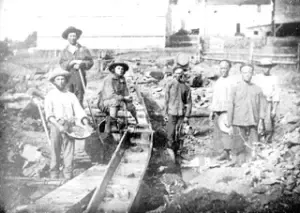
In January 1848, a carpenter named James Marshall was inspecting a sawmill under construction along the American River near Coloma, California, when he noticed something glimmering in the water.
At first, it appeared to be nothing more than a few small flakes of metal. But as word spread and the discovery was confirmed, those tiny specks would ignite one of the greatest migrations in American history.
The California Gold Rush transformed a remote frontier into the center of a global movement. Within a matter of years, hundreds of thousands of prospectors, merchants, entrepreneurs, and dreamers poured into California seeking fortune. Some arrived by wagon across the Great Plains. Others sailed around Cape Horn. Many crossed the Isthmus of Panama in hopes of reaching the gold fields faster.
Most would never strike it rich. But the promise of gold changed everything.
The population exploded. New towns appeared almost overnight. San Francisco grew from a small settlement into a booming city. Businesses flourished. Railroads expanded. California’s rapid growth ultimately helped secure its admission to the Union in 1850.
The discovery of gold did more than enrich a handful of lucky miners. It helped reshape the American West.
Seventy-Five Years Later
By 1925, California was preparing to celebrate the 75th anniversary of its statehood.
The state had changed dramatically since the days of canvas tents and muddy mining camps. Railroads connected major cities. Agriculture and industry were flourishing. Hollywood was emerging as a cultural force. Yet Californians remained proud of the event that had launched the state’s remarkable rise.
To mark the occasion, Congress authorized a commemorative half dollar honoring California’s Diamond Jubilee, celebrating seventy-five years since statehood. The coin would serve both as a souvenir and as a tribute to the pioneers whose pursuit of gold helped shape the state’s identity.
A Prospector Frozen in Time
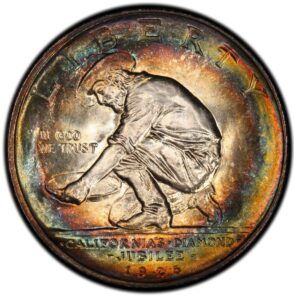
The task of designing the coin fell to sculptor Joseph Mora, often known simply as Jo Mora.
Rather than depict a governor, politician, or famous battlefield, Mora chose a more fitting symbol of California’s origins: the Forty-Niner.
The obverse features a kneeling prospector carefully panning for gold. His sleeves are rolled up. His attention is fixed on the pan before him. The image captures a moment repeated thousands of times during the Gold Rush as hopeful miners searched rivers and streams for signs of wealth.
The design honors the ordinary men and women whose determination helped build the American West.
The Bear That Became a Symbol
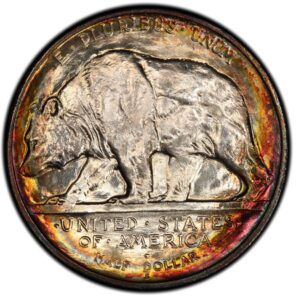
If the prospector tells the story of California’s beginnings, the reverse tells the story of its identity.
A massive grizzly bear strides confidently across the coin’s reverse. The animal had long served as a symbol of California and appeared on the state’s famous Bear Flag. Though grizzly bears had largely disappeared from California by the early twentieth century, they remained a powerful emblem of strength, independence, and frontier spirit.
Collectors have long admired the simplicity of the design.
A Celebration for the Entire State
Festivals, pageants, and public celebrations were held throughout the state to commemorate California’s Diamond Jubilee, or it’s seventy-fifth anniversary. The commemorative half dollar became a centerpiece of these festivities, giving citizens an opportunity to own a small piece of the celebration. Coins were sold for one dollar each, double their face value, with proceeds helping support the anniversary events.
The coin was struck at the San Francisco Mint, a fitting location given the city’s deep ties to the Gold Rush era. Although 300,000 pieces were authorized, only 150,000 were struck, and tens of thousands of unsold examples were eventually melted.
What survives today represents only a fraction of what was originally envisioned.
A Design Critics Nearly Killed
One of the most surprising chapters in the coin’s story occurred before it was ever struck.
Not everyone admired Jo Mora’s design. Some members of the art establishment criticized the proposed artwork and argued that a different artist should be selected. The design was even described as amateurish by one prominent reviewer. Fortunately, the committee overseeing the project stood behind Mora’s vision and moved forward with the original concept.
Today, the California Diamond Jubilee Half Dollar is frequently cited as one of the most attractive classic commemorative issues. Many collectors consider its straightforward depiction of California history to be among the strongest designs of the era.
The Enduring Appeal of the Forty-Niner
The California Gold Rush lasted only a few years, but its impact continues to shape the American imagination. Stories of prospectors crossing deserts, climbing mountains, and risking everything for a chance at discovery remain deeply woven into the nation’s history. The Gold Rush represented optimism, opportunity, and the belief that fortunes could be changed through determination and hard work.
The California Diamond Jubilee Half Dollar captures that spirit.
Its prospector reminds us of the dream that drew thousands westward. Its grizzly bear reflects the rugged independence that came to define California. Together, they tell the story of a state transformed by gold and of a nation expanding toward the Pacific.
A century after its release, the California Diamond Jubilee Half Dollar remains more than a commemorative coin. It is a tribute to one of the greatest adventures in American history.