First Day of Issue Coins: What the Label Really Means for Collectors and Investors

Third-party grading services have built a lucrative business around early release labels, and First Day of Issue is among the most recognized. The premise sounds compelling: a coin certified on the very first day it became available, presumably more exclusive than coins submitted later. In reality, the label documents something much simpler. It certifies that the coin reached the grading service within a specific timeframe following the Mint’s official release date, not when the coin was physically struck or where it fell in the production run. This guide explains what First Day of Issue coins are, how PCGS and NGC structure their programs differently, and whether the premiums these labels command are justified.
What First Day of Issue Actually Means
First Day of Issue is a label designation created by third-party grading services, not the U.S. Mint.
The Background
Early release designations emerged in the mid-2000s, when PCGS introduced its First Strike program for coins submitted within the first 30 days of a Mint release, and NGC developed equivalent programs under the names First Releases and Early Releases. The concept drew on the stamp collecting tradition of first day covers, where an envelope postmarked on the day a new stamp was issued carries a collector premium.
First Day of Issue is a stricter, narrower designation that gained prominence in the 2010s. Where First Strike and Early Releases accept any coin submitted within a 30-day window, First Day of Issue generally requires the coin to be purchased and submitted in close connection with the actual release date itself, making it the most restrictive of the early release labels. The U.S. Mint has stated explicitly that it does not track the order in which coins are produced and does not recognize early release designations of any kind.
The Basic Definition
To qualify for a First Day of Issue designation, a coin must meet the grading service’s submission and receipt requirements tied to the Mint’s official release date. The label appears on the grading holder alongside the coin’s grade and confirms only that the timing requirements were met. Two coins of identical quality struck on the same day at the same facility can end up with entirely different labels depending solely on when they were submitted for grading.
PCGS First Day of Issue Coins
The PCGS First Day of Issue designation applies to qualifying coins submitted through authorized channels within a limited period following the Mint’s official release date. Submissions typically require original Mint packaging and documentation confirming the purchase date. The program is most commonly associated with American Silver Eagles, modern commemoratives, and other high-demand annual releases.
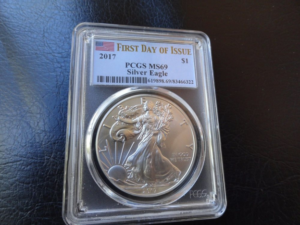
2017 American Silver Eagle graded PCGS MS-69 in a First Day of Issue holder
Source: PCGS
NGC First Day of Issue Coins
NGC First Day of Issue requires coins to be purchased within one day of the Mint’s official release date and received by NGC or an NGC-approved depository within one week of that date, accompanied by proof of purchase. The designation is primarily available through bulk submissions or select trade show submissions rather than standard individual submissions, and typically carries higher grading fees than standard certification.
For a closer look at how these designations work in practice, watch this video.
First Day of Issue Vs First Strike and Related Designations
Early release labels extend well beyond First Day of Issue. Each grading service has developed its own terminology, and the differences between them matter when assessing what a label actually certifies and what premium it justifies.
First Strike Vs First Day of Issue
First Strike is PCGS’s primary early release designation, applied to coins submitted within the first 30 days of the Mint’s official release date. It is the most widely recognized early release label in the market and appears most commonly on American Silver Eagles, Gold Buffalos, and modern commemoratives. Because the submission window is significantly broader than First Day of Issue, First Strike coins exist in far greater numbers and generally command a lower premium.
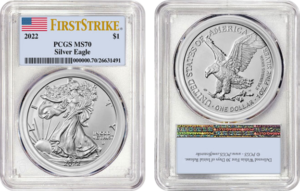
Front and back of a 2022 American Silver Eagle graded PCGS MS-70 in a First Strike holder
Source: PCGS
Early Releases and First Releases
NGC has used the terms First Releases and later Early Releases for coins received within the first 30 days of a Mint release. For practical purposes these designations are equivalent to PCGS’s First Strike in scope and market position, though the terminology has evolved over time and differs between the two services.
Other Designations
Both services have extended their label programs well beyond early release timing. PCGS issues show-specific labels for coins submitted on-site at major coin conventions, such as the FUN Show and Long Beach Expo labels, which designate where the coin was submitted rather than anything about the coin itself. NGC offers trade show First Day attributions, where a label reading “First Day – ANA,” for example, identifies a coin purchased and submitted at the ANA World’s Fair of Money on its opening day. NGC also offers Individually Numbered Strikes for coins whose production order was witnessed and documented by an authorized representative, with labels stating “First Coin Struck” or “Second Coin Struck.”
Both services additionally offer hand-signed labels for coins bearing the verified signature of a designer or Mint official. The result is a label ecosystem where a single coin series can generate dozens of distinct holder variations, each creating a separate population in the registry and a separate price tier in the market.
The American Silver Eagle Connection
No coin series has benefited more from early release label programs than the American Silver Eagle. Its predictable annual release schedule, massive collector base, and strong demand for MS-70 examples make it the natural home for First Day of Issue and First Strike designations.
Why Silver Eagles Dominate First Day Programs
Annual Release Tradition
The U.S. Mint releases new Silver Eagle dates on a predictable schedule, giving dealers and bulk submitters the opportunity to plan submissions in advance and meet the tight windows required for early release designations.
Collector Demand
The Silver Eagle is one of the most widely held modern bullion coins in the United States, with a collector base that extends well beyond traditional numismatists into precious metals investors. That broad demand creates a ready market for certified examples at every label tier.
Perfect Grade Premiums
The combination of a perfect MS-70 grade and an early release label creates the premium tier that drives the Silver Eagle certified market. A 2023 Silver Eagle MS70 First Day of Issue, for example, already commands a premium over spot value in standard certified form. Adding a First Day of Issue or First Strike designation pushes that premium higher, creating a hierarchy of labels within the same coin and year.
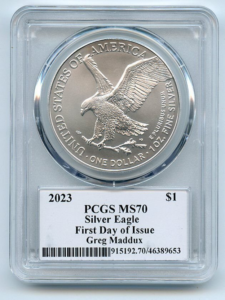
Reverse of a 2023 American Silver Eagle graded PCGS MS-70 First Day of Issue with Greg Maddux signature label
Source: PCGS
Dealer Programs
Bulk submission arrangements between major dealers and grading services are the primary mechanism through which First Day of Issue Silver Eagles reach the market. Individual collectors generally have more limited access to these designations at release compared to large bulk submitters.
Historical Examples and Case Studies
Early release designations are not purely a modern phenomenon. Looking at how first day associations have performed across different eras and series offers a clearer picture of their long-term value.
Susan B. Anthony First Day of Issue Coins
1979 Release Context
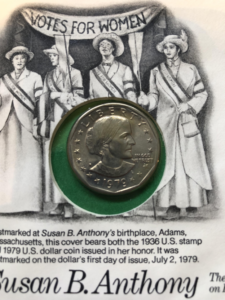
1979 Susan B. Anthony dollar first day of issue cover postmarked July 2, 1979
Source: Reddit
While modern grading-service labels did not yet exist, the release of the Susan B. Anthony dollar in 1979 demonstrated an earlier version of the same first day marketing concept. Several private enterprises produced first day covers, packaging the new coin with a commemorative envelope postmarked on release day, borrowing directly from stamp collecting culture where first day covers command lasting premiums.
For the SBA dollar, that premium never materialized. Most circulation strikes were produced in enormous quantities and held in government stockpiles for years, meaning uncirculated examples remained widely available long after the release date. Today, Susan B. Anthony ‘First Day of Issue’ value is only a few dollars, a result that underscores how little the first day association adds when supply is abundant and collector demand is shallow.
Modern Commemoratives and Presidential Dollars
First Day Programs for Special Releases
Modern commemoratives and dollar coin programs have been especially fertile ground for first day label marketing because they combine clearly defined release dates with large built-in collector audiences. Presidential dollars, Native American dollars, Innovation dollars, and State Quarters all generated extensive first day cover programs and early release certifications as new designs rolled out year after year.
At launch, these labels often carried noticeable premiums, fueled by collector enthusiasm and the appeal of owning a coin tied to a specific release date. In most cases, however, those premiums proved difficult to sustain over the long term. Presidential dollars are a particularly clear example: despite heavy promotion and widespread first day labeling, the enormous mintages ultimately limited lasting scarcity and compressed the price gap between labeled and unlabeled examples. The broader pattern across modern high-mintage series is consistent: early release labels can create short-term market excitement, but they rarely produce enduring premiums when supply remains abundant.
The Marketing vs Numismatic Value Debate
First Day of Issue and related labels exist at the intersection of genuine collector interest and deliberate revenue generation. Understanding which is driving the market at any given moment matters for anyone considering paying a premium for one.
Grading Service Business Model
Early release label programs are highly profitable for grading services for several reasons. Each designation carries its own submission requirements, additional documentation standards, and typically higher grading fees than standard certification. Bulk submission arrangements with major dealers further increase volume, creating a recurring stream of revenue tied to every major Mint release.
The growing number of label variations within a single coin series expands that revenue opportunity even further. Registry set collectors pursuing complete runs may seek multiple versions of the same coin distinguished only by label type, event attribution, or signature designation. Over time, grading services have effectively created an additional layer of demand around the holder itself, encouraging repeat submissions and new categories of collectible scarcity without altering the underlying coin.
Traditional Collector Perspective
Serious numismatists have historically prioritized the coin itself over the holder it sits in. Strike quality, surface preservation, eye appeal, date, mintmark, and genuine scarcity are the characteristics that have traditionally driven long-term value in the established coin market, and none of those qualities change based on when a coin was submitted for grading.
Registry set competition has complicated that picture to some extent, since collectors competing for top-ranked sets often seek out specific labels and designations to maximize registry points and differentiate their holdings. That demand is genuine, but relatively specialized. Outside the registry set market, the historical record for early release labels sustaining substantial long-term premiums is limited, and many traditional collectors continue to view them primarily as a modern marketing distinction rather than a meaningful numismatic one.
Making Informed Purchasing Decisions
First Day of Issue coins are the right choice in specific circumstances. Understanding when the premium is justified and when it is not saves collectors and investors from paying for something that adds no lasting value to their holdings.
When First Day Labels Make Sense
Registry Competition
Both PCGS and NGC operate online registries where collectors compete to assemble the highest-graded sets of a given coin series. Collectors pursuing top-ranked registry sets often seek matching label designations across an entire series, including First Strike or First Day of Issue coins, because consistency and scarcity can improve a set’s competitive standing and desirability. In that context, the label is not merely decorative. It serves a functional role within the registry system, and the premium reflects that collector demand rather than any intrinsic difference in the coin itself.
Personal Significance and Gift Purposes
A coin certified on the day of a birth, a national event, or a personally meaningful date carries sentimental value that has nothing to do with investment returns. For gifts or personally significant acquisitions, the First Day designation adds a layer of meaning that justifies the additional cost on its own terms.
Complete Series Goals
Collectors maintaining label consistency across a long-running series, such as annual Silver Eagles, may find it worthwhile to pay the First Day premium simply to keep their holdings uniform.
When to Skip the Premium
Bullion Stacking
For buyers focused purely on accumulating precious metal content, label premiums represent an added cost that does not increase silver or gold weight. The coin’s intrinsic value is identical to an unlabeled example of the same grade.
Limited Budgets
For collectors working within a defined budget, the premium paid for a First Day designation is money that could acquire an additional coin entirely. Maximizing the number of quality pieces in a collection generally serves long-term collecting goals better than paying for label distinctions on individual coins.
Long-term Uncertainty and Better Alternatives
The historical track record for First Day premiums holding over time is weak for high-mintage issues. Classic rarities with fixed populations, proven collector demand, and genuine scarcity offer stronger long-term investment fundamentals. For serious investors, the premium dollars spent on early release labels are often more productively deployed elsewhere in the market.
Conclusion
First Day of Issue and related early release labels occupy a genuine place in modern numismatics, and for the right collector they add real meaning to a certified coin. Understanding what they actually certify, how the programs work, and where premiums have historically held versus eroded allows buyers to make informed decisions rather than impulse ones. For registry set builders, series completionists, and collectors marking personally significant dates, the premium is often well justified. For investors and bullion buyers, the same capital frequently goes further when directed toward coins whose value rests on genuine scarcity and proven collector demand. Browse Blanchard’s precious metals selection for modern bullion coins, certified releases, and other precious metals products popular with both collectors and investors.
FAQs
1. What does First Day of Issue mean in coins?
First Day of Issue is a designation applied by third-party grading services to coins that meet specific submission and receipt requirements tied to the Mint’s official release date. It certifies when the coin arrived at the grading service, not when it was physically struck or where it fell in the production sequence.
2. Are First Day of Issue coins worth more?
First Day of Issue coins often sell for more than standard certified examples, particularly at the time of release and among collectors building registry sets or seeking specific label designations. Whether those premiums hold long term depends on the coin series, certified population, and ongoing collector demand.
3. What is the difference between First Strike and First Day of Issue
First Strike is PCGS’s designation for coins submitted within the first 30 days of a Mint release, while NGC and PCGS First Day of Issue applies to coins tied to the actual release date itself, making it the narrower of the two designations.