French Gold Coins: From Napoleon’s Empire to the Iconic 20 Franc Rooster

The Monnaie de Paris began striking coins in 864 AD, almost a millennium before America’s first mint opened. By the late 19th century, it introduced the 20 Franc gold Rooster, a coin that became one of Europe’s most trusted fractional gold pieces. French gold coinage evolved through monarchies, revolutions, and republics, but the Rooster of 1899-1914 marked a shift: a durable, mass-circulating coin intended for everyday use and for savers across continents. This article follows gold French coins from Napoleon’s reforms to the Rooster’s rise, explaining how its precise standards secured universal acceptance and lasting liquidity.
The Monnaie de Paris Legacy
The Paris Mint’s longevity shaped European coinage standards for more than a millennium.

Image: Historic courtyard of the Monnaie de Paris with neoclassical architecture and cobblestone plaza
Source: Pariscrea
Historical Significance
Founded under Charles the Bald in 864 AD, the Monnaie de Paris is one of the world’s oldest continuously operating mints. Through medieval, early modern, revolutionary, and republican eras, it struck coinage for successive regimes – from French medieval coins bearing royal insignia to revolutionary and republican issues – while steadily refining its technical capabilities. By the 18th century, it had become Europe’s foremost minting facility. Master engravers such as Augustin Dupré (whose Liberty and Hercules motifs defined the revolutionary period) and Jean-Baptiste Merlen helped establish artistic traditions that influenced coin designers across Europe.
Global Influence on Coinage
Throughout the 19th century, French minting practices became models for emerging national mints. The Monnaie de Paris pioneered steam-powered coining technology that increased speed and uniformity, innovations later adopted across Europe and the Americas. When France led the formation of the Latin Monetary Union in 1865, the union’s gold and silver standards were built directly on Paris Mint specifications. French iconography, including the Rooster and Marianne, also shaped the national symbols used on coins in many former French territories. Today, the Monnaie de Paris functions both as a commercial producer of French euro coins and commemoratives and as a custodian of twelve centuries of numismatic heritage.
The French Franc System and Gold Coinage Origins
The franc served as France’s national currency from 1795 until the euro adoption in 2002, with its gold coinage standards established during the Napoleonic era.
The Franc as National Currency: Origins and Early Development
The franc originated during the French Revolution in 1795, replacing the livre that had circulated under the monarchy. Initial French franc coins lacked standardization, with varying weights and fineness creating confusion in commerce. The successive Revolutionary governments, i.e. the Directory (1795 – 1799) and the Consulate (1799 – 1804), failed to establish consistent monetary policy, leaving France without reliable gold coinage specifications as the 18th century ended.
Napoleon’s Monetary Reforms
The Germinal Franc of 1803
Napoleon Bonaparte instituted the Germinal Franc on April 7, 1803, responding to a decade of monetary instability that had undermined public confidence in French currency. The Revolutionary period’s assignats (paper money backed by confiscated church lands) had collapsed into hyperinflation, wiping out savings and destabilizing commerce. Napoleon needed a stable monetary system to finance his military campaigns, facilitate tax collection, and legitimize his regime through economic competence. He fixed the franc’s value at 290.32 milligrams of fine gold, creating a bimetallic standard that defined both gold and French silver coins by precise weight and fineness. This reform transformed the franc from a Revolutionary experiment into a stable, internationally recognized currency that would outlast Napoleon himself.
The 20 Franc Gold Standard
The 20 Franc gold piece emerged as the cornerstone denomination, containing 5.80645 grams of fine gold at .900 fineness (6.45 grams total weight). This standardization eliminated regional variation and established specifications that would survive regime changes from Empire through Republic.
Latin Monetary Union Foundation
Napoleon’s success prompted neighboring nations to adopt similar systems. By 1865, France formalized the Latin Monetary Union with Belgium, Italy, and Switzerland, all adopting French gold specifications.
Pre-Rooster 20 Franc Gold Issues
Napoleon I Gold Francs (1803-1815)
Napoleon’s 20 Franc pieces featured his evolving portrait from First Consul through Emperor, with varying laurel wreaths reflecting his political ascent.
Restoration and July Monarchy (1814-1848)
Bourbon Restoration monarchs Louis XVIII and Charles X maintained the gold standard with their own portraits. Louis Philippe, who took power after the 1830 July Revolution and styled himself “King of the French” rather than “King of France,” became known as the “Citizen King” for his more constitutional, bourgeois approach to monarchy. His 20 Franc issues reflected this moderate image while preserving Napoleon’s gold specifications.
Second Empire (1852-1870)
Napoleon III produced extensive 20 Franc gold coinage with both laureate and bare-headed portraits, striking tens of millions of pieces that circulated throughout Europe.
The 20 Franc Gold Rooster: Icon of the Third Republic
In 1899, the Monnaie de Paris introduced a 20 Franc gold piece featuring Le Coq Gaulois, i.e. the Gallic Rooster that had symbolized France since ancient times, replacing earlier designs that had featured allegorical angels and various republican imagery.
Historical Context and Production
Third Republic Stability
The Third Republic (1870-1940) provided political stability after decades of regime changes between empires, monarchies, and republics. By the 1890s, France sought coin designs reflecting permanent republican values rather than the portraits of rulers who might be overthrown. The Rooster, as a centuries-old national emblem representing French identity and vigilance, offered an enduring symbol that transcended individual leaders – echoing the symbolism of French Revolution coins that first replaced royal imagery with republican ideals. The design’s 1899 introduction coincided with France’s Belle Époque period of cultural flourishing and economic confidence.
Watch this video to learn more about how the Gallic Rooster became France’s national symbol.
Production Volumes and Modern Availability
The Monnaie de Paris struck millions of Roosters annually between 1899 and 1914. The 1907 mintage exceeded 10 million pieces, with similar high-volume years creating substantial surviving populations. World War I halted production in 1914, but the preceding fifteen years had generated enough Roosters to supply today’s precious metals market abundantly. These high original mintages explain why century-old Roosters typically trade near bullion value rather than commanding significant numismatic premiums.
Design Elements and Symbolism
Obverse: Marianne’s Portrait
Jules-Clément Chaplain, a medallic sculptor commissioned by the Third Republic, created the obverse portrayal of Marianne in left-facing profile wearing the Phrygian cap. In ancient Rome, freed slaves wore this distinctive cap as a symbol of their liberty, and it became republican France’s emblem during the Revolution. The inscription “RÉPUBLIQUE FRANÇAISE” encircles the portrait, with Chaplain’s signature appearing at the neck truncation. Marianne personified France itself, embodying the revolutionary values of “Liberté, Égalité, Fraternité.”
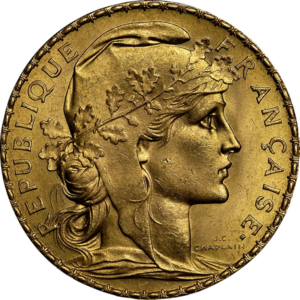
Image: Obverse of French 20 Franc gold coin showing Marianne wearing Phrygian cap with “RÉPUBLIQUE FRANÇAISE” inscription
Source: Numista
Reverse: Le Coq Gaulois
The Gallic Rooster dominates the reverse of the coin, standing in profile with one foot raised in a vigilant pose. The bird’s association with France dates to Roman times, when “Gallus” meant both “Gaul” and “rooster” in Latin. Renaissance writers reinforced this connection, and Revolutionary France adopted the rooster as an alternative to the fleur-de-lis of the deposed monarchy. On the coin, the rooster appears surrounded by the denomination “20 FRANCS” and the striking year, with a laurel branch below symbolizing victory and honor. The design projects strength and watchfulness, qualities the Third Republic wanted to associate with its currency.
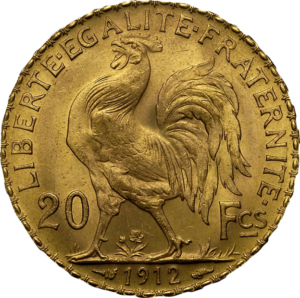
Image: Reverse of French 20 Franc gold Rooster showing Gallic Rooster in profile with “20 FCS” denomination and 1912 date
Source: Numista
Technical Specifications
Gold Content and Purity
Each 20 Franc Rooster contains exactly 0.1867 troy ounces of pure gold, achieved through .900 fineness (90% gold, 10% copper for durability). These specifications matched the Latin Monetary Union standards established decades earlier, ensuring the coins circulated freely across France, Belgium, Italy, and Switzerland without exchange complications.
Physical Characteristics
The coins measure 21mm in diameter with a reeded edge and weigh precisely 6.45 grams. This size made them practical for everyday carry and storage while containing enough gold to make them valuable French coins. The copper alloy provided hardness to resist wear during circulation, while the standard weight allowed rapid authentication by merchants and bankers using precision scales.
The French Rooster Vs. Other Latin Monetary Union Coins
The union standardized fractional gold across four nations, but French Roosters dominate modern bullion markets through higher original production.
Swiss 20 Franc Helvetia
Switzerland’s 20 Franc pieces featured Helvetia, the female personification of Switzerland, in various designs throughout the union period. These coins matched French specifications exactly: 0.1867 troy ounces at .900 fineness, 21mm diameter, 6.45 grams weight. Swiss production was substantial but never matched French volumes due to Switzerland’s smaller economy and population.
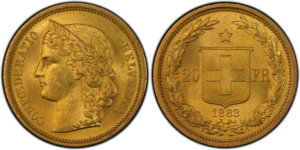
Image: Swiss 20 Franc Helvetia gold coin obverse and reverse from 1883 showing female portrait and Swiss cross shield
Source: PCGS
Italian 20 Lire
Italy struck 20 Lire gold pieces featuring King Umberto I (1879 – 1900) and later King Vittorio Emanuele III (1900 – 1943). These coins contained equivalent gold content to French 20 Francs and circulated under identical Latin Monetary Union standards, though production focused primarily on domestic Italian markets.
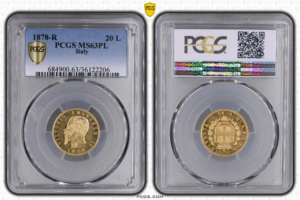
Image: Italian 20 Lire gold coin from 1878-R graded PCGS MS63PL showing King Umberto I portrait and Italian shield
Source: PCGS
Belgian 20 Franc
Belgium produced 20 Franc pieces with King Leopold II’s portrait, maintaining complete standardization with other union members. Belgian mintages remained modest compared to France, reflecting the country’s smaller economic scale within the union.
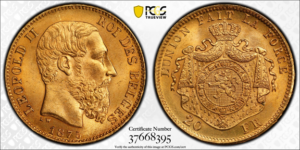
Image: Belgian 20 Franc gold coin from 1875 showing King Leopold II portrait and Belgian coat of arms with crown
Source: PCGS
Why Roosters Dominate Modern Markets
Production Volume Disparity
France’s larger economy and extensive colonial empire required massive gold coinage production. Annual French mintages regularly exceeded 10 million pieces during peak years (1899-1914), while other union members produced significantly fewer coins. This production gap created today’s market reality where French Roosters comprise the vast majority of available Latin Monetary Union fractional gold.
Market Recognition and Liquidity
Precious metals dealers worldwide recognize French Roosters immediately and price them competitively near spot gold value. Swiss Helvetias maintain similar recognition but appear less frequently in dealer inventories. Italian and Belgian pieces, despite containing identical gold content, remain scarce in international bullion markets and may require additional dealer verification due to lower familiarity among buyers – identifying old French coins from smaller union members often requires specialized numismatic knowledge.
Other Notable French Gold Coinage
Beyond the ubiquitous Rooster, French gold coinage includes higher and lower denominations plus earlier republican designs that appeal to numismatic collectors.
Napoleon Gold French Coins (Various Denominations)
40 Franc Gold Pieces
France struck 40 Franc gold coins during both empires under Napoleon I and Napoleon III. These larger pieces contained double the gold of 20 Franc coins (0.3734 troy ounces) and featured imperial portraits with laureate designs. Limited production makes them scarcer than 20 Franc pieces.
10 Franc Gold
The 10 Franc gold piece contained 0.0933 troy ounces of .900 fine gold, serving smaller transactions. Napoleon I through Third Republic governments struck these coins with designs paralleling their 20 Franc counterparts.
Collector Premiums
Napoleon-era French gold coins often command numismatic premiums above bullion value due to lower surviving populations and historical appeal, particularly First Empire pieces bearing Napoleon I’s image.
Angels and Other Pre-Rooster Designs
“Angel” 20 Francs (1871-1898)
Before 1899, the Third Republic struck “Angel” 20 Franc pieces featuring a standing guardian angel writing the French constitution. Designer Augustin Dupré created this allegorical design representing republican values. Angels circulated for nearly three decades before the Rooster replaced them.
Earlier Allegorical Issues
Ceres Head 20 Francs depicted the Roman agricultural goddess during the Second Republic (1848-1852). Various Liberty Head designs appeared across different regimes, each commissioning new allegorical representations while maintaining Napoleon’s gold specifications.
Scarcity Considerations
Pre-Rooster designs command higher premiums than Roosters due to lower original mintages. Angel 20 Francs trade above bullion value in better grades, while Ceres issues remain genuinely scarce.
French Gold Coins: Practical Collecting and Investment Guide
French gold coins offer multiple entry points depending on whether collectors prioritize bullion value or numismatic interest.
Starting a French Gold Collection
Entry Point Strategy
Common-date Roosters (1899-1914) provide the most affordable entry into French gold ownership, typically trading within small premiums over spot gold prices. High original mintages mean these French coins remain readily available through established precious metals dealers.
Authentication and Storage
Verifying authenticity of old French coins through weight testing (6.45 grams exact) and dealer certification protects against counterfeits before expanding holdings. Proper storage in individual capsules prevents surface damage and maintains resale value.
Building Beyond Basic Roosters
Type Collection Approach
Collectors can acquire representative examples from different French political eras: First Empire Napoleon I, Restoration monarchs, Second Empire Napoleon III, and Third Republic designs. This approach creates historical breadth without requiring rare French coins or uncommon dates.
Specialized Focus Areas
Some collectors concentrate on Napoleon-era pieces exclusively, accepting higher premiums for First and Second Empire coins. Others pursue pre-Rooster allegorical designs like Angels or Ceres heads, which command numismatic interest beyond gold content.
Market Timing and Acquisition
Gold Price Correlation
French gold coin premiums fluctuate with spot gold prices. During high gold markets, Roosters may trade closer to melt value as investors focus on gold content rather than numismatic factors.
Dealer Selection and Liquidity
Established precious metals dealers like Blanchard offer authenticated French gold with transparent pricing. Bulk purchases of common Roosters often reduce per-coin premiums, while maintaining liquidity for future resale.
Conclusion
French 20 Franc gold Roosters represent over a century of proven fractional gold coinage, combining 0.1867 troy ounces of .900 fine gold with historical significance rooted in Napoleon’s monetary reforms and the Latin Monetary Union’s standardization. These coins offer accessible fractional gold ownership with minimal premiums over melt value, backed by universal market recognition across international precious metals markets. High original mintages ensure ready availability, while their Belle Époque origins and iconic Gallic Rooster design provide historical appeal beyond pure bullion value. Explore Blanchard’s selection of authentic French 20 Franc gold Roosters and other French gold coins for sale to add historically significant fractional gold pieces to your precious metals portfolio.
FAQs
1. What are French coins called?
French coins were called francs from 1795 until France adopted the euro in 2002.
2. Are French franc coins worth anything?
French coins value comes mainly from their gold or silver content. Most base-metal and common-date silver francs carry little value beyond interest from collectors of scarce issues.
3. What is the 20 Franc gold Rooster coin?
The 20 Franc gold Rooster is a French coin struck between 1899 and 1914 featuring the Gallic Rooster on the reverse and Marianne on the obverse.
4. How much gold is in a French 20 Franc coin?
Each 20 Franc coin contains just under one-fifth of a troy ounce of pure gold at 90% fineness, making it a practical fractional gold piece.
5. What French coins are valuable?
French gold coins, particularly Napoleon-era pieces and pre-Rooster Third Republic designs, command the highest values, while common Rooster 20 Francs trade near their gold melt value.