Gold Coins vs Gold Bars: What Each Costs and Why

Gold coins vs gold bars is a choice between two packages for the same metal. A one-ounce American Gold Eagle and a one-ounce bar each hold a troy ounce of gold. What differs is how much you pay above that gold, how easily the piece can be sold, and how hard it is to fake.
Bullion coins are struck by government mints and most carry a face value. Bars come from refiners and some government mints, in sizes from a single gram to the 400-ounce bars that banks trade. This guide explains how the modern bullion coin came about, what each form cost at one dealer on a single trading day, and what to check before buying either. It covers bullion; older U.S. gold coins that carry a collector premium have their own guide to pre-1933 gold coins.
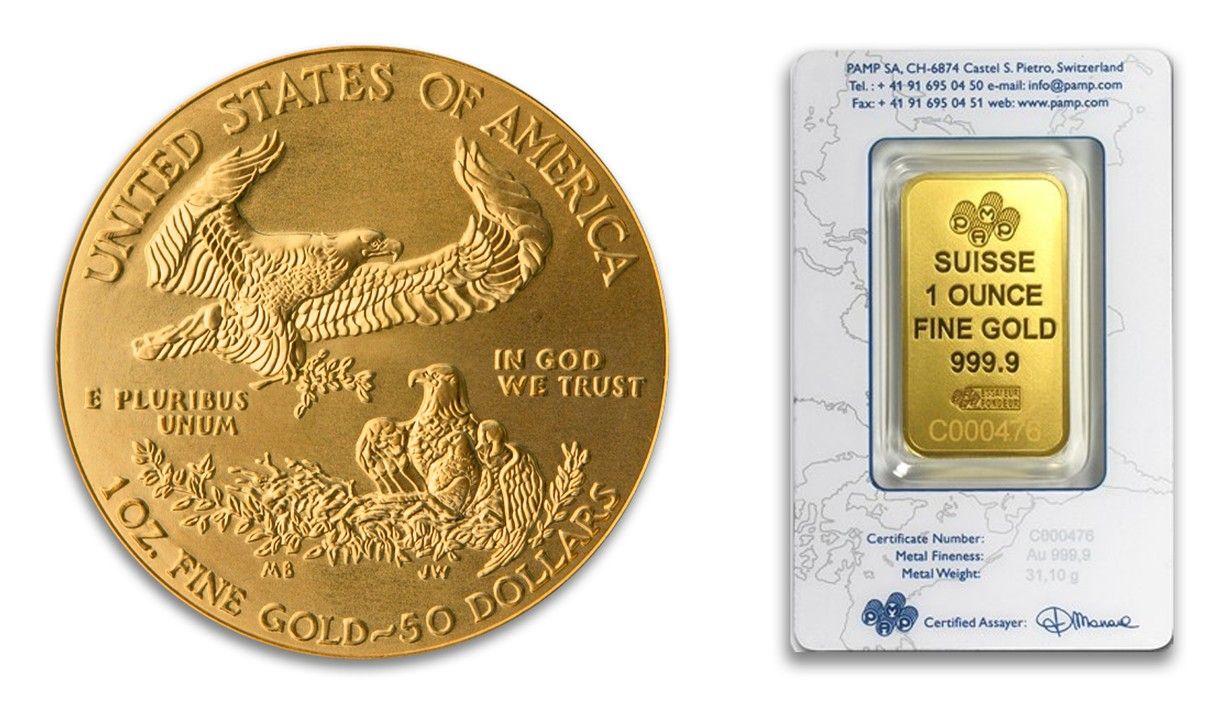
- On November 12, 2026, Blanchard’s cash prices ran from 2.7% over gold value (1-ounce Maple Leaf, Krugerrand, 100-gram bar) to 30.3% (1-gram bar).
- Size moved the premium most: a tenth-ounce Gold Eagle cost 19.8% over its gold, a 1-ounce Eagle 5.1%.
- At similar weights, bars cost less: a 20-gram bar ran 5.1%, a half-ounce Eagle 11.3%.
- A 22-karat Gold Eagle and a 24-karat Maple Leaf each contain one troy ounce of gold.
- Counterfeiters have filled real bar shells with tungsten, which is as dense as gold.
What’s the Difference Between Gold Coins and Gold Bars?
A gold bullion coin is struck by a national mint to sell for its gold content plus a premium. The best known are the U.S. Mint’s American Gold Eagle, Canada’s Gold Maple Leaf, and South Africa’s Krugerrand. Each states its gold content on the coin.
Most government bullion coins also carry a face value far below their gold value. The one-ounce Eagle is a $50 coin, and the Maple Leaf a 50-dollar Canadian coin; the Krugerrand has no face value at all.
A gold bar is refined gold sold by weight. Retail bars come from refiners such as PAMP and Valcambi, both in Switzerland, and from some government mints, in sizes that start at 1 gram and include 1-kilogram bars of 32.15 troy ounces. A bar has no face value. The maker stamps its name, the weight, and the fineness on the metal, often with a serial number.
22 Karat or 24 Karat, It’s Still an Ounce
A one-ounce coin and a one-ounce bar contain the same gold even when the coin weighs more. The Gold Eagle and the Krugerrand are 22-karat gold, about 91.67% pure, and the rest is alloy. By law the one-ounce Eagle weighs 33.931 grams and contains one troy ounce of fine gold, 31.10 grams: 33.931 × 0.9167 = 31.10.
The Maple Leaf, the American Buffalo, and most bars are 24-karat gold, .9999 fine, so a one-ounce piece weighs about 31.1 grams.
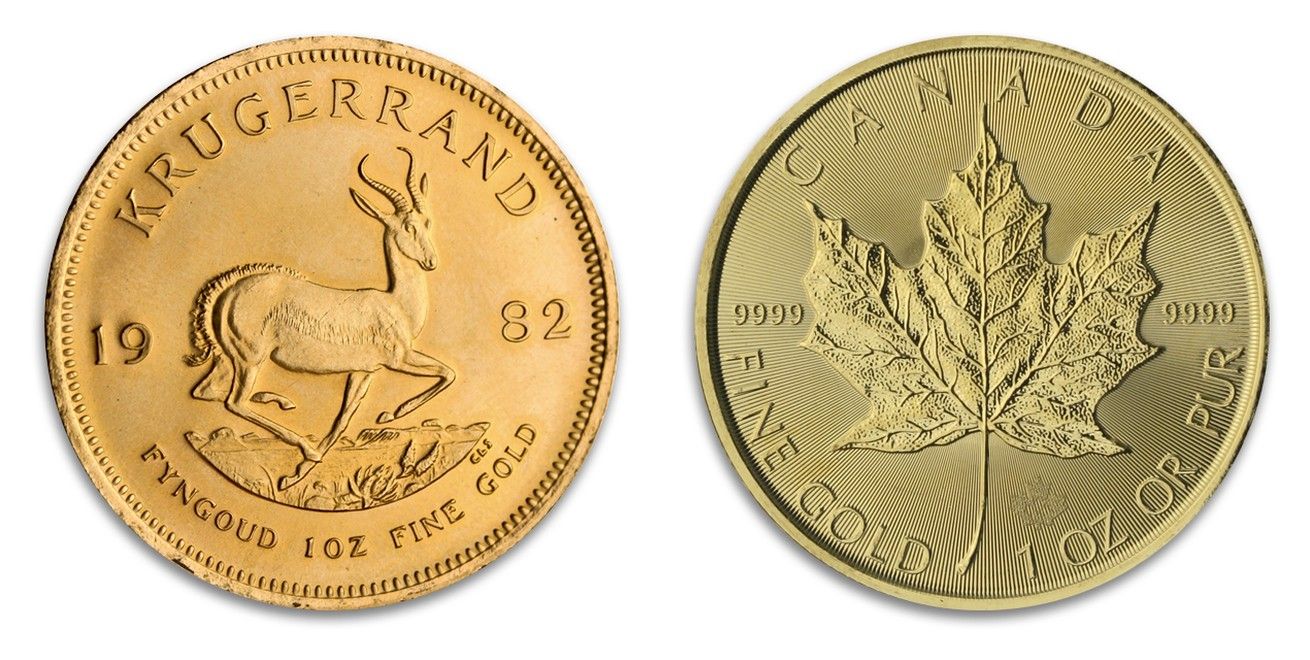
Purity shows in the color. The London Bullion Market Association (LBMA) attributes the Krugerrand’s reddish tinge to the copper in its alloy.
The 400-Ounce Bars Behind the Market
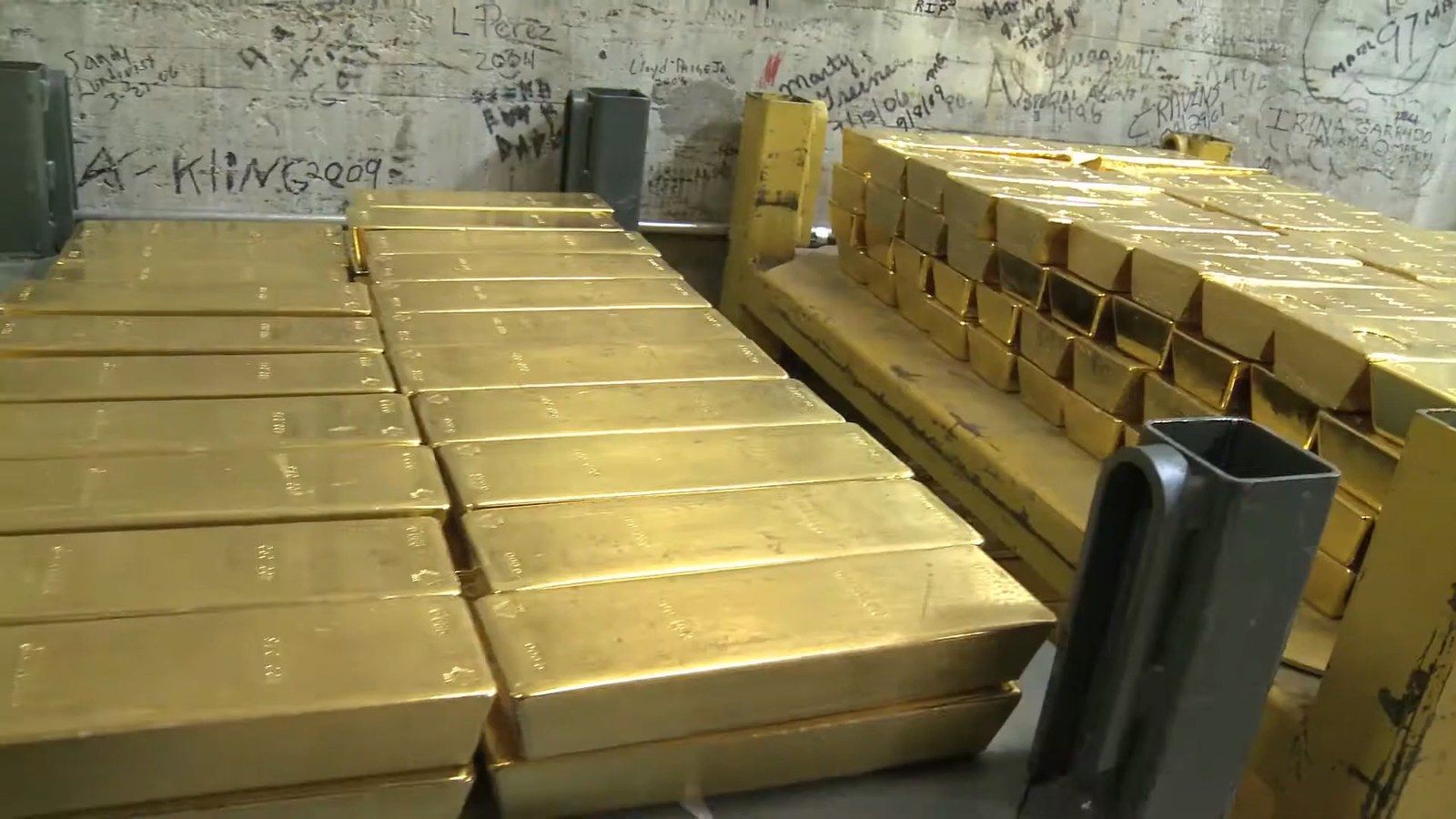
The bars that settle the wholesale market are far larger than anything sold at retail. Under the LBMA’s Good Delivery rules, a standard gold bar holds between 350 and 430 fine troy ounces at a minimum fineness of 995.0 parts per thousand. Each carries a serial number, the refiner’s stamp, its fineness, and, on bars made since January 2019, the year and month of manufacture.
The LBMA puts the typical bar at “approximately 400 troy ounces.” Small bars fall outside the Good Delivery rules, even when they come from the same accredited refiners.
How the Modern Gold Bullion Coin Came to Be
In 1934 the United States turned its gold coins into bars. The Gold Reserve Act declared that “no gold shall hereafter be coined” and ordered the nation’s gold coin withdrawn from circulation and “formed into bars.” Private ownership of gold bullion stayed restricted until a 1974 law restored Americans’ right to buy, hold, and sell gold, effective December 31, 1974.
South Africa already had a coin built for the purpose. The Chamber of Mines of South Africa wanted, in the LBMA’s words, “to encourage the ‘man-in-the-street’ to invest in gold,” and its Krugerrand contained exactly one ounce of fine gold with no face value.
After proof issues in 1967-1969, the Krugerrand went into mass production in 1970, and in 1978 alone South Africa issued 6,012,293 of them. The LBMA calls it “the world’s most successful gold bullion coin.”
Canada followed in 1979 with the Gold Maple Leaf, which the Royal Canadian Mint says became the first bullion coin struck to .9999 purity.
“Postal Gold”: The Medallions That Weren’t Money
The U.S. government’s own entry came from Congress. The American Arts Gold Medallion Act, signed November 10, 1978, ordered the Mint to strike one-ounce and half-ounce medallions of 90% gold honoring American artists. They were to be “sold to the general public at a competitive price equal to the free market value of the gold contained therein plus the cost of manufacture.” The Treasury stated plainly that the medallions “will not be legal tender.”
Buying one took some effort. A buyer picked up an order form at a post office, called a toll-free number for that day’s price, and could order no more than three of each size. Sales of the first issue opened on July 15, 1980. Of the 500,000 one-ounce Grant Wood medallions struck for 1980, about 299,000 sold; the 1981 one-ounce issue sold about 87,000.
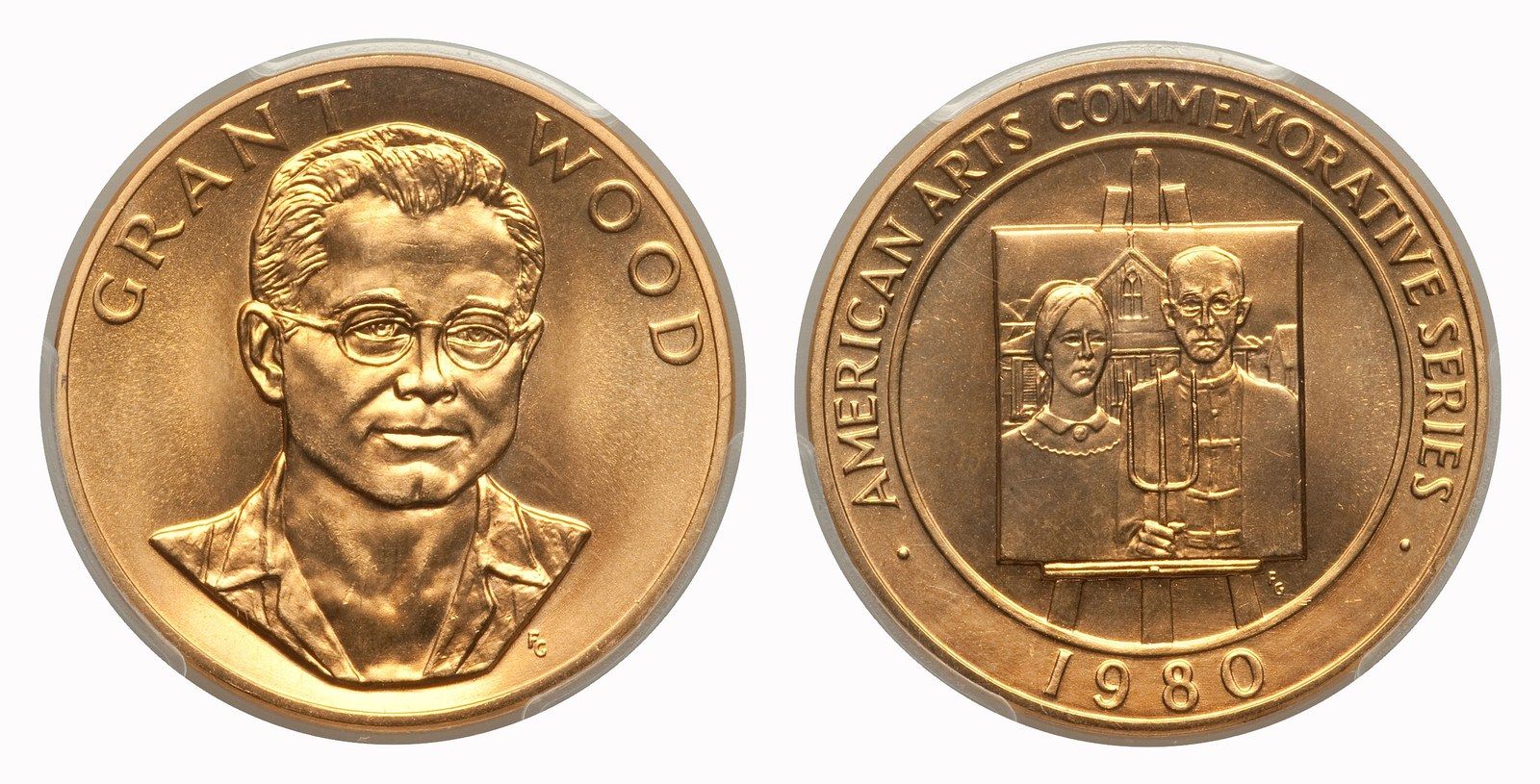
In 1982 the Mint handed marketing to J. Aron & Company, which sold the medallions through banks, brokerage houses, and coin shops at prices the Mint called “competitive with those charged for Krugerrands and other foreign gold coins.” The last medallions were dated 1984.
1985-1986: A Ban and a New Coin
On October 1, 1985, as part of economic sanctions on South Africa, President Ronald Reagan banned imports of Krugerrands into the United States, effective October 11. The ban stayed in place until July 1991.
Eleven weeks after the order, on December 17, 1985, the Gold Bullion Coin Act created the American Eagle: legal tender gold coins of one, one-half, one-quarter, and one-tenth troy ounce, with face values of $50, $25, $10, and $5. The law prices them at “the market value of the bullion at the time of sale,” plus the cost of minting, marketing, and distributing them, and barred sales before October 1, 1986.
On September 8, 1986, Treasury Secretary James A. Baker III pushed the button for the ceremonial first strike of the one-ounce Eagle at the West Point Bullion Depository. In 2006 the U.S. Mint added the American Buffalo, struck in 24-karat gold.
The medallions held real gold, yet they lacked legal tender status and were sold on order forms through the Postal Service. The Eagle that followed is legal tender, states its gold content on the coin as the law requires, and reaches buyers through dealers.
Why Gold Coins Usually Cost More Than Gold Bars
The premium is what a buyer pays above the value of the gold, and for coins it starts at the mint. The U.S. Mint does not sell bullion Eagles to the public. It sells them to authorized purchasers, with a minimum order of 1,000 ounces, at 3% over the gold price for the one-ounce coin and 9% for the tenth-ounce coin, Coin World reported in January 2026. Every dealer after that adds a margin.
Blanchard’s posted prices on the morning of November 12, 2026 show how the gap played out at retail. Gold stood at $3,885.20 an ounce at 8:13 a.m. Central.
| Product | Issuer | Fineness | Face value | Over gold value |
|---|---|---|---|---|
| Gold Maple Leaf, 1 oz | Royal Canadian Mint | .9999 | 50 Canadian dollars | 2.7% |
| Krugerrand, 1 oz | South African Mint | .9167 (22 karat) | none | 2.7% |
| American Gold Eagle, 1 oz | U.S. Mint | .9167 (22 karat) | $50 | 5.1% |
| American Gold Buffalo, 1 oz | U.S. Mint | .9999 | $50 | 6.4% |
| Valcambi CombiBar, 1 oz (ten 1/10 oz pieces) | Valcambi | .9999 | none | 6.6% |
| Gold bar, 100 grams (3.215 oz) | refiners vary | .9999 | none | 2.7% |
Three patterns stand out.
Size matters most. A 1-gram bar cost 30.3% over its gold and a tenth-ounce Eagle 19.8%, against 2.7% for a 100-gram bar.
At similar weights, bars cost less than Eagles. A 20-gram bar, about two-thirds of an ounce, ran 5.1% over its gold; a half-ounce Eagle ran 11.3%. The Valcambi CombiBar, which snaps apart into ten tenth-ounce pieces, cost 6.6%, while ten separate tenth-ounce Eagles would have cost 19.8%.
Coins differ among themselves. The one-ounce Maple Leaf and Krugerrand matched the 100-gram bar at 2.7%, about half the Eagle’s premium.
So the familiar rule that bars cost less holds best when the weights match and the bars are large. These are one morning’s prices, and premiums move with supply and demand.
Gold Coins vs Gold Bars: The Case For and Against Each
Collectors and investors who buy gold weigh the same handful of factors. Which way they lean depends on how much gold they want and how they expect to sell it.
What Draws Buyers to Coins
- Recognition. The Eagle, Maple Leaf, and Krugerrand are struck by government mints to published standards, and each states its gold content on the coin.
- Legal tender status. The Eagle, Buffalo, and Maple Leaf are legal tender, with their weight and gold content set by their governments.
- Smaller sizes. Fractional coins let a buyer own or sell gold in tenth-ounce steps, at a higher premium per ounce.
- Security features. The Royal Canadian Mint micro-engraves a security mark on every Gold Maple Leaf die and records it, and dealers registered with its Bullion DNA system can authenticate coins dated 2014 and later.
What Draws Buyers to Bars
- Lower premiums at size. In the November 2026 snapshot, a 100-gram bar cost 2.7% over its gold and a 50-gram bar 3.4%.
- Compact storage. Bars are flat and stack, and a kilo bar holds 32.15 ounces in one piece.
- Paperwork. Refiners such as PAMP sell small bars, including the 1-ounce gold bar, sealed in an assay card printed with the bar’s serial number, fineness, and weight.
The Tradeoffs
- Premiums and spreads. Every form costs more than its gold, and dealers buy back for less than they sell. Both gaps have to be made up before a holding shows a gain.
- All or nothing. A 10-ounce bar has to be sold whole; ten one-ounce coins can be sold one at a time.
- Testing on resale. A bar out of its sealed card, or from an unfamiliar maker, may need testing before a dealer will quote a firm price.
- Storage and insurance. Both forms need secure storage and insurance, and neither pays interest or dividends.
- Taxes. How a sale is taxed and reported depends on the product and your circumstances; consult a tax professional.
Silver buyers face the same choice, with rounds as a third option; the guide to silver rounds, bars, and coins covers it.
How to Buy Gold Coins or Bars Without Getting Burned
- Price it per ounce. Divide the price by the piece’s gold content and compare the result with the day’s gold price. For a 1-gram bar, divide by 0.03215.
- Stick to recognized products. Government-mint coins, and bars from established refiners in sealed assay packaging, are the easiest to verify. On a bar, check that the serial number matches the one on its card.
- Know how fakes are made. In 2012 a Manhattan jeweler drilled into 10-ounce gold bars he had bought and found them “filled with gray tungsten,” NBC News reported. Tungsten is as dense as gold (19.3 grams per cubic centimeter for both, per the Royal Society of Chemistry), so a filled bar can match a real one’s size and weight. Coins are counterfeited too, which is why the Royal Canadian Mint built its Bullion DNA anti-counterfeiting system.
- Ask for the buy price, too. The difference between what a dealer charges and what it pays back is part of the cost of owning gold.
- Never buy gold on a stranger’s instructions. The FBI has warned of scammers who pose as tech support or government officials, tell victims to turn their savings into gold, and send couriers to collect it; losses topped $55 million from May to December 2023. In the FBI’s words, “The US Government and legitimate businesses will never request you purchase gold or other precious metals.” This account of how gold bar scams unfold shows the warning signs.
Because a coin or bar is only worth its gold if it is genuine, buying sealed, recognized products from an established dealer is the practical safeguard. Blanchard carries gold bullion coins from the U.S. Mint and other government mints, along with bars from refiners such as PAMP and Valcambi.
Frequently Asked Questions
1. Is it better to buy gold coins or gold bars?
Neither is better for every buyer. In a November 2026 price snapshot, bars cost less per ounce than Gold Eagles of similar weight, and large bars carried the lowest premiums. Recognized bullion coins come in smaller sizes, are legal tender, and can be sold one at a time, so collectors and investors weigh price per ounce against how they expect to sell.
2. Why are gold coins more expensive than gold bars?
Part of the difference starts at the mint: the U.S. Mint charges its authorized purchasers 3% over the gold price for a one-ounce Eagle and 9% for a tenth-ounce Eagle, before any dealer’s margin. On November 12, 2026, a one-ounce Eagle cost 5.1% over its gold at Blanchard’s cash price, and a 100-gram bar 2.7%.
3. Does a 22-karat Gold Eagle contain less gold than a 24-karat coin?
No. A one-ounce Gold Eagle contains one troy ounce of fine gold, the same as a one-ounce Maple Leaf or Buffalo. The Eagle is 91.67% gold, so it weighs more: 33.931 grams, against about 31.1 grams for a 24-karat coin.
4. Are gold bars a good investment?
Gold bars are a low-premium way to own gold by weight in larger sizes, and their value rises and falls with the gold price. Collectors and investors weigh that against storage, insurance, dealer spreads, and the need to sell a bar whole. No form of gold comes with a guaranteed return.
5. What are the disadvantages of gold coins?
The main one is cost. In a November 2026 price snapshot, Gold Eagles cost more over their gold than bars of similar weight, and a tenth-ounce Eagle cost 19.8%. Coins also need secure storage, and like bars, they can be counterfeited.
Conclusion
Gold coins and gold bars hold the same metal. The difference is the premium, which climbs as the piece gets smaller, and the convenience: coins sell one at a time and carry a government’s stamp, while larger bars put the most gold in one piece for the least premium.
Weighing coins against bars for your holdings? Contact Blanchard’s precious metals team to talk through sizes and premiums with a specialist, or compare gold bars by price per ounce.
Want to read more? Subscribe to the Blanchard Newsletter and get our tales from the vault, our favorite stories from around the world and the latest tangible assets news delivered to your inbox weekly.