Mexican 50 Peso Gold Coin: Minted for Independence and Cherished by Collectors

The 50 peso gold coin contains more gold than an American Eagle or Canadian Maple Leaf. This makes it one of the most substantial bullion coins available to collectors and investors. Known as the Centenario, this historic piece has been a staple of the precious metals market since 1921. Originally created as a commemorative issue for the centennial of Mexican independence, the 50 peso later evolved into a modern bullion standard, with production spanning multiple eras and restrike periods. This guide examines the coin’s gold content and design significance, its dating conventions, factors affecting authenticity and value, and what to consider when buying Mexican 50 peso gold coins.
What Is the Mexican 50 Peso Gold Coin?
The 50 pesos gold coin combines commemorative origins with practical investment appeal, making it distinct from purely investment-focused modern coins.
The Centenario Name
The Centenario name comes from the coin’s commemorative purpose: celebrating 100 years of Mexican independence. Mexico first struck it in 1921 to mark the centennial of independence from Spain in 1821.
Historical Context and Production
Production of the 50 peso gold coin began in 1921 and continued through 1931, covering its original commemorative purpose and early minting period. After a pause during the 1930s and early 1940s, the Mexican Mint resumed striking the coin from 1943 to 1947.
What truly defines the Centenario’s long-term role, however, is the restrike era that followed. After 1947, Mexico continued producing large quantities of coins all bearing the 1947 date, even though many were minted decades later. These restrikes were not made for circulation or for commemorative use – they were produced specifically to meet global demand for investment gold.
This shift in purpose effectively transformed the Centenario into a bullion coin. Its substantial gold content, international availability, and decades of restrike production allowed it to function similarly to later bullion standards such as the Krugerrand or Maple Leaf. As a result, the 50 peso gold coin became recognized worldwide not just as a historic commemorative issue, but as a practical and widely traded form of gold bullion.
Physical Specifications
The specifications of the gold 50 peso coin make it instantly recognizable and substantial. It weighs 41.666 grams total, containing 37.5 grams of pure gold, equivalent to 1.2057 troy ounces. The purity stands at .900 fine: 90% gold alloyed with 10% copper for durability. At 37 millimeters in diameter and 2.65 millimeters thick, the Centenario exceeds most modern one-ounce bullion coins in size. The edge features traditional reeding for security and authentication purposes.
For a collector’s perspective on what makes this coin special, watch this video from the Long Beach Expo.
The Iconic Design: Winged Victory and Independence
The Centenario’s design, created by engraver Emilio del Moral, combines Mexican symbolism with artistic beauty that has made it one of the world’s most recognizable gold coins.
Obverse: Winged Victory
The obverse of the 50 peso Mexican gold coin features El Ángel de la Independencia, i.e. the Angel of Independence, standing front-facing with a laurel wreath raised in her right hand and broken chains in her left. These symbols represent victory and freedom from colonial rule. The figure mirrors Mexico City’s famous Independence Monument, a landmark honoring the nation’s struggle for liberty. In the background, the twin volcanoes Popocatépetl and Iztaccíhuatl frame the scene, grounding the design in Mexican geography and Aztec legend. The coin displays “50 PESOS” and “37.5 Gr ORO PURO” alongside the dates 1821 and the year of issue.
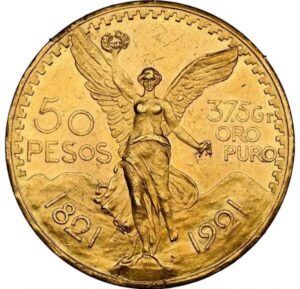
Image: Obverse of 1921 Mexican 50 peso gold coin showing Winged Victory standing before twin volcanoes, with “50 PESOS” on left, “37.5 Gr ORO PURO” on right, dates “1821” and “1921” at bottom.
Source: NGC PhotoVision – NGCcoin.com (via Heritage Auctions, HA.com)
Reverse: National Coat of Arms
The reverse displays Mexico’s coat of arms: a golden eagle perched on a cactus, gripping a snake in its beak. This image draws from Aztec mythology, symbolizing the prophecy that led to the founding of Tenochtitlán, which became Mexico City. The inscription “ESTADOS UNIDOS MEXICANOS” encircles the design, while the coin’s edge bears “INDEPENDENCIA Y LIBERTAD.”
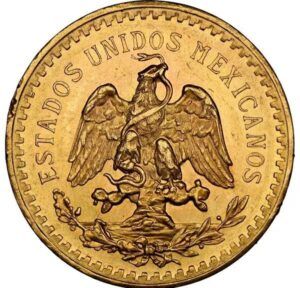
Image: Reverse of 1921 Mexican 50 peso gold coin displaying Mexican coat of arms with eagle perched on cactus gripping snake, surrounded by “ESTADOS UNIDOS MEXICANOS” inscription and laurel wreath.
Source: NGC PhotoVision – NGCcoin.com (via Heritage Auctions, HA.com)
Understanding the Date Mystery: 1947 Restrikes
The Centenario’s production history creates one of numismatics’ most interesting dating puzzles, where a single year appears on millions of coins struck across multiple decades.
Original Production Periods
The 50 peso gold coin was first minted in 1921 and continued annually through 1931, with most years producing between 500,000 and 700,000 coins. The highest mintage came in 1925 with 716,000 pieces. As mentioned previously, production halted during the 1930s depression and early 1940s wartime years. When minting resumed in 1943, it continued through 1947 before the final dated issue was struck.
Why Mexico Froze the 1947 Date
In 1949, Mexico began producing the coins again, but with a crucial difference: every 50 peso coin bore the date 1947 regardless of actual production year. This practice continued through 1972, producing approximately 4 million coins all dated 1947.
The frozen date served practical purposes. Mexico didn’t need to commission new dies for what had become a bullion product rather than a commemorative issue. Some numismatists also suggest the pre-1948 date allowed sales into the American market, where gold coin ownership remained restricted to pre-1933 dates until 1974.
Restrike Production Continues
The 1947 restrikes didn’t end in 1972. After a pause of more than two decades, Mexico resumed production in 1996 with a massive restrike of nearly 8 million coins, all still dated 1947. Production continued sporadically, with several hundred thousand more pieces struck between 2000 and the early 2010s. These modern restrikes often display a distinctive matte or burnished finish that differs from the original mint luster of earlier coins, making them sometimes identifiable as later production. However, the date on every single one remains 1947.
Can You Tell Restrikes from Originals?
For coins dated 1947, distinguishing an original from a restrike is essentially impossible. Even NGC, a major grading service, states there’s “no way to tell an original 1947 from a restrike” and labels all 1947 coins as restrikes. Only the modern restrikes from 1996 onward sometimes show telltale surface characteristics, i.e. a more polished, burnished appearance compared to the original mint luster. Coins dated before 1947 avoid this ambiguity entirely, as restrikes only used the 1947 date.
Pre-1947 Dates: Genuine Vintage
Any Centenario dated 1921 through 1946 is an original strike from that year. These dates carry numismatic premiums beyond gold content, particularly the lowest mintage years. The 1943 50 peso gold coin was the series’ lowest mintage with just 89,000 coins and features a unique design variation with double “37.5 Gr Oro Puro” markings and no denomination. The 1931 produced 137,000 pieces, and some examples show a 1931/0 overdate that commands additional premium. The inaugural 1921 issue had a relatively modest 180,000 mintage and typically sells for the highest premiums of any date.
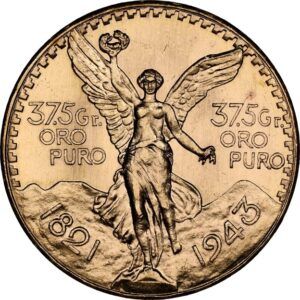
Image: 1943 Mexican 50 peso gold coin obverse showing unique double “37.5 Gr ORO PURO” markings on both sides of Winged Victory, with dates “1821” and “1943” at bottom.
Source: NGC
Collector vs. Bullion Perspective
For serious collectors, pre-1947 dates offer the appeal of documented rarity and vintage status. These coins trade at premiums reflecting both gold content and numismatic value. For bullion buyers, 1947-dated restrikes provide the same 1.2057 ounces of gold at lower premiums, making them the practical choice. The market treats all 1947 coins as restrikes regardless of actual production year, pricing them close to melt value with only modest dealer spreads.
Valuing the 50 Peso Gold Coin
50 peso gold coin value today stems primarily from the coin’s substantial gold content, with numismatic factors adding premiums for certain dates and conditions.
50 Peso Gold Coin Melt Value as the Foundation
At 1.2057 troy ounces of pure gold, the coin’s intrinsic value tracks directly with gold spot prices. This gold content establishes the minimum value floor, i.e. what the Centenario coin would be worth if melted down. Daily fluctuations in precious metals markets affect the baseline value of every Centenario regardless of date or condition.
Premium Structure
Common 1947 gold 50 peso coin restrikes typically trade at modest premiums above their gold content, reflecting their bullion status. Pre-1947 dates command higher premiums, particularly low-mintage years like 1921, 1931, and 1943. Condition significantly affects premium levels – higher-grade examples in mint state can justify substantially larger spreads.
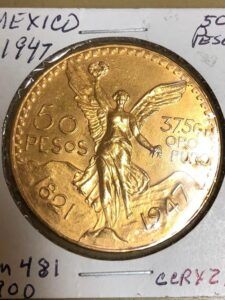
Image: 1947 50 peso gold coin obverse showing standard design with “50 PESOS” on left, “37.5 Gr ORO PURO” on right, Winged Victory center, dates “1821” and “1947” at bottom.
Source: Reddit
How to Spot a Fake 50 Peso Gold Coin
Counterfeit Centenarios exist in the marketplace, making authentication knowledge essential for buyers.
50 Peso Gold Coin Weight and Dimensions
An authentic Mexican 50 peso gold coin weighs exactly 41.666 grams. This precise specification provides the easiest first test, as counterfeiters struggle to match the weight of the .900 gold and copper alloy. Verify dimensions with calipers: 37 millimeters in diameter and 2.65 millimeters thick. Deviations from these measurements indicate a fake.
Visual and Physical Tests
Examine design details closely: genuine coins show crisp, sharp features on Winged Victory and the coat of arms. Check edge reeding for consistency and proper depth. The color should reflect the distinctive rose-gold tone of 90% gold alloyed with copper. A simple magnet test eliminates obvious fakes, as gold isn’t magnetic. The “ping” test (striking the coin gently and listening for the clear ring of precious metal) can help distinguish genuine gold from base metal counterfeits.
Professional Authentication
For significant purchases, professional grading services provide definitive authentication using X-ray fluorescence and ultrasonic testing to verify composition and detect sophisticated counterfeits.
Centenario vs. Other Mexican Gold Coins
The 50 pesos gold coin represents the flagship of Mexico’s historic gold coinage, but it’s part of a larger family.
The Smaller Denominations
Mexico also minted 2, 2.5, 5, 10, and 20 peso gold coins, though each denomination features distinct designs rather than variations of Winged Victory. The Hidalgo series (comprising the 2.5, 5, and 10 peso coins) displays the portrait of Miguel Hidalgo, the revolutionary priest and father of Mexican independence. The 20 peso features the ancient Aztec Sun Stone calendar. The 2 peso shows a simple laurel wreath. All share the .900 fineness and similar dating characteristics, including restrikes. The gold content ranges from 0.0482 ounces in the 2 peso to 0.4823 ounces in the 20 peso.
Why the Mexican 50 Peso Gold Coin Dominates
The 50 peso’s substantial 1.2057-ounce gold content makes it the most practical choice for serious precious metals investors. Its larger size creates an impressive physical presence that smaller denominations lack. International recognition and superior liquidity in the bullion market give the 50 pesos gold coin significant advantages over its smaller counterparts.
Libertad Comparison
Mexico’s modern Libertad gold coins also feature Winged Victory imagery, creating thematic continuity between vintage and contemporary issues. However, Libertads contain .999 fine gold versus the Centenario’s .900 fineness, appealing to different collecting philosophies – vintage history versus modern purity.
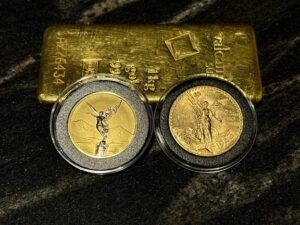
Image: Comparison showing Mexican Centenario next to modern Mexican Libertad gold coin and gold bar, both coins displaying Winged Victory designs in protective capsules.
Source: Reddit
The Centenario stands as Mexico’s most iconic gold coin, but it’s part of a rich numismatic tradition spanning centuries. To explore other rare and valuable Mexican coins beyond the 50 peso series, read about valuable rare Mexican coins from colonial times through the revolutionary period.
The Cultural Significance of the Centenario Coin
Beyond its gold content, the 50 peso holds deep cultural meaning in Mexico and commands respect in international markets.
Mexican Independence Connection
The coin’s commemorative origin ties it permanently to Mexico’s independence centennial. The Winged Victory design mirrors El Ángel de la Independencia monument in Mexico City, one of the nation’s most iconic landmarks. This connection makes the Centenario a tangible symbol of national pride and historical achievement.
Role in Mexican Culture
Within Mexico, the 50 peso traditionally serves as a vehicle for generational wealth preservation. Families pass these coins down through inheritance, viewing them as stores of value that transcend currency fluctuations. The coins frequently appear as wedding gifts and celebration presents, marking significant life events with something both valuable and symbolically meaningful.
International Recognition
The Mexican gold 50 peso coin enjoys worldwide respect among collectors and investors. Throughout Latin America, it remains a traditional favorite for gold investment, deeply embedded in regional bullion markets. The combination of artistic design and substantial gold content creates cross-cultural appeal that extends far beyond Mexico’s borders.
Collecting Strategies for 50 Peso Gold Coins
Buyers approach the Centenario with different goals, from pure bullion accumulation to serious numismatic collecting.
The Bullion Approach
Investors focused on gold content target common 1947 restrikes, which offer the lowest premiums above melt value. Condition matters less for this strategy: the goal is acquiring maximum gold weight at minimum cost. These coins function purely as precious metal holdings, valued for their 1.2057 ounces rather than numismatic characteristics. As central banks and investors worldwide increase gold holdings, physical coins like the Mexican gold 50 peso coin provide tangible exposure to precious metals markets.
Date Collecting
Numismatists pursue complete date runs, typically focusing on the 1921-1931 period or attempting to acquire all original production years through 1947. This approach presents budget challenges, as lower-mintage years like 1921, 1931, and 1943 command significant premiums. Advanced collectors also seek die varieties and overdate examples, though these require specialist knowledge to authenticate properly.
Condition Collecting
Some collectors concentrate on acquiring high-grade examples graded MS-65 or better by professional services. This strategy involves studying population reports to identify scarce date-grade combinations and paying substantial premiums for exceptional quality.
Type Collecting
Many collectors simply want a single representative Centenario as part of a broader Mexican gold collection or world gold coin portfolio. This approach pairs well with acquiring the smaller denominations or combining vintage Centenarios with modern Libertads.
Whether you’re pursuing bullion, dates, or condition rarities, understanding your investment timeline and goals helps determine the right approach. Explore different asset options for precious metals investors here.
Conclusion
The Mexican 50 peso Centenario combines substantial gold content with historical significance and one of the most beautiful designs in world coinage. Understanding the 1947 restrike phenomenon is essential for buyers, as it directly affects valuation and collecting strategies. Pre-1947 dates carry numismatic premiums, while common restrikes offer practical bullion value. Whether you’re drawn to the coin’s connection to Mexican independence, its impressive size, or simply its gold content, the Centenario remains Mexico’s premier historic gold coin. Its appeal spans both serious collectors pursuing vintage dates and investors seeking substantial gold holdings in a single, recognizable piece. Explore Blanchard’s selection of Mexican Mint gold coins and discover how these iconic pieces can enhance your precious metals portfolio.
FAQs
1. How much is a 50 peso gold coin worth?
Mexican 50 peso gold coin value depends on current gold prices, plus any premium based on date, condition, and market demand.
2. How much gold is in a 50 peso gold coin?
Each coin contains 37.5 grams (1.2057 troy ounces) of pure gold at .900 fineness.
3. What is the weight of 50 peso gold coin pieces?
The total Centenario weight is 41.666 grams, with 37.5 grams being pure gold and the remainder copper for durability.