Before There Was America: The Story of the 1652 Pine Tree Shilling Noe-11

In the summer of 1652, Boston was a growing port town perched on the edge of the known world.
Merchant ships crowded its harbor, warehouses filled with timber, fish, furs, and goods bound for Europe and the Caribbean. New settlements continued to push farther into the forests of New England. What had begun as a small religious colony only a few decades earlier was rapidly becoming an economic success. Yet beneath that growth was a problem that threatened to slow everything down. There wasn’t enough money. Trade was expanding faster than the supply of coinage. English silver rarely remained in the colonies for long, often going back across the Atlantic through commerce. Colonists relied on a patchwork of barter, foreign coins, and improvised exchanges to conduct business. For merchants trying to build a thriving economy, it was an increasingly serious obstacle.
Faced with this challenge, leaders of the Massachusetts Bay Colony made a decision that would have seemed extraordinary to many in England. They would create their own money. On May 27, 1652, the Massachusetts General Court authorized Boston silversmith John Hull and his partner Robert Sanderson to establish a mint and strike silver coinage for the colony. The decision was practical, but it was also remarkably bold. The right to create money traditionally belonged to the Crown. Massachusetts had not received explicit permission to exercise that authority.
What followed would produce a very important coin in American numismatics.
More than a century before the Declaration of Independence, and nearly 140 years before the first federal mint opened its doors, Massachusetts was striking coins that circulated throughout New England. Those pieces would become known collectively as Pine Tree Shillings, and they remain among the earliest and most iconic coins associated with America’s colonial past.
A Colony Takes a Risk
The timing of the mint’s creation proved especially fortunate. England was experiencing one of the most turbulent periods in its history. King Charles I had been executed in 1649, and Oliver Cromwell’s Commonwealth government ruled in his place. For a brief period, there was no monarch on the English throne. Historians have long suggested that Massachusetts officials understood the opportunity this presented. Nearly every coin produced by the colony’s mint would bear the date 1652, even when struck years or decades later. The date may have served as a form of political protection, tying the coinage to a moment when royal authority was unusually uncertain.
Whether that was the original intention or not, the strategy worked. The Massachusetts Mint continued operating for decades, producing silver coinage that became a trusted medium of exchange throughout New England. The colony had solved its monetary problem, but it had also established something far more significant: one of the first examples of self-directed economic action in North America.
The Birth of the Pine Tree Shilling
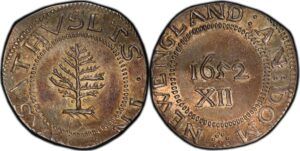
The first coins struck by the Massachusetts Mint were relatively simple. Known today as the NE coinage, they featured little more than the letters “NE” for New England and a denomination. They served their purpose, but they lacked the distinctive identity colonial leaders hoped to create. Additional designs followed. Willow Tree coinage appeared first, followed by Oak Tree issues. Eventually, the mint adopted a design that would become one of the most recognizable images in early American numismatics: the Pine Tree Shilling.
To seventeenth-century New Englanders, the pine tree represented much more than the forests surrounding their communities. Towering white pines were among the region’s most valuable natural resources. Their straight trunks were prized for ship masts, making them essential to both commercial shipping and the British navy. The pine tree symbolized prosperity, commerce, and the economic promise of the New World. It was a fitting emblem for a coin intended to support a growing colonial economy.
Silver in a Growing Colonial Economy
The Pine Tree Shilling circulated through a world very different from the America we know today. Farmers used them to purchase tools and supplies. Merchants accepted them in exchange for imported goods arriving from Europe. Ship captains carried them between ports as commerce expanded throughout the Atlantic world.
Unlike many historic coins that were produced primarily as ceremonial pieces or commemoratives, Pine Tree Shillings served a practical purpose. They were money in the truest sense of the word. They facilitated trade, supported economic growth, and helped create stability in a region where reliable coinage had once been scarce.
The Noe-11 “No H” Variety
Centuries after the Massachusetts Mint closed its doors, collectors began studying the surviving Pine Tree Shillings in greater detail. Subtle differences in lettering, spacing, and design elements revealed that numerous dies had been used during production.
One of the most influential studies was conducted by numismatist Sydney P. Noe, whose classification system remains the standard reference for Massachusetts silver coinage today.
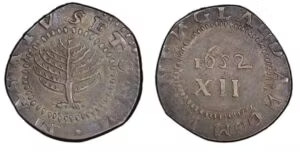
Among the many varieties identified by Noe, one has become especially well known: Noe-11. This variety is commonly referred to as the “No H” Pine Tree Shilling because of a missing letter in the inscription spelling Massachusetts. Rather than reading “MASATHVSETS,” the expected “H” is absent, creating a distinctive feature that immediately attracts the attention of specialists. To modern collectors, the missing letter is an important diagnostic characteristic. To the seventeenth-century die engraver who created it, however, it was likely nothing more than a minor oversight.
The dies used to strike Pine Tree Shillings were engraved by hand. Small variations, imperfections, and inconsistencies were inevitable. What may have been considered insignificant at the time has become one of the defining characteristics of this fascinating variety.
A Legacy Larger Than a Coin
The significance of the 1652 Pine Tree Shilling extends far beyond its silver content or rarity.
It represents a colony determined to solve its own problems. It reflects the realities of life in seventeenth-century North America, where distance from England often required practical solutions that stretched the limits of colonial authority.
More than a century before the Declaration of Independence, Massachusetts had already demonstrated a willingness to act independently when circumstances demanded it.
The Pine Tree Shilling remains one of the earliest and most powerful symbols of that spirit.
For collectors today, the Noe-11 variety offers an opportunity to own more than an early American coin. It offers a direct connection to the people who built colonial New England, the merchants who helped shape its economy, and the silversmiths whose work produced one of the most iconic coins in American numismatic history.
Long before there was a United States, there was a small silver coin bearing a pine tree. Its story continues to captivate collectors nearly four centuries later.