1921 Silver Dollar Value: What It’s Worth and Why

1921 is the only year the United States Mint struck both the Morgan and the Peace dollar for circulation. In February, Philadelphia revived George T. Morgan’s design after a 17-year pause. In the last days of December, it began striking Anthony de Francisci’s Peace dollar, the design that a year later produced the record-mintage 1922 Peace dollar.
1921 silver dollar value starts with which of the two you have. The Mint struck 86,730,000 Morgan dollars that year and just 1,006,473 Peace dollars.
Each holds about $39.50 of silver with silver at about $51 per ounce (as of November 12, 2026), and most worn Morgans sell for little more. This guide explains which coins bring real money and how to tell yours apart.
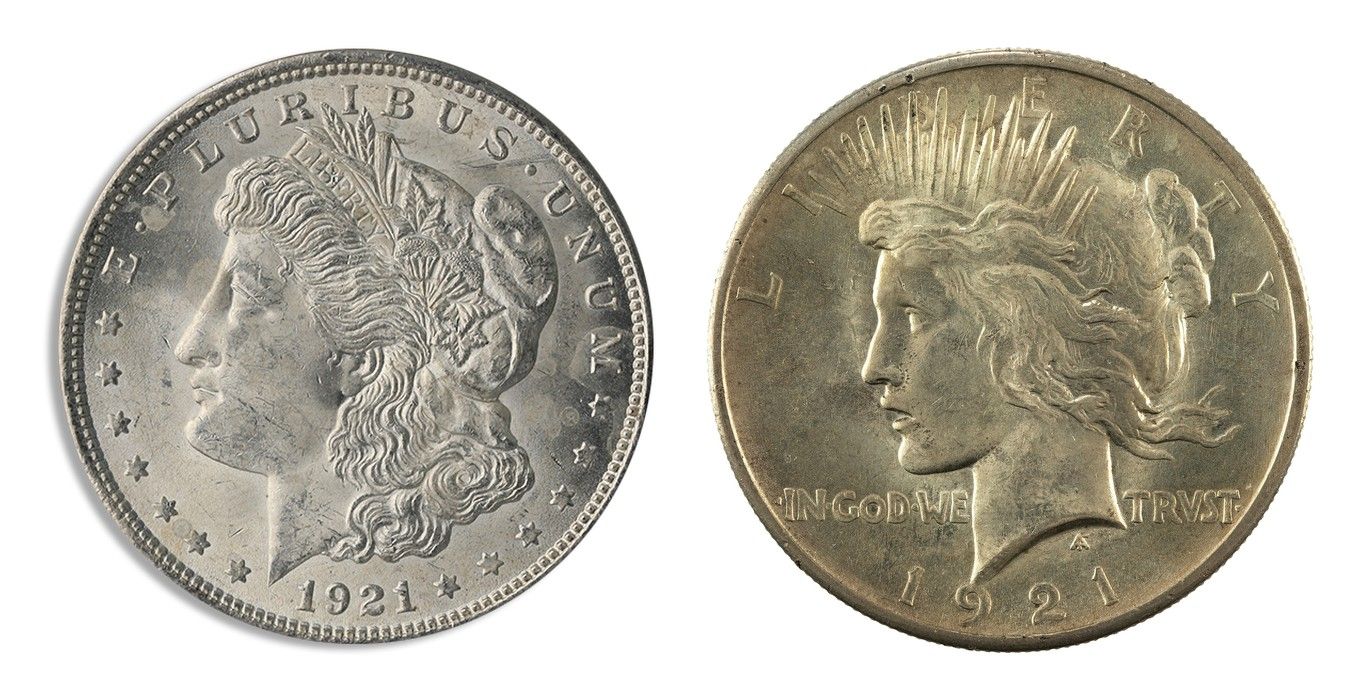
- 1921 brought two silver dollar designs: 86,730,000 Morgans and 1,006,473 Peace dollars.
- Each holds 0.7734 ounces of silver, about $39.50 at $51 silver (November 12, 2026). Worn Morgans bring $45 to $60.
- A 1921 Peace dollar lists at $150 even in Good and $3,250 in MS-65 (NGC).
- In MS-65 a 1921-S Morgan lists at $875, four times a Philadelphia coin.
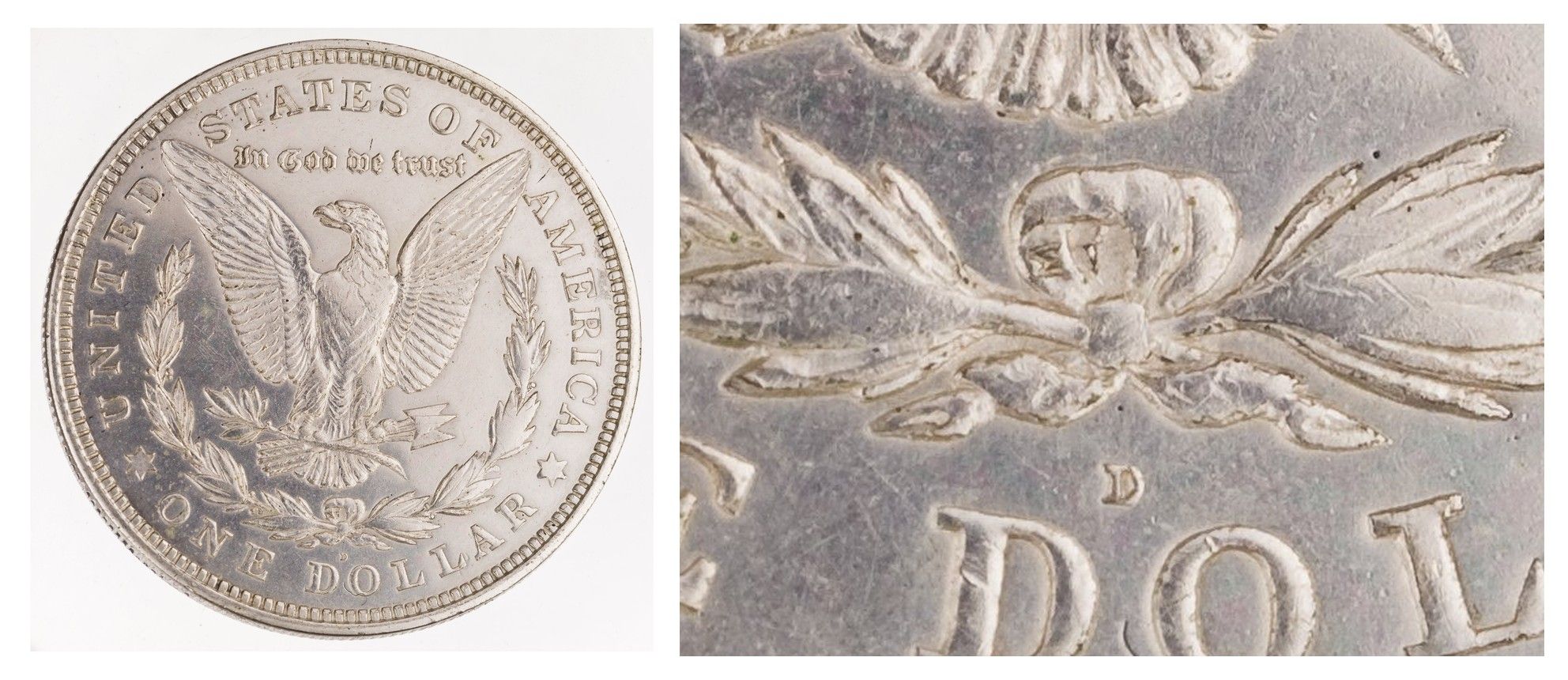
- A tiny D or S below the wreath on a Morgan’s reverse marks Denver or San Francisco; no letter means Philadelphia.
Two Silver Dollars in One Year: Background and History
The Pittman Act and the Morgan’s Return
The 1921 Morgan dollar was a repayment. Under the Pittman Act of April 23, 1918, the Treasury melted 270,232,722 silver dollars and sold the silver to Britain as wartime bullion, much of it bound for India. The same law required the melted dollars to be replaced with new ones struck from American silver, bought at $1 an ounce.
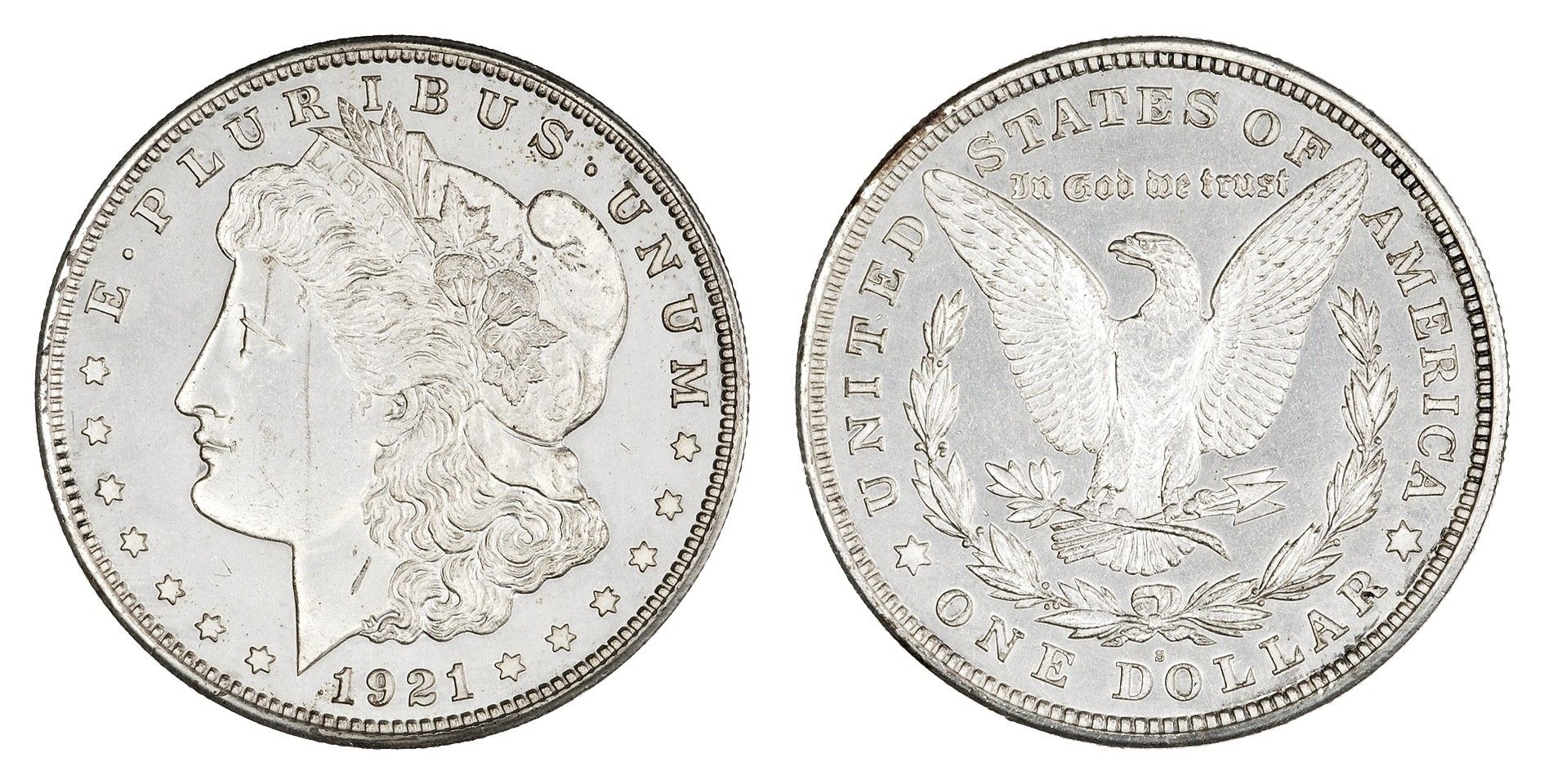
The Mint faced one problem: it had destroyed the Morgan dollar’s hubs in 1910, believing the design was finished. George T. Morgan, who had designed the coin in 1878 and was now the Mint’s chief engraver, made new hubs with John R. Sinnock, but in shallower relief. Next to an 1880s Morgan, a 1921 shows a flatter cheek on Liberty and almost no feather detail on the eagle’s breast.
Philadelphia struck 56,000 dollars in February 1921, the first since 1904. They were “of the same design as those coined in 1904,” the Mint’s superintendent wrote, and “not being paid out”: the new dollars went into Treasury vaults to back new silver certificates. The year closed out the original run of the Morgan silver dollar series, which had begun in 1878.
Three Mints, One Old Design
Denver had never struck a silver dollar before 1921. Its first came off the presses on May 4, 1921, according to the research of numismatist Norman M. Davis, and the 1921-D was the only Morgan dollar Denver struck until the Mint’s 2021 centennial coins. San Francisco began on May 9.
In all, the three mints struck:
- Philadelphia (no mint mark): 44,690,000
- Denver (D): 20,345,000
- San Francisco (S): 21,695,000
A Peace Dollar in Three Weeks
The second design of 1921 came from collectors. Farran Zerbe, a former president of the American Numismatic Association, had campaigned for a coin marking the peace after the war.
On November 23, 1921, at the Mint director’s request, the Commission of Fine Arts invited eight of the country’s leading medalists to compete. They had three weeks. On December 13 the commission unanimously chose Anthony de Francisci, a New York sculptor who had studied under James Earle Fraser, the designer of the Buffalo nickel.
His wife, Teresa, posed for Liberty, and he opened a window so the breeze would loosen her hair. He was so sure he would lose that he bet friends a dollar each against himself, then paid them off with the 50 early-strike dollars the government gave him.
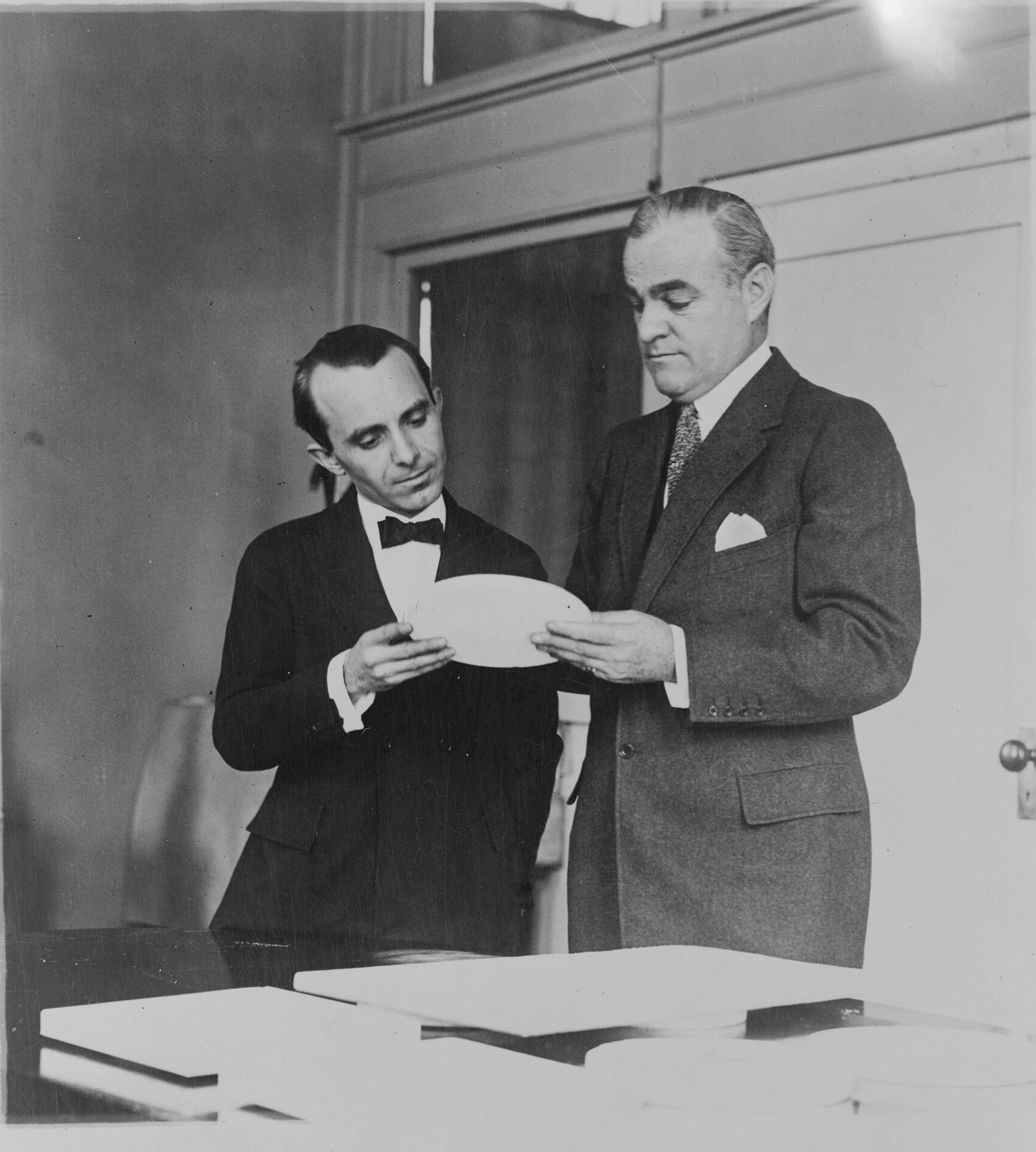
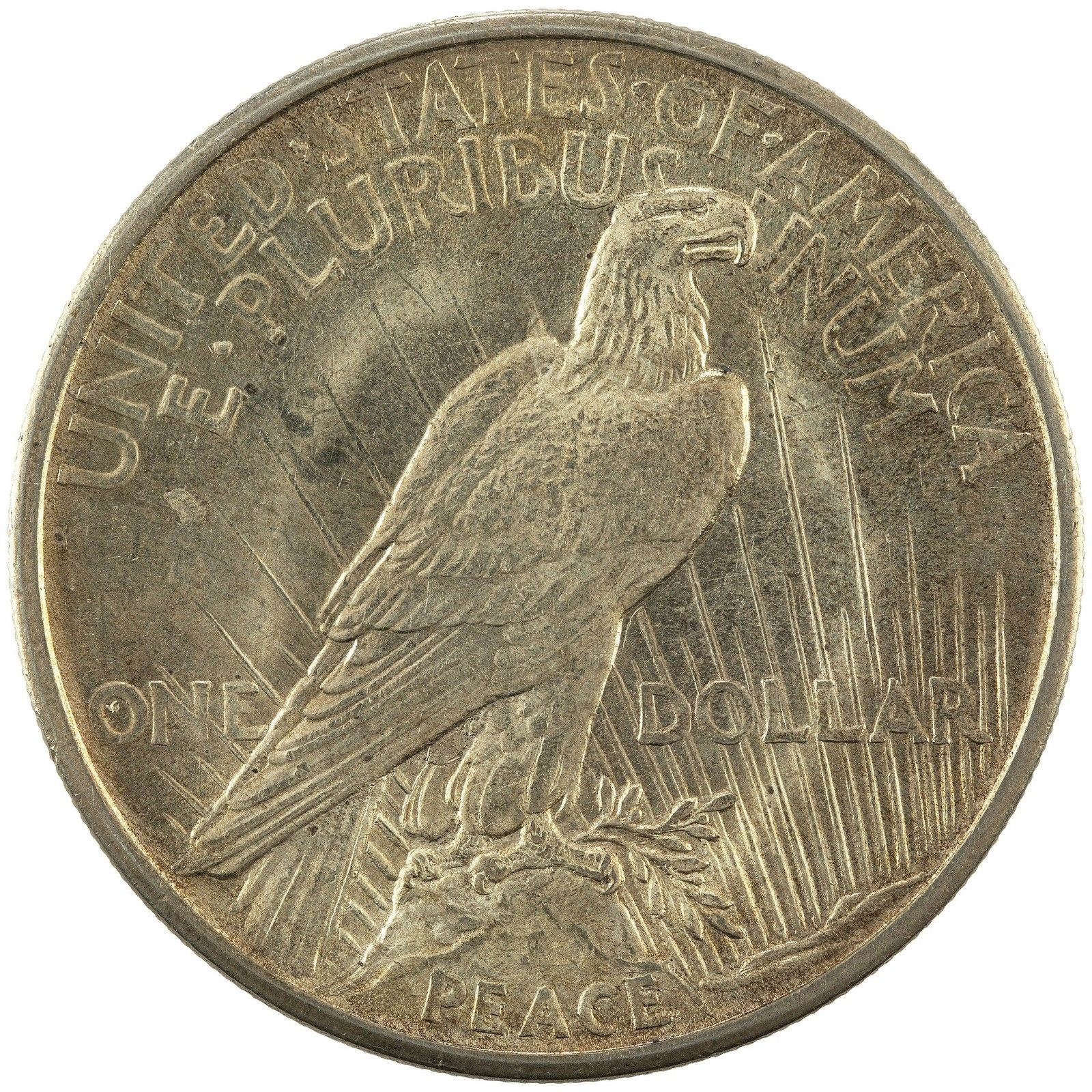
President Warren G. Harding approved the models on December 19, after asking the sculptor to remove what looked like a dimple from Liberty’s chin, and Treasury Secretary Andrew Mellon approved the coin that month. The reverse then showed the eagle clutching a broken sword, meant to mark the end of the war. Critics read it as a symbol of defeat, and the sword was removed before production, leaving the olive branch.
Philadelphia began striking the coin on December 28, 1921, and finished the year with 1,006,473 pieces. The public got its first Peace dollars on January 3, 1922.
That same day, Morgan wrote to de Francisci that “in changing the date to 1922” he had made “a slight change in the curvature of the ground,” expecting “at least 20 tons less pressure” to strike it. The sculptor was furious, but the lower relief stayed, which makes the high-relief 1921 a one-year design.
Historical context America in 1921
- Under the Pittman Act, the Treasury paid $1 an ounce for the domestic silver used to recoin the melted dollars; on the open market, silver averaged about 67 cents an ounce in the year to June 30, 1922.
- The mints ran 24 hours a day, six days a week, through the Pittman silver; in the late summer of 1921, Philadelphia averaged 260,000 silver dollars a day.
- Each new dollar let the Treasury issue a new silver certificate, which it used to retire short-term certificates of indebtedness paying 2% interest.
- In 1921 Secretary of State Charles Evans Hughes invited nine nations to Washington for a conference on naval disarmament; Teresa de Francisci called the new coin symbolic of “the disarmament conference.”
1921 Silver Dollar Value: What Is Yours Worth?
Every 1921 silver dollar is worth at least its silver, and most worn Morgans bring only a little more. The real money sits in the Peace dollar, in high-grade Denver and San Francisco Morgans, and in a few special strikes.
Silver Value: The Floor Under Every 1921 Dollar
Both designs are 90% silver and 10% copper, weigh 26.73 grams, and hold 0.7734 troy ounces of pure silver. Multiply that by the silver price for the melt value: with silver at about $51 per ounce (as of November 12, 2026), a 1921 dollar holds about $39.50 of silver.
That floor moves with the metal every day, and worn coins trade close to it. In NGC’s price guide, a circulated 1921 Morgan runs $45 to $60 from any of the three mints.
1921 Morgan Dollar Value by Grade
The Philadelphia 1921 is “the commonest of all Morgan dollars,” in the words of the numismatic historian Q. David Bowers. PCGS estimates that 4,470,000 survive, 360,000 of them in Mint State, and most were weakly struck from the shallow 1921 dies.
NGC’s guide (November 2026) lists the coin at $90 in MS-60, $120 in MS-63, and $215 in MS-65. Above that the price climbs fast: $700 in MS-66 and $11,500 in MS-67. With the premium packed into a few grade points, it pays to understand how professional grading affects an uncirculated coin’s value.
Denver and San Francisco: What the Mint Mark Is Worth
In worn condition, a 1921-D or 1921-S Morgan is worth the same as a Philadelphia coin. In Mint State the mint mark starts to matter, because far fewer branch-mint coins survive in top grades. PCGS estimates 13,500 Philadelphia coins in MS-65 or better, against 6,000 from Denver and 2,900 from San Francisco.
The 1921-D was the best struck of the three, Bowers notes. The 1921-S was the worst: “Most are a weak mushy strike,” wrote the dollar specialist Wayne Miller. So few 1921-S dollars came out sharp and clean that gems are scarce: NGC lists the 1921-S at $875 in MS-65 and $3,500 in MS-66, against $550 and $1,000 for the 1921-D.
1921 Peace Dollar Value
The 1921 Peace dollar is worth far more than a 1921 Morgan in the same grade. Only 1,006,473 were struck, and PCGS estimates about 100,000 survive. The public saved them one or two at a time as novelties, Bowers wrote, and he never heard of an original bag of 1,000 reaching the market.
NGC lists the coin at $150 in Good, $300 in Extremely Fine, $500 in AU-58, $1,100 in MS-63, and $3,250 in MS-65, rising to $8,500 in MS-66. Heritage sold PCGS MS-65 examples for $3,050 to $3,782 in 2026.
The high relief made the coins hard to strike, so nearly every one is weak at the center of Liberty’s hair; Bowers estimated that fewer than 10 in 1,000 are sharp. A fully struck 1921 brings a premium even within the same grade. For the story behind the design, see the history of the 1921 Peace dollar.
Proofs, Special Strikes, and Varieties
Chapman Proofs. The Mint made no proof sets in 1921, but the numismatist Henry Chapman had a few mirror-finish Morgan proofs struck to his order. Walter Breen reported seeing a bill of sale for 10, and perhaps 15 were made in all. PCGS now estimates about 30 survive, more than the records account for, and one graded PR-64 sold for $100,625 in 2011.
Zerbe special strikes. Zerbe is also credited with Morgans struck on specially polished dies. PCGS grades them as special strikes (SP) and estimates 150 to 200 exist, and Bowers warned that many coins sold as “Zerbe proofs” are ordinary prooflike dollars. The American Numismatic Society holds a 1921-S it received from Zerbe himself on May 29, 1921, cataloged as a “special striking.”
Varieties. Morgan specialists collect die varieties by VAM number, from the reference by Leroy Van Allen and A. George Mallis. Three 1921 varieties made PCGS’s list of the Top 100 Morgan VAMs: the “Pitted Reverse” (VAM-41A), the “Wide Reeding” coins struck in a collar with 157 reeds against the usual 189, and the 1921-D “TRU_T” (VAM-1A), with the S of TRUST filled in. Among Peace dollars, the 1921 “Line Through L” (VAM-3) is a Top 50 variety.
Notable Auction Records
The top prices belong to gem Peace dollars and the rare Chapman proofs.
| Coin and Grade | Price Realized | Auction House | Sale Date |
|---|---|---|---|
| 1921 Peace, MS-67 (PCGS) | $132,000 | Stack’s Bowers Galleries | August 2018 |
| 1921 Peace, MS-67 (PCGS) | $111,000 | Heritage Auctions | January 2018 |
| 1921 Morgan, Chapman Proof, PR-64 (PCGS) | $100,625 | Stack’s Bowers Galleries | November 2011 |
| 1921-D Morgan, MS-67+ (PCGS) | $44,063 | Heritage Auctions | April 2013 |
| 1921 Morgan, MS-67 (PCGS) | $15,863 | Heritage Auctions | January 2014 |
| 1921-S Morgan, MS-66 (PCGS) | $3,904 | Heritage Auctions | March 2026 |
How to Check Your 1921 Silver Dollar
Five Checks for Any 1921 Dollar
- The design. A Morgan shows Liberty with the word LIBERTY on her headband and, on the reverse, an eagle with spread wings inside a wreath. A Peace dollar shows Liberty in a crown of rays and, on the reverse, an eagle at rest above the word PEACE.
- The mint mark. On a Morgan, look on the reverse just below the bow of the wreath, above the letters DO in DOLLAR. The 1921 D and S are tiny, so use a magnifier. No letter means Philadelphia. A 1921 Peace dollar never carries a mint mark, because only Philadelphia struck them.
- The specifications. A genuine coin of either design weighs 26.73 grams, measures 38.1 millimeters, and has a reeded edge.
- The strike. On a Peace dollar, check the hair at the center of Liberty’s head. On a Morgan, look at Liberty’s cheek, which is grainy on weakly struck 1921 coins. Full detail is rare and adds value in Mint State.
- The date. A Morgan or Peace dollar dated 2021 is one of the Mint’s centennial collector coins in .999 fine silver, a different coin with its own market.
Counterfeits and Altered Coins
A 1921 Peace dollar is worth hundreds of dollars in Mint State, and fakes turn up. NGC documented a die-struck counterfeit that tested at just 0.3% silver: it was mostly copper and zinc, weighed 27.7 grams, and was visibly thicker than a genuine coin. Its fields looked oddly prooflike, and its devices showed raised lumps and pitting, as NGC’s counterfeit report shows.
Two more cautions apply. A 1921 Peace dollar with a D or S is altered or counterfeit, since Denver and San Francisco struck none that year. And prooflike Morgans offered as “Zerbe proofs” or “Chapman proofs” with old letters or certificates deserve skepticism until PCGS or NGC confirms them.
When Professional Appraisal Makes Sense
A worn 1921 Morgan trades on its silver, so certification rarely changes its value. It earns its fee in four cases:
- Any 1921 Peace dollar
- An uncirculated Morgan, especially a 1921-S or 1921-D that looks MS-64 or better
- A coin offered as a Chapman proof, a Zerbe special strike, or a named VAM
- Any coin you suspect is counterfeit or altered
Professional services like PCGS or NGC provide authentication and a grade the market trusts. If you have inherited a roll or a box of old silver dollars and aren’t sure which deserve a closer look, Blanchard’s numismatists can evaluate coins like these.
What Collectors and Investors Watch
1921 dollars sit in two markets. Worn Morgans trade close to their silver, so their prices follow the metal. The Peace dollar and the gem Denver and San Francisco Morgans trade on scarcity and certified grade.
The common coins have been plentiful for a century. As late as June 1934, collectors could still buy uncirculated 1921 Morgan and Peace dollars at face value plus postage, and in the mid-1960s, Bowers recalled, most of the dollars on Nevada gaming tables were 1921 Morgans. Millions were later melted, many of them when silver prices soared in the 1970s.
The tradeoffs are real: dealer premiums over silver on common coins, price jumps of three times or more from one Mint State grade to the next, and a gem market that rewards patience and a good magnifier.
Counterfeit Peace dollars and misattributed proofs are common enough that buying certified coins from an established dealer is the practical safeguard. Blanchard offers certified rare coins graded by PCGS and NGC, the standard any reputable dealer should meet.
Frequently Asked Questions
1. How much is a 1921 silver dollar worth?
Most 1921 Morgan dollars are worth about $45 to $60 in circulated condition, a little above their roughly $39.50 of silver at about $51 per ounce (November 12, 2026). A 1921 Peace dollar lists at about $150 in Good and $3,250 in MS-65, and gem Morgans from Denver and San Francisco run from hundreds to thousands of dollars (NGC, November 2026).
2. Is a 1921 silver dollar real silver?
Yes, 90% of it. Both the Morgan and the Peace dollar are 90% silver and 10% copper, weigh 26.73 grams, and contain 0.7734 troy ounces of pure silver.
3. Where is the mint mark on a 1921 silver dollar, and what if it has none?
On a 1921 Morgan, the mint mark is on the reverse just below the bow of the wreath: a tiny D for Denver or S for San Francisco. A Morgan with no mint mark was struck in Philadelphia, the most common of the three. The 1921 Peace dollar has no mint mark, because only Philadelphia struck it.
4. What makes a 1921 silver dollar rare?
The design, the mint, and the grade. The Peace dollar is the scarce design, with 1,006,473 struck against 86,730,000 Morgans. Among Morgans, high-grade 1921-S and 1921-D coins are scarce, and Chapman proofs and Zerbe special strikes are rare, while an ordinary worn 1921 Morgan is the most common Morgan dollar of all.
5. What is a 1921 Liberty silver dollar?
It can be either coin. Both 1921 silver dollars show Liberty and carry the word LIBERTY, so people use the name for the Morgan and the Peace dollar alike. To tell them apart, turn the coin over: an eagle with spread wings is a Morgan, and an eagle at rest above the word PEACE is a Peace dollar.
6. What are the 2021 Morgan and Peace dollars?
They are modern collector coins the US Mint struck for the centennial under the 1921 Silver Dollar Coin Anniversary Act, signed January 5, 2021. Each holds 0.858 troy ounces of .999 fine silver, about $44 of metal at November 2026 prices. The Mint sold them for $85 each, with limits of 175,000 for each Morgan version and 200,000 for the Peace dollar.
Conclusion
1921 silver dollar value comes down to three questions: which design, which mint, and what grade. A worn Morgan is worth its silver plus a little, while a Peace dollar, a gem 1921-S or 1921-D, or a genuine Chapman proof is worth far more.
Checking takes a minute: look at the eagle, turn the coin over for the tiny mint mark, and weigh it. Most will prove to be a Morgan from the Pittman Act’s great recoinage, a coin with a story worth knowing even when its value is mostly silver.
Ready to add a classic silver dollar to your collection? Explore Blanchard’s Morgan silver dollars, the series whose original run ended in 1921.
Want to read more? Subscribe to the Blanchard Newsletter and get our tales from the vault, our favorite stories from around the world and the latest tangible assets news delivered to your inbox weekly.