Indian Head Penny Value: What It’s Worth and Why

By late 1862, Americans were hoarding even their pennies. Gold and silver had vanished from circulation, the copper-nickel Indian Head cent traded at a 20% premium over face value, and merchants made change with private tokens. Congress answered in 1864 with a thinner bronze cent that nobody wanted to hoard, and that coin carried James B. Longacre’s Indian Head design until 1909.
Indian Head penny value starts with an honest number: most are worth $2 to $10. The Mint struck tens of millions of these cents almost every year, and PCGS lists most worn common dates from the 1880s and 1900s at $2 to $6. This guide explains which dates, varieties and grades bring real money, from a $650 worn 1877 to six-figure gems, and how to check yours.
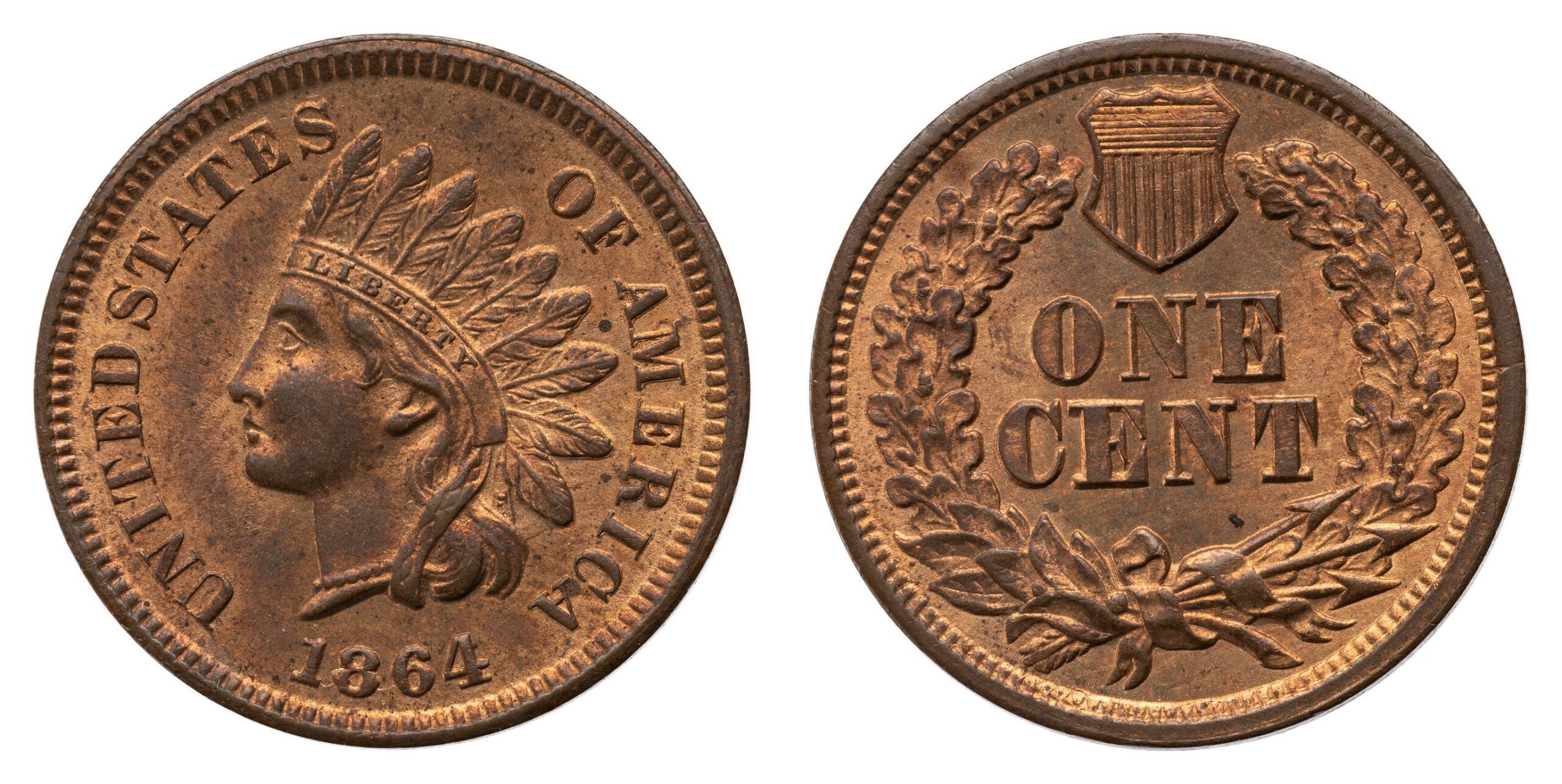
- Most Indian Head pennies dated 1880 to 1908 are worth $2 to $10 in well-worn condition.
- The 1877 is the key date: $650 even in Good-4 (PCGS).
- Only the 1908-S and 1909-S carry a mint mark, an S below the wreath; a worn 1909-S lists at $400.
- Copper-nickel cents (1859 to 1864) are paler and heavier, and bring $12 to $26 in Good-4.
- Check any 1864 bronze cent for an L on the headdress ribbon: $65 in Good-4, against $15 without it.
The Indian Head Cent: Background and History
Longacre’s New Cent
The United States had used small cents for barely a year when the Mint started over. The Flying Eagle cent, the first small cent, often came off the presses weakly struck at the eagle’s tail and wingtip, so Mint Director James Ross Snowden asked Chief Engraver James B. Longacre for a replacement.
Longacre produced more than a dozen pattern cents in 1858. Snowden chose his head of Liberty in a feathered headdress, paired with a simple laurel wreath, and production began in January 1859.
A popular story holds that Longacre modeled the face on his young daughter, Sarah. The evidence points elsewhere: nearly the same head appears in his sketchbooks a decade earlier, and Longacre himself called the profile the Venus Accroupie, or “Crouching Venus,” a Greco-Roman statue then on display in Philadelphia.
A Shield for 1860
The laurel wreath lasted a single year. In 1860 Snowden added a small shield to the top of the reverse, writing to Treasury Secretary Howell Cobb that “this will give it a more National character,” and an oak wreath replaced the laurel. That makes the 1859 a one-year type.
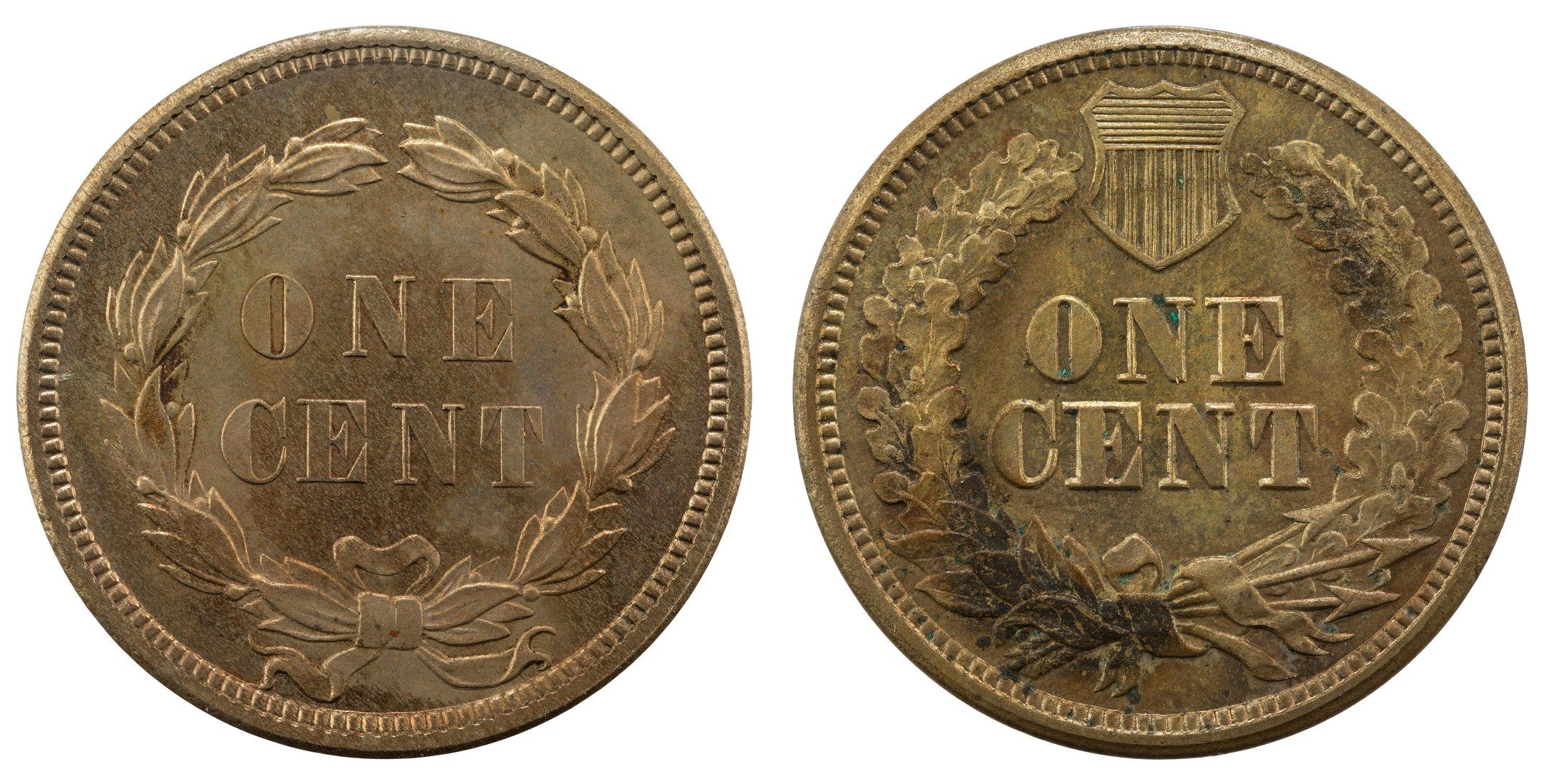
Philadelphia struck about 158 million copper-nickel cents from 1859 to 1864. The alloy of 88% copper and 12% nickel gave them a pale, tan color and a weight of about 4.7 grams.
Hoarded in Wartime, Remade in Bronze
The Civil War turned the little cent into a commodity. Once banks suspended payments in gold and silver at the end of 1861, those coins disappeared, and merchants bundled cents into paper rolls to stand in for silver change. By the end of 1862 the public was hoarding the cents as well, and huge mintages did little to bring them back: more than 28 million 1862 cents, Longacre’s Civil War issue, and nearly 50 million in 1863.
Merchants filled the gap themselves. In 1863 they issued thin copper tokens in enormous numbers, carrying patriotic slogans or advertising. Each held only about a quarter cent’s worth of metal, so nobody hoarded them.
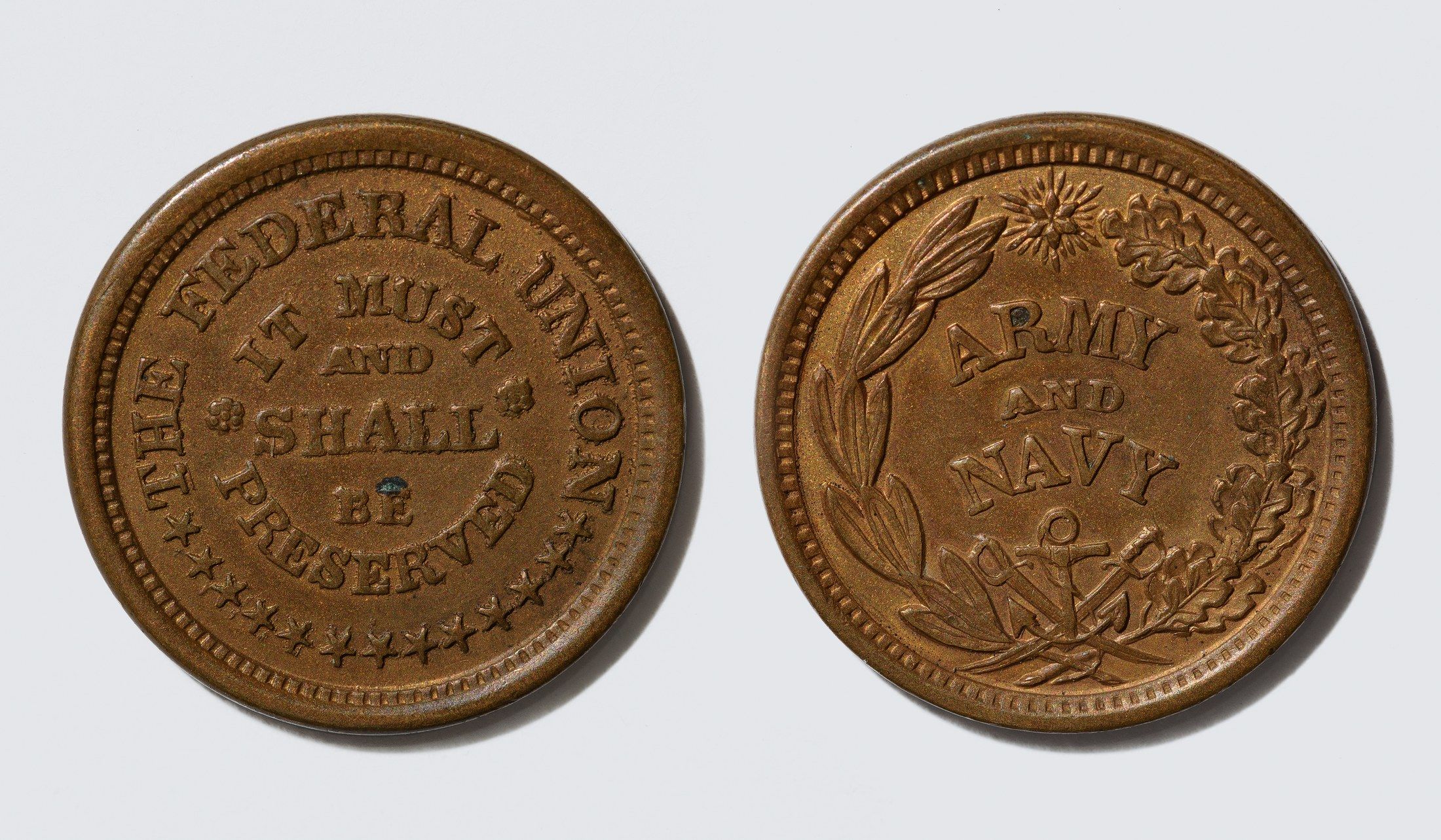
Congress took the hint. The Act of April 22, 1864 created a cent of bronze, 95% copper and 5% tin and zinc, weighing 48 grains (3.11 grams), a third lighter than before. The same law outlawed tokens made in imitation of the new cent and authorized a two-cent piece of the same alloy.
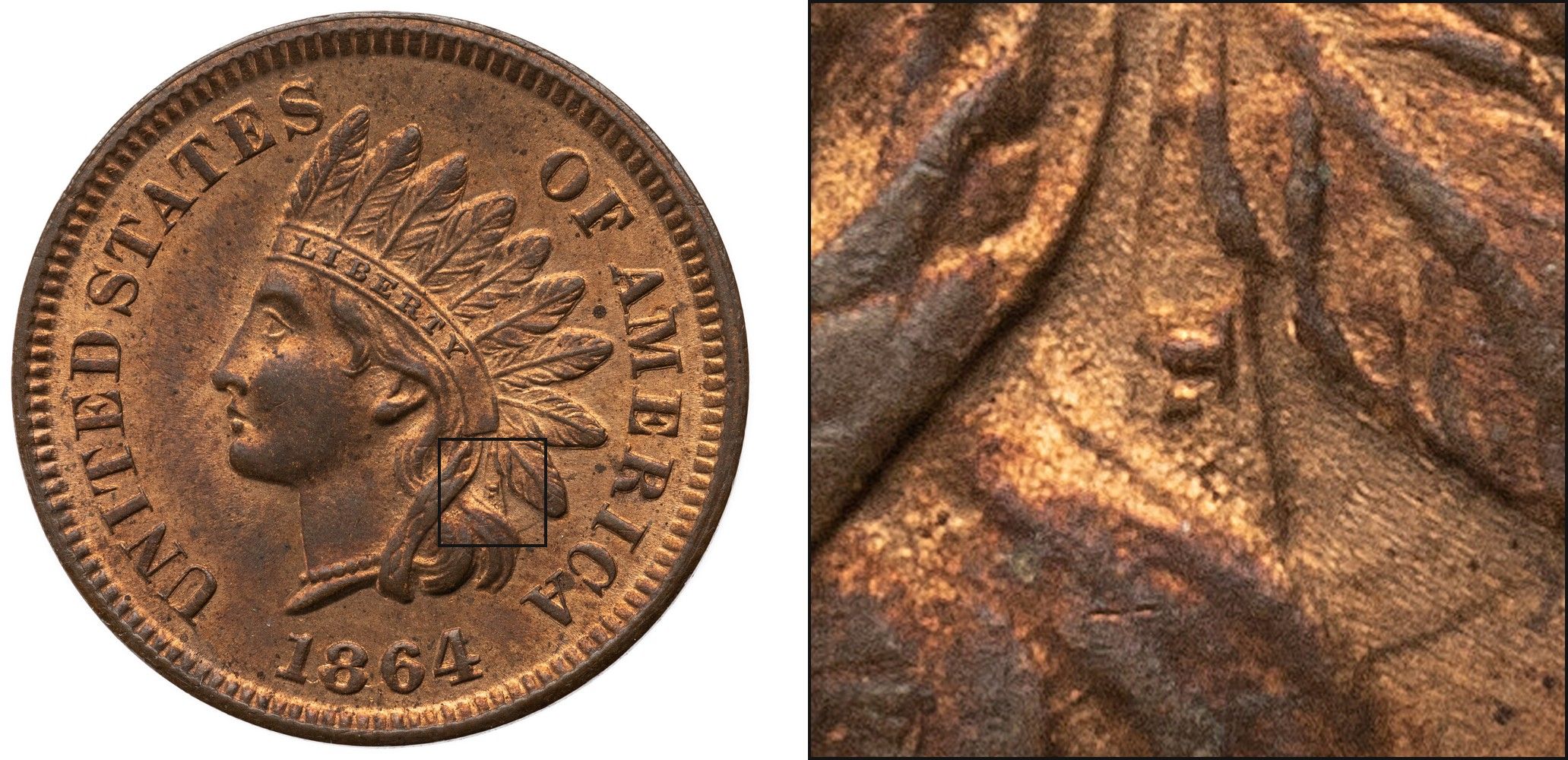
Philadelphia had already struck more than 13 million copper-nickel cents that year; more than 39 million bronze ones followed. Late in the year Longacre’s initial L appeared on the ribbon beside the lowest feather, and series specialist Rick Snow estimated that about 5 million of the 1864 bronze cents carry it.
Historical context The small-change crisis, 1861-1864
- New York banks suspended payments in gold and silver on December 28, 1861; by the summer of 1862, precious-metal coins had all but disappeared.
- Before the war a copper-nickel cent held nearly a cent’s worth of metal, and wartime demand drove the price of nickel higher.
- Until 1864, U.S. cents were not legal tender at all; the April 1864 law made them legal tender for payments of up to 10 cents.
- Later in 1864, the new two-cent piece became the first U.S. coin to carry IN GOD WE TRUST.
- A first-class letter cost 3 cents per half ounce from July 1, 1863, so mailing one took three Indian Head cents.
Fifty Years in Bronze
With the war over, the country soon had more cents than it needed. Mintages fell to between 3.9 million and 6.4 million a year from 1869 through 1872, and an 1871 law let holders redeem their surplus cents, which the Treasury melted. Those four dates are scarce today.
The low point came in 1877. A depression had cut demand, and almost 10 million cents came back to the Mint as unneeded that year; 9,821,500 of them were simply reissued. Philadelphia struck just 852,500 new cents dated 1877, and few people thought to save one.
Demand climbed again with the economy, and in 1907 the Mint passed 100 million cents for the only time, striking more than 108 million. In November 1908, under a 1906 law that let the branch mints strike minor coins, San Francisco produced its first cents, marked with an S. Production of the Indian Head design ended in the spring of 1909, ahead of Victor D. Brenner’s Lincoln cent.
What Determines Indian Head Penny Value Today?
Start with the honest baseline: an Indian Head penny dated 1880 to 1908 in well-worn condition is worth about $2 to $10, and an uncirculated common date about $50 to $120.
Value comes from four things: the date, the mint mark, the coin’s condition and color, and a short list of varieties.
The Key Dates
The 1877 leads the series. PCGS lists it at $650 in Good-4, $1,350 in Fine-12 and $5,750 in MS-60, and NGC notes that its survivors are rarer than even the low mintage suggests, because collectors of the day bought proofs and ignored the coins in circulation. Most 1877 cents known today are heavily worn.
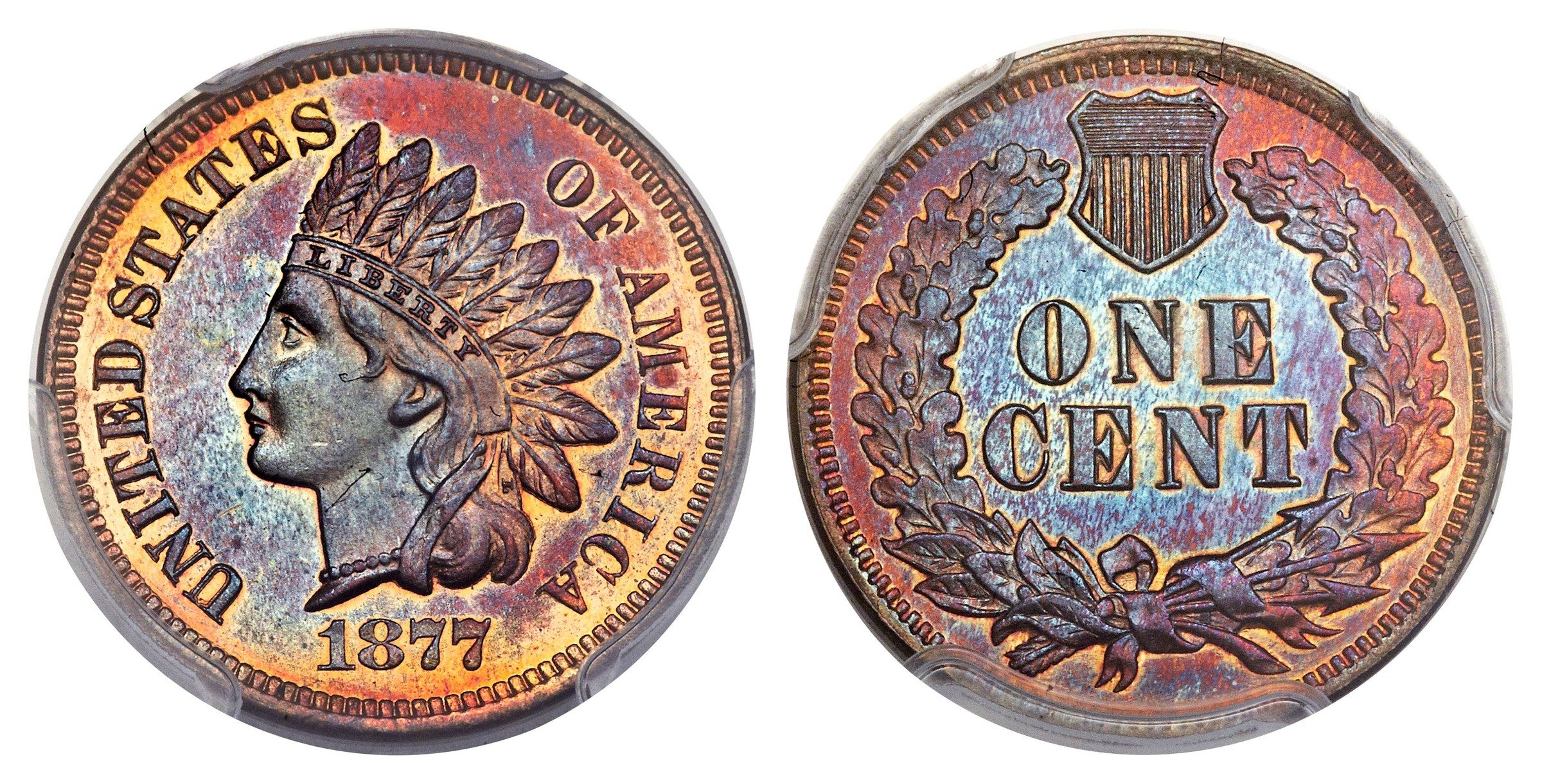
Only two obverse dies and one reverse die are known for the 1877, too few, some researchers argue, to have struck 852,500 coins.
The 1909-S has the lowest mintage, 309,000, but collectors and speculators saved it almost from the start, so uncirculated examples survive in numbers and a well-worn one is the harder find. PCGS lists it at $400 in Good-4 and $1,400 in MS-60. The 1908-S, with 1,115,000 struck, lists at $75 in Good-4.
Next come the low-mintage cents of 1869 through 1872, at $60 to $110 in Good-4, and the 1864 L.
Common dates are common. An 1884 cent, the subject of Blanchard’s story of the 1884 Indian Head penny, lists at $5 in Good-4, and the Philadelphia dates from 1889 through 1909 at $2 to $12.
Condition and Color
Grade separates a $2 coin from a $250 one. Wear shows first on the hair above Liberty’s ear and the curl beside the ribbon, and on the reverse at the bow knot. A quick check: on a coin in Fine or better, all seven letters of LIBERTY on the headband are readable, while on a coin in Good the word has worn away.
A 1900 cent, one of 66.8 million struck, shows how the ladder climbs.
In Mint State, color matters as much as grade. PCGS and NGC label copper coins brown (BN), red-brown (RB) or red (RD), depending on how much original mint color survives. The same 1900 cent in MS-65 lists at $250 brown and $750 red.
Mint State coins are plentiful through MS-65, but populations drop sharply at MS-66, and fully red coins are rarer still. At these levels, professional grading is what sets the price. Never clean an Indian Head cent: cleaning strips the original surface, and the grading services give a cleaned coin a “details” label instead of a numeric grade.
Copper-Nickel Cents, 1859-1864
The six copper-nickel dates have no rarities, but none of them is cheap. PCGS lists them at $12 to $26 in Good-4 and $165 to $440 in MS-60. The 1859, the only laurel-wreath year, brings the most: $22 in Good-4 and $3,000 in MS-65.
Varieties Worth Knowing
1864 L on the ribbon. Late-1864 cents carry Longacre’s L, turned on its side, on the ribbon beside the lowest feather, and a pointed tip on the bust. PCGS lists the variety at $65 in Good-4, against $15 for an 1864 bronze cent without it, and $1,450 in MS-65 brown.
1869/9. A repunched date, cataloged as FS-301 (PCGS lists it as 1869/69). NGC calls it rare only in high grades; an MS-66+ red example sold for $31,200 at Heritage in March 2025.
1873 Doubled LIBERTY. A doubled-die obverse (FS-101) on which the letters of LIBERTY are clearly doubled. PCGS estimates that 500 to 1,000 survive, most of them circulated, and lists the variety at $250 in Good-4 and $7,800 in MS-60.
1886 Type 1 and Type 2. Partway through 1886, Chief Engraver Charles Barber’s department revised the obverse. On Type 1 coins the lowest feather points between the I and C of AMERICA; on the later Type 2 it points between the C and A. Type 2 lists at $35 in Good-4, against $12 for Type 1.
1888/7. The most valuable variety in the series: a final 8 punched over a 7, with traces of the 7 at the upper left of the last 8 and a small lump at its base. PCGS lists it at $1,750 in Good-4 and $12,500 in XF-40, and its finest known examples grade only MS-63.
Notable Auction Records
The top prices belong to key dates and to common dates in grades almost no other coins reach.
| Coin and Grade | Price Realized | Auction House | Sale Date |
|---|---|---|---|
| 1877, MS-66 RD (PCGS) | $149,500 | Heritage Auctions | August 2007 |
| 1902, MS-68 RD (PCGS) | $144,000 | Stack’s Bowers | June 2022 |
| 1872, MS-66 RD (PCGS) | $126,500 | Heritage Auctions | August 2007 |
| 1909-S, MS-67 RD (PCGS) | $97,750 | Heritage Auctions | January 2006 |
| 1888/7, MS-63 BN (PCGS) | $74,750 | Heritage Auctions | August 2007 |
The 1902 shows how far condition can carry an ordinary date. More than 87 million were struck, yet PCGS had graded only two in MS-68 RD, and both sold in the summer of 2022, for $144,000 and $120,000.
How to Check Your Indian Head Penny
Five Checks for Any Indian Head Cent
- The date. Look first for 1877, 1869 to 1872, 1864, 1873, 1886, 1888 and 1908-1909.
- The mint mark. Turn the coin over and look below the wreath. An S means a 1908-S or 1909-S; no letter means Philadelphia.
- The metal. Copper-nickel cents (1859-1864) are pale tan and weigh about 4.7 grams; bronze cents (1864-1909) are brown or red and weigh 3.11 grams.
- The reverse. A laurel wreath with no shield means 1859; an oak wreath with a shield at the top means 1860 or later.
- The ribbon. On any 1864 bronze cent, use a magnifier on the ribbon beside the lowest feather. A tiny L, with a pointed bust tip, marks the scarcer variety.
Every Indian Head cent measures 19 millimeters across, with a plain edge.
Look-Alikes and Fakes
- Wheat pennies. Lincoln cents of 1909 to 1958, such as the wartime coin in the 1943 steel penny value guide, carry two ears of wheat on the reverse where the Indian Head has a wreath.
- Indian Head gold. The $2.50, $5 and $10 gold coins of 1907 to 1933 also show an Indian and form a separate series.
- Fakes and altered coins. NGC notes counterfeits of the 1877 and 1909-S above all, and of the 1864 L, the 1866-1878 dates and the 1908-S. Philadelphia cents with an added S are a known trick: look for tool marks around the letter, and remember that genuine 1909-S cents are usually weak at the feather tips.
When Professional Appraisal Makes Sense
For a worn common date, a grading fee costs more than the coin is worth. Certification earns its cost in three cases:
- Any 1877, 1909-S or 1908-S
- An 1864 L, a cent from 1869 to 1872, or a possible 1873 Doubled LIBERTY or 1888/7
- An uncirculated coin that still shows original red color
Professional services like PCGS or NGC provide authentication and a grade the market trusts. If you’ve inherited a jar or an old album of Indian Head cents, Blanchard’s numismatists can evaluate coins like these.
What Collectors and Investors Watch
The Indian Head cent is one of the most popular American series to collect by date. It has only two branch-mint issues and few costly rarities, so many collectors assemble complete date sets, and every set needs an 1877 and a 1909-S.
The tradeoffs are real. Grading fees exceed the value of most coins in the series, and top-grade prices can fall as well as rise. The same 1872 cent in MS-66 RD sold for $126,500 in 2007, $54,000 in 2019 and $49,200 in 2021, and the finest PCGS 1909-S went from $97,750 in 2006 to $48,000 in 2019.
Added mint marks, altered dates and cleaned coins are common enough in this series that buying certified coins from an established dealer is the practical safeguard. Blanchard offers certified rare coins graded by PCGS and NGC, the standard any reputable dealer should meet.
Frequently Asked Questions
1. How much is an Indian Head penny worth?
Most Indian Head pennies are worth $2 to $10; PCGS lists most common dates of the 1880s and 1900s at $2 to $6 in Good-4. Key dates are the exception: a worn 1877 lists at $650 and a worn 1909-S at $400.
2. Which Indian Head pennies are worth the most?
The 1877 is the most valuable regular date, at $650 in Good-4 and $13,000 in MS-65 brown (PCGS). The 1888/7 overdate is worth even more, $1,750 in Good-4. The 1909-S, 1873 Doubled LIBERTY, 1869 through 1872 and 1864 L follow.
3. Where is the mint mark on an Indian Head penny?
On the reverse, below the wreath. Only the 1908-S and 1909-S have one, an S for San Francisco. Every other Indian Head cent was struck at Philadelphia with no mint mark, so a missing mint mark is normal and adds no value.
4. How much are 1890s and 1900s Indian Head pennies worth?
Most are worth $2 to $10 worn. PCGS lists an 1890 at $3 in Good-4 and $80 in MS-60, and a 1907 at $2 and $52. Gems with original red color bring far more: a 1907 in MS-65 red lists at $700.
5. Is an Indian Head penny the same as a wheat penny?
No. The Indian Head cent (1859-1909) has a wreath on the reverse. The wheat penny is the Lincoln cent of 1909 to 1958, with two ears of wheat on the reverse, a separate series with its own key dates.
6. What is an 1864 L Indian Head penny?
It is an 1864 bronze cent with James B. Longacre’s initial L on the ribbon beside the lowest feather, added late that year. PCGS lists it at $65 in Good-4, against $15 for an 1864 without the L.
Conclusion
Indian Head penny value follows a clear order. Worn common dates are worth a few dollars and the copper-nickel cents somewhat more. Above them come the key dates, the 1864 L and the major varieties, and finally gems with original red color.
Checking takes a minute: read the date, look for an S, and study the ribbon on any 1864. Most Indian Head cents will prove to be common coins with a remarkable story, and the rare exception is worth the minute.
Ready to own an Indian Head in another metal? Explore Blanchard’s pre-1933 U.S. gold coins, including Indian Head quarter eagles and eagles from the early 20th century.
Want to read more? Subscribe to the Blanchard Newsletter and get our tales from the vault, our favorite stories from around the world and the latest tangible assets news delivered to your inbox weekly.