1883 $5 Gold Coin Proof: Understanding This Classic Liberty Head Rarity

The 1883 $5 gold coin proof is one of the more elusive coins in American gold coinage. The Philadelphia Mint struck just 61 examples that year – not for circulation, but for a small group of collectors who purchased them directly through the mint. Of those 61, only a fraction are traceable today. That survival rate, combined with the enduring appeal of 19th-century American gold, places this coin firmly in the category of serious numismatic rarities. This guide covers the Liberty Head half eagle series, how Victorian-era proof coinage was produced, and what collectors need to know about grading, authentication, and the realities of acquiring an 1883 proof today.
Liberty Head Half Eagle Background
The Liberty Head half eagle ran from 1839 to 1908, making it one of the longest-running designs in American gold coinage and the series from which the proof 1883 $5 gold originates.
Series History
In 1839 Christian Gobrecht, the third Chief Engraver of the US Mint, introduced a new Liberty Head design for the half eagle, replacing the short-lived Classic Head type that had been in production since 1834. Gobrecht’s design featured Liberty facing left on the obverse, wearing a coronet inscribed “LIBERTY” – a clean, refined portrait that would remain virtually unchanged for nearly 70 years. The series ended in 1908 when it was replaced by Bela Lyon Pratt’s Indian Head design. Over that span coins were produced at six different mints: Philadelphia, San Francisco, Carson City, New Orleans, Charlotte, and Dahlonega.
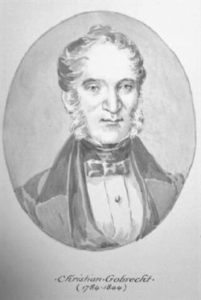
Image: Portrait of Christian Gobrecht, designer of the Liberty Head coin series.
Source: Find A Grave
Watch this American Numismatic Society lecture on Christian Gobrecht to learn more about the engraver behind the Liberty Head design.
Design Elements
The Liberty Head half eagle obverse depicts Liberty facing left, wearing a coronet inscribed “LIBERTY”, surrounded by thirteen stars representing the original colonies. The reverse shows a heraldic eagle with a shield on its breast, clutching arrows and an olive branch, with the denomination marked as “FIVE D”. Each coin weighs 8.359 grams, measures 21.6mm in diameter, and contains 0.24187 troy ounces of pure gold in a .900 fine composition (90% gold, 10% copper).
Two Major Types
The series divides into two distinct collecting types. Coins struck from 1839 to 1866 carry no motto on the reverse and are known as No Motto pieces. Following the Civil War, the Coinage Act of 1865 authorized the addition of “IN GOD WE TRUST” above the eagle, creating the With Motto type that ran from 1866 through 1908. The proof 1883 $5 gold coin is a With Motto coin.
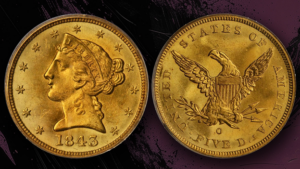
Image: Both sides of an 1843 No Motto Liberty Head half eagle gold coin.
Source: Coin Week
Understanding 19th Century Proof Coinage
Proof coins in the Victorian era were a fundamentally different product from what the mint produced for circulation. They were produced in very small quantities with specialized preparation, for a small audience of serious collectors.
Victorian Proof Production
The Philadelphia Mint began selling proof coins to collectors on an annual basis from 1858. Buyers could purchase either a complete set spanning denominations from cent through double eagle, or individual pieces from the year’s proof offerings. Either way, they paid a small premium over face value to cover the additional production costs. The collector base was small: coin collecting in America had only taken off in earnest in the late 1850s, and the market for proof gold in particular was limited to a tight circle of wealthy numismatists who had both the means and the knowledge to order directly from the mint. Unlike today’s mass-market proof programs, these coins were never advertised broadly. Whatever went unsold at the end of the year was simply melted down to recover the bullion.
Proof Characteristics
The difference between a proof and a circulation strike came down to how much care went into making it. Where circulation coins were produced in bulk with little individual attention, proof coins were made with individual attention using specially prepared dies that had been hand-polished to create deeply reflective mirror fields. The planchets, i.e. the blank metal discs before striking, were individually selected for quality rather than fed through in volume. Each coin was then struck multiple times under higher pressure than a circulation strike, which brought up the full detail of the design and produced the frosted raised devices that contrast against the mirrored background. Once struck, the coins were handled carefully and packaged to prevent contact marks: treatment that a coin destined for circulation never received.
Proof 1883 $5 Gold Coin Mintage and Availability
The 61 proof half eagles struck in 1883 represent a meaningful number only in the context of Victorian-era proof production. In absolute terms, this is an exceptionally small mintage for any coin.
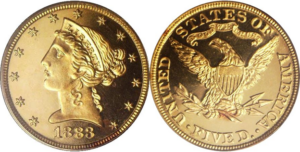
Image: Both sides of an 1883 Liberty Head half eagle gold proof coin.
Source: PCGS
Production Numbers
The Philadelphia Mint struck 61 proof half eagles in 1883, a modest increase over the previous year when only 48 were produced. As was standard practice, some were issued as part of complete proof sets while the remainder were sold as individual pieces throughout the year. The 1883 $5 Liberty gold coin proof set was a notably large one overall, with multiple nickel types included that year due to a transition in the series. The gold denominations, including the half eagle, were struck in their typical range of small proof quantities and sold at a modest premium over face value to cover the additional production costs.
Survival Rate
The higher mintage relative to 1882 did not translate into a noticeably larger surviving population. Survival rates for 1880s proof half eagles are generally low, and the 1883 $5 gold coin is no exception. Only a fraction of the original 61 survive today, preserved by their original owners rather than spent or melted.
Modern Availability
Today the 1883 proof half eagle appears infrequently at auction and is rarely available through dealers. When examples do come to market, they are typically certified by PCGS or NGC, whose population reports provide the most reliable picture of how many graded examples exist and in what conditions.
1883 5 Dollar Gold Coin Circulation Strikes
While the proof half eagle was made for collectors, the Philadelphia Mint simultaneously struck 233,461 half eagles for circulation in 1883. These coins were made quickly, in volume, with no special preparation. Understanding the difference between the two is essential for anyone examining an 1883 $5 liberty gold coin.
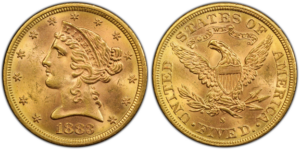
Image: Both sides of an 1883-S Liberty Head half eagle circulation strike.
Source: PCGS
Business Strike Production
The 1883 Philadelphia business strike is a common date. It is readily available in circulated grades and not difficult to find in lower mint state grades either. In lower grades, 1883 $5 gold coin value is driven primarily by gold content, with numismatic premiums modest compared to the proof version.
Distinguishing Proofs from Circulation Strikes
The differences are visible to an experienced eye. Proof coins typically have sharper, more squared rims than the rounded rims of business strikes. The fields on a genuine proof are deeply mirrored rather than the frosty or satiny finish of a circulation strike. Proofs show frosted raised devices contrasting against those mirrored fields, a combination that business strikes do not exhibit to the same degree. Strike sharpness is also noticeably superior on proofs, with finer design details more fully developed. Signs of wear on a proof indicate the coin has seen circulation at some point, even if it was originally struck as a proof.
Grading Proof Liberty Head Gold
Proof coins are graded on the same 70-point scale as circulation strikes, but the standards applied differ. Surface quality, eye appeal, and the presence or absence of hairlines carry more weight than they would on a business strike.
Proof Grade Scale
Proof grades run from PR60 at the low end to a theoretical PR70. For 19th-century proof gold, grades above PR65 are generally rare. Many surviving 1880s proof half eagles fall in the PR63 to PR64 range, reflecting the handling and light cleaning that many experienced over the decades. A PR65 (gem quality) represents a coin with minimal imperfections and strong overall eye appeal. PR66 and above are condition rarities for this era, commanding significant premiums when they appear. PR68 and above are extreme condition rarities, with very few examples known, and auction appearances at those grades are exceptional events.
Cameo Designations
Beyond the numeric grade, proof coins can receive cameo designations from PCGS and NGC. A Cameo designation indicates meaningful contrast between the frosted devices and the mirrored fields. Deep Cameo indicates the strongest possible contrast; NGC uses the equivalent term Ultra Cameo for the same designation. On 1880s proof gold, deep cameo examples are scarce, and coins carrying that designation trade at premiums above non-designated examples of the same numeric grade.
Condition Issues
The most common problem on proof gold is hairlines: fine scratches caused by wiping or cleaning, which show clearly against the mirrored fields. Contact marks from improper handling are also common. Toning is another factor: natural color that has developed over decades is generally viewed positively, while artificial or chemically altered toning reduces desirability. Coins with original, unaltered surfaces are significantly more desirable than those that have been dipped or cleaned, even if the numeric grade is similar.
Third-Party Certification
For any proof 1883 $5 gold coin, certification by PCGS, CACG or NGC is essential. Beyond establishing grade, these services authenticate the coin, confirming it is a genuine proof rather than an altered business strike. Their population reports track every certified example by grade and designation, providing collectors with the most reliable picture of how many examples exist and in what condition.
Current Market Values
The proof 1883 $5 gold coin sits at the intersection of two distinct value drivers: the gold content of the coin itself, and the numismatic premium that comes from genuine rarity. Understanding both is essential for anyone considering a purchase.
Price by Grade
Proof 1883 $5 gold coin value increases significantly with grade. Entry-level examples in PR63 represent the most accessible point of the market, while PR64 coins (one of the more frequently encountered grades) command meaningful premiums above them. PR65 gem examples are substantially more valuable, and PR66 and above are condition rarities where each grade increment represents a dramatic price increase. Cameo and Deep Cameo designations add further premiums at every grade level. Given the thin population of certified examples and infrequent auction appearances, current pricing is best confirmed through specialist dealers rather than general price guides.
Market Dynamics
The gold content of the coin establishes a minimum floor (0.24187 troy ounces of pure gold) but the numismatic premium far exceeds the melt value for any problem-free certified example. Because so few 1883 proof half eagles exist and long-term owners rarely sell, the market is illiquid by nature. Private treaty sales between collectors and specialist dealers are common alongside public auction results for this date.
Within the proof Liberty Head half eagle series, the 1883 $5 gold coin is neither among the rarest dates nor among the most available – its scarcity reflects the generally low survival rates common to 1880s proof gold. For collectors assembling a complete proof date run, the 1883 is a challenging but not impossible date to locate in acceptable grades, and one where condition and originality matter as much as the date itself.
Collecting Liberty Head Proof Gold
The proof 1883 $5 gold coin can be pursued in several different ways depending on a collector’s goals and budget.
Type Collecting
The most accessible approach is acquiring a single proof half eagle as a type coin, i.e. one example representing the With Motto design without committing to a full date run. The 1883 is a challenging but obtainable date, making it a viable candidate for a type set alongside more common proof dates from the 1890s and early 1900s.
Date Set Assembly
Assembling a complete run of With Motto proof half eagles from 1866 through 1907 is a serious long-term undertaking. Many dates rarely appear on the market and require patience to locate in acceptable grades. The proof 1883 $5 gold coin is neither the easiest nor the hardest date in the series to find, but condition and originality will always determine whether a given example is worth pursuing.
Investment Approach
For collectors focused on value, the priority should be originality and grade. Genuinely scarce proof dates in problem-free condition have historically supported strong prices. Buying the best affordable example rather than a compromised higher-grade coin is the standard approach among experienced collectors of 19th-century proof gold.
Authentication Considerations
For a coin as valuable and rare as the proof 1883 $5 Liberty gold coin, authentication is not optional.
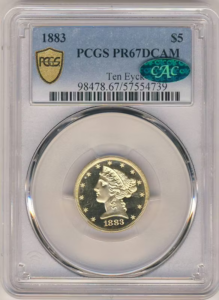
Image: 1883 $5 Liberty Head proof half eagle graded PCGS PR67 Deep Cameo CAC.
Source: Blanchard
Genuine Proof Verification
The most common fraud in this area is not an outright counterfeit but an altered business strike, i.e. a circulation coin that has been polished or chemically treated to create the appearance of mirror fields. The result can be convincing to an inexperienced eye but will not hold up under scrutiny. Genuine proof surfaces have a depth and consistency that artificially polished coins cannot replicate. Strike sharpness, rim definition, and the quality of the frosted devices are all indicators that require expert evaluation.
Third-Party Certification
19th-century US gold is a heavily counterfeited area in American numismatics, with high-quality fakes documented since the 1960s. No proof 1883 $5 gold coin should be purchased without certification from PCGS or NGC. Beyond establishing grade, certification confirms authenticity and provides recourse if questions arise later. Buying from an established numismatic dealer with expertise in proof Liberty Head gold adds a further layer of protection.
Conclusion
The proof 1883 $5 Liberty gold coin is a product of an era when proof gold was made in tiny quantities for a small circle of serious collectors. With only 61 struck and a fraction of those believed to survive today, it represents genuine numismatic scarcity backed by substantial gold content. For type collectors, date set assemblers, and investors in classic American gold alike, it is a coin that rewards patience, careful authentication, and a clear understanding of condition. Certified examples in problem-free grades are rarely available and command prices that reflect both the metal and the history. Consult Blanchard’s numismatic specialists to discuss acquiring a certified 1883 Liberty Head proof or other classic American gold rarities.
FAQs
Are 1883 half eagles rare?
The 1883 Philadelphia business strike is a common date, readily available in circulated and lower mint state grades. The 1883 gold 5 dollar coin proof issue is an entirely different matter and is one of the scarcer survivors from an era of extremely limited proof gold production.
How many 1883 $5 Liberty Head Proofs were made?
The Philadelphia Mint struck 61 proof examples in 1883. Only a fraction of those survive today.
What is a proof 1883 $5 Liberty Head worth?
Proof 1883 $5 gold coin value depends heavily on grade, surface originality, and whether the coin carries a cameo designation. Given the rarity and infrequent market appearances, current pricing is best confirmed through a specialist dealer rather than a general price guide.
How can you tell if an 1883 5 dollar gold coin is a proof?
Genuine proofs display deeply mirrored fields, frosted raised devices, and sharper strike detail than circulation strikes. Third-party certification from PCGS or NGC is the most reliable way to confirm proof status.