Mercury Dime Value: What It’s Worth and Why

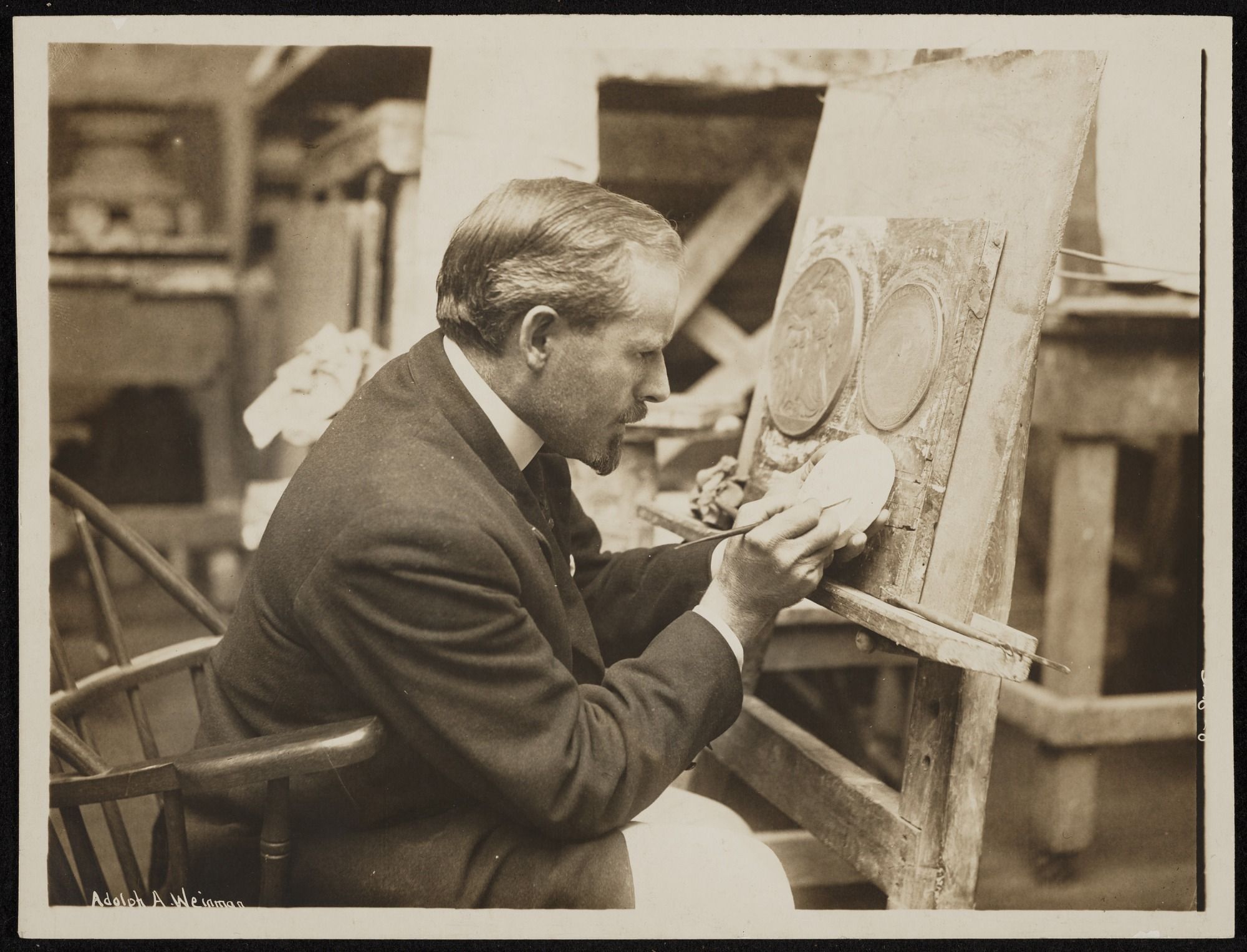
In the last days of October 1916, Americans got their first look at a new dime by the sculptor Adolph A. Weinman, who also designed the Walking Liberty half dollar that year. His Liberty wore a winged cap, whose wings he said stood for “liberty of thought.” Collectors saw the god Mercury instead, and the nickname stuck far better than the official name, the Winged Liberty Head dime.
Mercury dime value starts with silver. Each of the roughly 2.68 billion struck holds about 0.0723 ounces of it, worth about $3.75 with silver at about $52 per ounce (as of November 10, 2026), and most worn dates sell for little more. This guide explains which dates, varieties, and strikes bring real money, and how to check the dime in your hand.
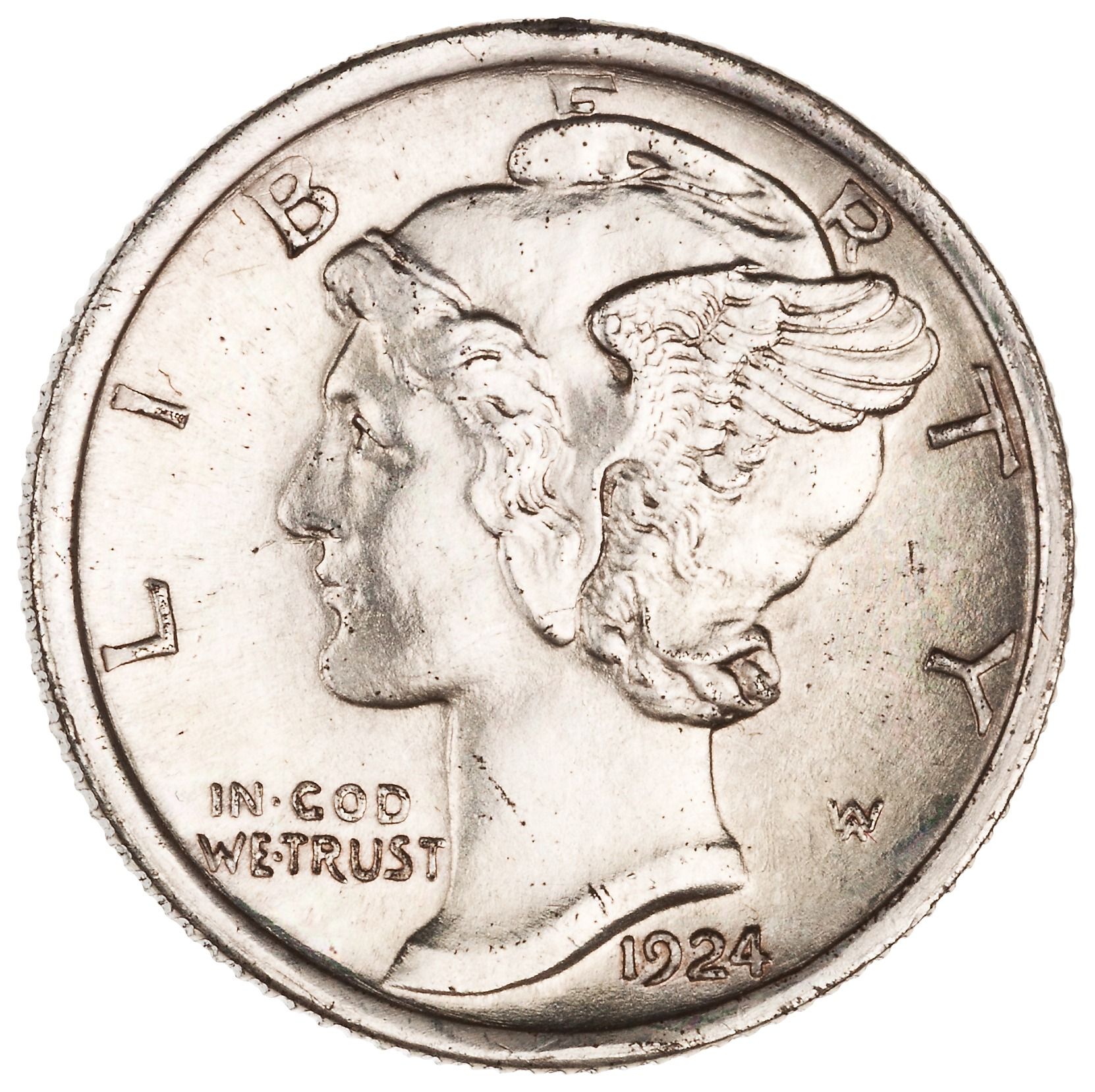
- Every Mercury dime holds about $3.75 of silver (November 2026); worn common dates bring about $5 to $9.
- Uncirculated 1940s dates run about $25 to $75 in MS-63 to MS-65.
- The key date is the 1916-D: 264,000 struck, $1,750 in Good (PCGS).
- Full Bands, a clean split in the center bands on the fasces, turn a $65 MS-65 1945 Philadelphia dime into a $19,000 coin.
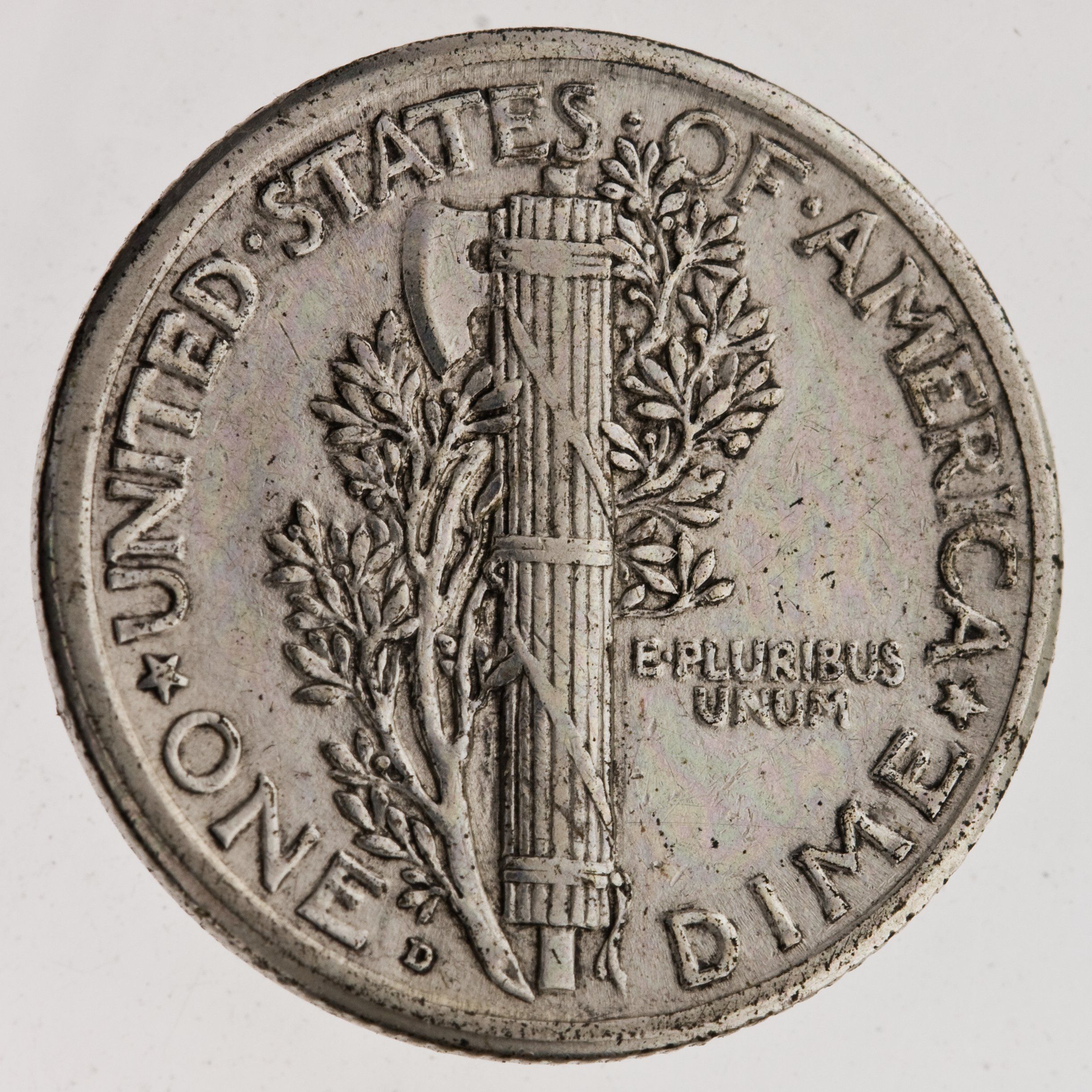
- A D or S beside the fasces on the reverse marks Denver or San Francisco; no mark means Philadelphia.
The Winged Liberty Dime: Background and History
A Law Read as a Deadline
The redesign began with a misreading. The Coinage Act of 1890 barred changing a coin’s design more often than once in 25 years, and the Barber dime, quarter, and half dollar all dated from 1892.
Mint Director Robert W. Woolley treated the 25-year mark as a requirement. A Mint dispatch of March 3, 1916 put it plainly: “Designs of these coins must be changed by law every twenty-five years and the present twenty-five-year period ends with 1916.”
In late 1915 the Commission of Fine Arts steered Woolley to three sculptors: Hermon A. MacNeil, Albin Polasek, and Adolph A. Weinman. From “more than 50” sketch models, Treasury Secretary William G. McAdoo and Woolley chose Weinman’s designs for the dime and half dollar and MacNeil’s for the quarter. For the first time, each of the three silver coins carried its own design.
Liberty in a Winged Cap
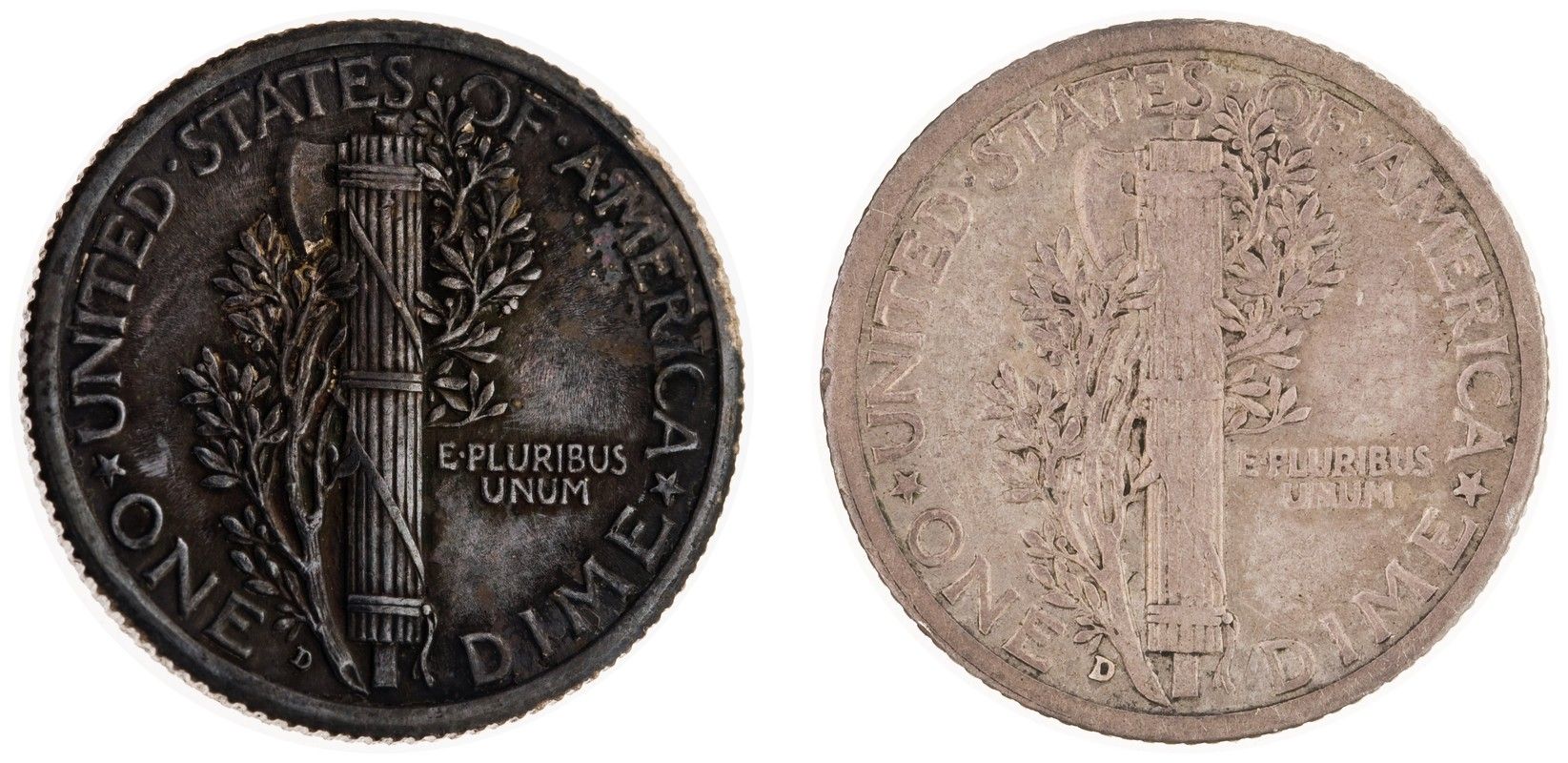
Weinman explained his choices in a letter of November 17, 1916: “The wings crowning her cap are intended to symbolize liberty of thought.” On the reverse, he wrote, the fasces and olive branch “symbolize the strength which lies in unity, while the battle-ax stands for preparedness to defend the Union.”
Neither Weinman’s letter nor the Mint’s own description, a “head of Liberty with winged cap,” mentions Mercury. By January 1917, though, the numismatist David Proskey had written in The Numismatist that Liberty’s cap was “adorned with a wing similar to that we are accustomed to see on the cap of Mercury.” The nickname stuck, even as the Treasury went on calling them “winged Liberty head dimes” as late as 1946.
Weinman never named a model, though a 1913 bust of his tenant Elsie Stevens, wife of the poet Wallace Stevens, is widely believed to lie behind the portrait.
Eleven Models and a Late Start
The Treasury announced the designs on May 30, 1916, and the new coins were expected “soon after July 1.” The dime took far longer. Weinman later told the American Numismatic Society that at least eleven models were made before the Mint was satisfied the coin could be struck in a practical way, and in October The Numismatist reported the issue “indefinitely postponed.”
San Francisco delivered the first new dimes on October 24, 1916, and Philadelphia followed on October 27. Denver delivered its first only on December 29. The Numismatist welcomed the result as “perhaps the most attractive coin this Government has ever put in circulation.”
Thirty Years, Then Roosevelt
Philadelphia, Denver, and San Francisco struck Mercury dimes every year from 1916 through 1945 except 1922, 1932, and 1933, in 77 regular date-and-mint combinations.
After President Franklin D. Roosevelt died on April 12, 1945, the Mint asked for a Roosevelt dime “in sufficient quantity to use them in the infantile paralysis drive,” the March of Dimes he had started in 1938. The last Mercury dimes came off the presses in late December 1945, and the Roosevelt dime was released on January 30, 1946, his birthday.
Historical context America in 1916
- The Mint struck 347,900,469 coins in 1916, its largest year since its founding in 1792; the new silver designs were one reason.
- Silver averaged about 69 cents an ounce in London in 1916, so the metal in a new dime was worth about 5 cents.
- President Wilson signed the National Defense Act on June 3, 1916, after Pancho Villa’s raid on Columbus, New Mexico.
- The Federal Farm Loan Act of 1916 created a federal land bank in each of 12 districts.
- On August 25, 1916, Wilson signed the act creating the National Park Service.
Mercury Dime Value: How Much Is Yours Worth?
Start with the floor: every Mercury dime is worth at least its silver, and most worn dates bring only a little more.
The real money sits in a short list of low-mintage dates, two overdates, and coins whose strike earns a Full Bands designation.
Silver Value: What Every Mercury Dime Is Worth
Mercury dimes are 90% silver and 10% copper and weigh 2.50 grams, so each holds 0.0723 troy ounces of pure silver. To find the melt value, multiply that by the silver price. With silver at about $52 per ounce (as of November 10, 2026), a Mercury dime holds about $3.75 of silver.
The same alloy runs through every U.S. dime, quarter, and half dollar dated 1964 or earlier, including the 1964 Kennedy half dollar. Silver moves daily, so the floor under a worn Mercury dime moves with it.
Common Dates: The 1930s and 1940s
The Philadelphia dimes of the war years are the largest issues: 231,410,000 dated 1944, 205,410,000 dated 1942, 191,710,000 dated 1943, and 175,090,000 dated 1941. Worn examples of these and the 1940 trade close to their silver value, about $5 in Good to Very Fine in NGC’s guide, and $9 for coins already certified by PCGS. The 1930s dates, led by the 1936 and 1939, were struck in the tens of millions too.
In Extremely Fine to About Uncirculated, the 1940s dates bring about $5 to $14. Uncirculated coins run about $25 to $37 in MS-63, $40 to $75 in MS-65, and $50 to $105 in MS-66 (PCGS and NGC guides, November 2026).
The late-1920s Philadelphia dates cost more in top grades: the 1928 and 1929 list at $9 through Very Fine, but $50 to $85 in MS-63 and $155 to $200 in MS-65 (PCGS). At this level the grade sets the price, which is why professional grading matters for uncirculated coins.
Full Bands: The Strike That Multiplies Value
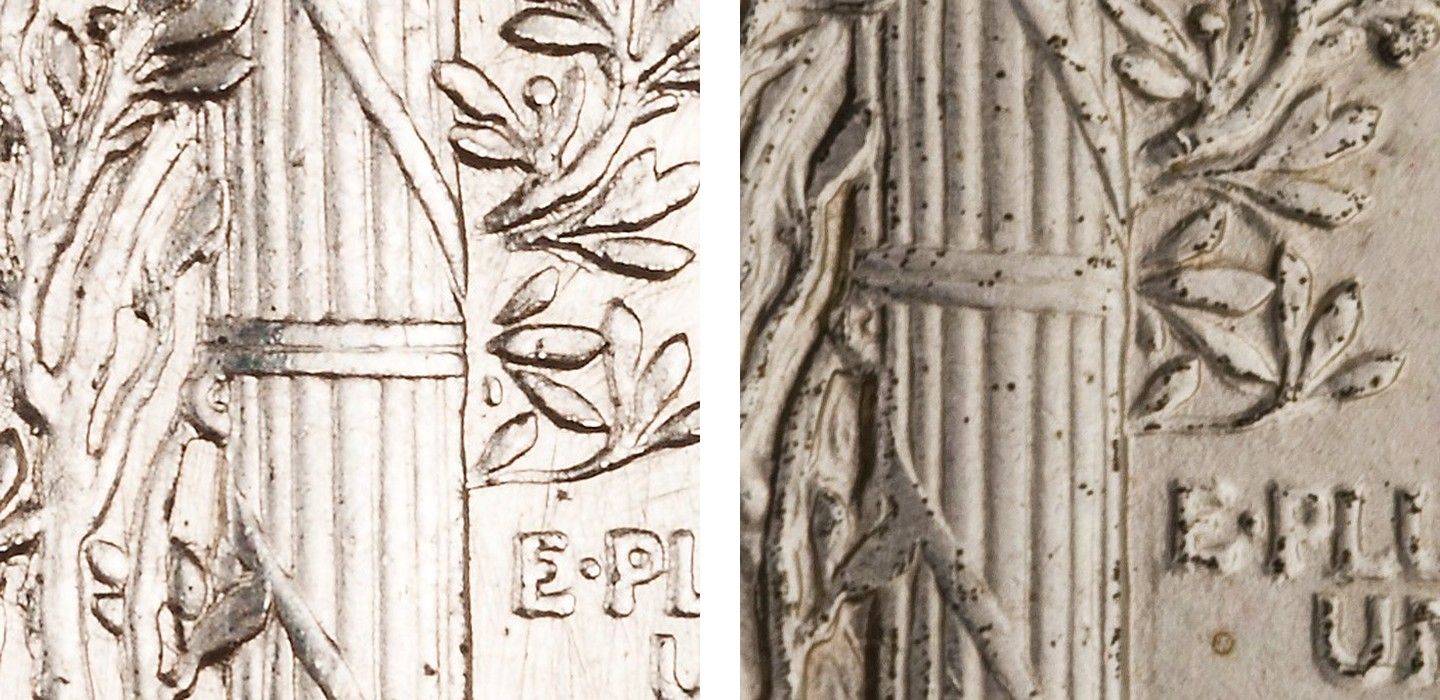
The fasces on the reverse is bound by three sets of bands. When the middle set shows a complete split, PCGS designates the coin Full Bands (FB). It grants the designation only to coins grading MS-60 or better, except the 1916-D and the two 1942 overdates, which can earn it from AU-50. NGC also requires the top and bottom bands to show separation, and it sets no minimum grade.
For most dates the designation adds modestly: a 1941 in MS-65 lists at $65, or $75 with Full Bands (PCGS). Where fully struck coins are scarce, it multiplies the price.
PCGS reports that only 1.26% of the 1945 Philadelphia dimes it has graded qualify. It lists an MS-65 FB example at $19,000, and one sold for $21,960 at Heritage in March 2026. A 1945-D with Full Bands, by contrast, is common.
The Key Dates
The 1916-D is the key to the series and the only issue under a million: Denver struck just 264,000. It delivered its first new dimes only on December 29, 1916, while striking 6,540,800 of the old Barber quarters that year. The usual explanation, that Denver shifted its effort to quarters, is speculation.
PCGS lists the 1916-D at $1,750 in Good, $6,000 in Very Fine, and $38,500 in MS-65. PCGS-graded examples in Good sold for $1,342 to $1,769 at Heritage in 2026.
The 1921 and 1921-D, at 1,230,000 and 1,080,000, come next. In the year to June 1922 the Mint coined more than 92 million silver dollars from Pittman Act bullion, and “of coins below the dollar but few were executed.” In Good the two list at $85 and $110, in Very Fine at $275 and $385 (PCGS).
The Depression produced the rest of the short list: the 1931-D (1,260,000), 1931-S (1,800,000), 1930-S (1,843,000), and 1931 (3,150,000). Many early-1930s coins were saved in rolls, according to Mercury dime specialist David Lange, so the 1931-D lists at only $375 in MS-65. The 1926-S (1,520,000) runs the other way: about $20 in Good, but $5,500 in MS-65.
Overdates and Other Varieties
1942/1 (FS-101). One Philadelphia working die was hubbed with both a 1941-dated and a 1942-dated hub, so traces of the 1 show beneath the 2, along with doubling on IN GOD WE TRUST and the Y of LIBERTY. It was discovered in 1943. PCGS lists it at $425 in Good and $12,000 in MS-65.
1942/1-D (FS-101). The Denver version is slightly scarcer than the Philadelphia coin, per PCGS, and lists at $400 in Good.
1945-S Micro S (FS-512). The smallest mint mark of the series appears only on this date. It is popular but plentiful: PCGS lists it at $135 in MS-65, or $750 with Full Bands.
Look-alikes that carry no premium. The small AW on the obverse is Weinman’s monogram; the only mint marks on Mercury dimes of 1916 to 1945 are D and S. Dimes dated 1923-D or 1930-D are counterfeits, since Denver struck no dimes in those years. A gold Mercury dime is either one of the Mint’s 2016 gold centennial coins or a plated novelty.
Notable Auction Records
Every top result in this series belongs to a Full Bands coin.
| Coin and Grade | Price Realized | Auction House | Sale Date |
|---|---|---|---|
| 1916-D, MS-67 FB (PCGS) | $204,000 | Stack’s Bowers Galleries | March 2020 |
| 1942/1, MS-66 FB (PCGS) | $102,000 | Heritage Auctions | May 2024 |
| 1945, MS-67+ FB (PCGS) | $96,000 | Heritage Auctions | January 2018 |
| 1921, MS-67 FB (PCGS) | $32,200 | Heritage Auctions | August 2010 |
| 1916-D, VF-20 (PCGS) | $5,734 | Heritage Auctions | May 2026 |
| 1916-D, G-4 (PCGS) | $1,464 | Heritage Auctions | November 2026 |
How to Check Your Mercury Dime
Five Checks for Any Mercury Dime
- The date. It sits in the lower right of the obverse. Mercury dimes run from 1916 to 1945, with none dated 1922, 1932, or 1933, and 1916 dimes were also struck in the older Barber design.
- The mint mark. Turn the coin over and look at the lower left of the fasces, near the word ONE. A D means Denver and an S means San Francisco; Philadelphia coins carry none.
- The AW. The small monogram to the right of Liberty’s neck is Weinman’s, found on every Mercury dime.
- The bands. On an uncirculated coin, look at the middle bands of the fasces under a magnifier. A clean split between them is the first sign of Full Bands.
- The variety dates. On a 1942, look for a 1 beneath the 2. On a 1945-S, check whether the S is unusually small.
A genuine Mercury dime weighs 2.50 grams, measures 17.9 millimeters across, and has a reeded edge.
Altered Coins and Look-Alikes
The valuable coins in this series attract alterations:
- Added-D 1916 dimes. “The bad guys add a ‘D’ to a 1916 Philadelphia,” writes PCGS’s David Hall, who calls the 1916-D “one of the most counterfeited of all U.S. rare coins.” NGC advises checking for a seam where the added letter meets the field, tool marks, and discoloration. In low grades, NGC notes, many supposed 1916-Ds are simply worn 1916-S dimes.
- Altered 1921 dates. The 4 of a 1941 dime can be removed and replaced with a 2. On a genuine 1921 the 9 is open, and a 1921-D carries the smaller D used through 1934, while a 1941-D has the larger D.
- Knife-cut bands. PCGS warns that coins with bands cut by a sharp tool, such as a pen knife, to imitate Full Bands “are commonly encountered on the marketplace.”
When Professional Appraisal Makes Sense
For a worn common date, a grading fee costs more than the coin is worth. Certification earns its cost in three cases:
- A 1916-D, 1921, 1921-D, 1926-S, or 1931-D, or any 1942 with a doubled date
- An uncirculated coin with split center bands, especially a 1945 Philadelphia
- A coin you suspect has been altered
Professional services like PCGS or NGC provide authentication and a grade the market trusts. If you’ve inherited a jar or an album of old dimes and aren’t sure which deserve a second look, Blanchard’s numismatists can evaluate coins like these.
What Collectors and Investors Watch
Mercury dimes sit in two markets. Worn common dates trade largely on their silver, so their prices follow the metal. Key dates, overdates, and Full Bands gems trade on scarcity and certified populations, where the grading service matters too: NGC-graded 1945 MS-65 FB dimes sold for about 40% to 55% of the prices of PCGS-graded ones in 2015 to 2017.
The tradeoffs are real: dealer premiums over silver on common dates, price gaps between the grading services, and a Full Bands market that rewards patience and a good magnifier.
Collectors chasing a complete set of all 77 regular issues meet the 1916-D early and the Full Bands question late; collecting Mercury dimes as a full set is its own project.
Added mint marks, altered dates, and knife-cut bands are common enough in this series that buying certified coins from an established dealer is the practical safeguard. Blanchard offers certified rare coins graded by PCGS and NGC, the standard any reputable dealer should meet.
Frequently Asked Questions
1. Are Mercury dimes real silver, and what is their melt value?
Yes: 90% silver and 10% copper, with 0.0723 troy ounces of pure silver. Multiply that by the silver price for the melt value, about $3.75 with silver at about $52 per ounce (as of November 10, 2026).
2. What is a 1942 Mercury dime worth?
An ordinary 1942 is one of the most common dates: about $5 to $9 when worn and about $65 in MS-65 (PCGS). The valuable 1942 is the 1942/1 overdate, which shows traces of a 1 beneath the 2 and lists at $425 even in Good.
3. Which Mercury dime is the most valuable, and is any worth $1 million?
The top results belong to Full Bands gems: a 1916-D in MS-67 FB brought $204,000 in March 2020, and a 1942/1 in MS-66 FB brought $102,000 in May 2024. No Mercury dime has come close to $1 million. The million-dollar dimes belong to an earlier series: an 1894-S Barber dime sold for $1,997,500 at Heritage in January 2016.
4. Where is the mint mark on a Mercury dime, and what if it has none?
The mint mark is on the reverse, at the lower left of the fasces near ONE: a D for Denver or an S for San Francisco. A Mercury dime with no mint mark was struck in Philadelphia, which is normal and adds no premium.
5. How can you tell if a 1916-D Mercury dime is real?
Most fakes are genuine 1916 Philadelphia dimes with an added D, so look for a seam or tool marks around the mint mark. A coin worth more than $1,000 even in Good deserves certification by PCGS or NGC before you buy or sell it.
6. Is there a 1914 or 1922 Mercury dime?
No. The design first appeared in 1916, so a dime dated 1914 is a Barber dime, and 1916 has both designs. No dimes were struck in 1922, 1932, or 1933, and from 1946 the dime carries Roosevelt.
Conclusion
Mercury dime value follows a clear order: silver under every coin, a few dollars more for worn common dates, tens of dollars for uncirculated ones, and above them the 1916-D, the 1921 pair, the 1942 overdates, and Full Bands rarities like the 1945 Philadelphia.
Checking takes a minute: read the date, turn the coin over for the mint mark, and look closely at the bands. Most will prove to be an affordable piece of Weinman’s 1916 design, with its silver intact.
Ready to add classic 90% silver to your holdings? Explore Blanchard’s 90% silver coins, struck in the same alloy as Weinman’s dime.
Want to read more? Subscribe to the Blanchard Newsletter and get our tales from the vault, our favorite stories from around the world and the latest tangible assets news delivered to your inbox weekly.