Platinum Bars: The Case for Investing in This Undervalued Precious Metal

Platinum is often cited as being around 30 times rarer than gold. Yet for much of the past decade, it has traded well below its historical relationship to the yellow metal – a disconnect that has drawn increasing attention from value-oriented investors. Platinum bars are one of the most cost-efficient ways to gain exposure to this metal, carrying lower premiums than coins while providing direct ownership of a scarce, industrially critical asset. This article covers what platinum bullion bars are, how they compare to coins, which manufacturers to look for, and how they fit within a broader precious metals portfolio.
The Case for Platinum Investment
Platinum’s investment appeal today rests on a combination of genuine scarcity, suppressed pricing relative to historical norms, and an industrial demand base that spans multiple sectors.
Historical Price Relationships
For most of the 20th century, platinum traded at a premium to gold – a relationship that made intuitive sense given its far greater geological scarcity and essential industrial role. That relationship inverted in the mid-2010s and has largely persisted since. The disconnect is notable: a metal that is approximately 30 times rarer than gold, with robust industrial demand and constrained supply, trading well below it. Many analysts argue this gap is unsustainable, and that a reversion toward historical norms represents a meaningful upside case for platinum investors.
Platinum vs. Palladium
Platinum also commanded a premium over palladium for most of its traded history, before the diesel emissions scandal and surging gasoline vehicle demand flipped that relationship after 2015. That gap has narrowed considerably since 2022 as palladium pulled back from record highs and platinum attracted renewed interest both as a substitute in gasoline catalysts and as an asset trading below its own historical norms.
Rarity and Supply Constraints
Global Scarcity
Approximately 170-180 metric tons of platinum are mined annually, compared to over 3,000 metric tons of gold. To put that in perspective, all the platinum ever extracted in human history could fit inside an average family home. That is not a cyclical dip in production – it reflects the fundamental geological rarity of the metal, which occurs in only a handful of locations worldwide and requires processing vast quantities of ore to yield small amounts of refined platinum.
Supply Concentration
Around 70-80% of global platinum supply comes from South Africa, where mining operations face persistent structural challenges such as energy instability, aging infrastructure, and periodic labor disruptions. Russia accounts for most of the remainder. This level of geographic concentration means that disruptions in either country can move the platinum market significantly, and investors holding the metal carry an implicit geopolitical risk premium that has historically supported prices during periods of uncertainty.

Aerial view of the Mogalakwena platinum mine in South Africa’s Limpopo Province, with heavy equipment and tiered excavation levels
Source: NS Energy
Industrial Demand
Platinum’s demand base is broader than most investors appreciate. Automotive catalytic converters remain the largest single application, but platinum also plays essential roles in chemical processing, petroleum refining, glass manufacturing, and medical devices. Emerging hydrogen fuel cell technology represents a potential long-term demand catalyst, as platinum is a key component in proton exchange membrane fuel cells. This diversification means platinum is not hostage to any single industry’s fortunes – a meaningful distinction from metals with more concentrated demand profiles.
Investment Demand
Platinum currently attracts relatively modest investment demand compared to its industrial footprint. ETF holdings remain well below historical peaks, and institutional positioning is light. That under-ownership, at a time when supply is constrained and the price-to-gold ratio remains historically anomalous, is precisely what makes platinum interesting to contrarian investors: the metal appears to be pricing in pessimism that its fundamentals do not fully support.
For a detailed breakdown of the supply forces currently driving the platinum market, watch this video analysis.
Platinum Bars: Formats and Specifications
Bars of platinum are straightforward investment products: their value lies in their metal content, not their appearance. Understanding what you are buying helps investors make informed decisions about format, size, and sourcing.
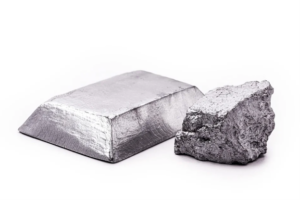
A refined platinum bar alongside a raw platinum ore nugget, illustrating the metal from its natural state to investment-grade form
Source: AZO Materials
Purity and Markings
Investment-grade platinum bars are produced to a standard purity of .9995 fine platinum, i.e. 99.95% pure. Each bar is stamped with its weight, purity, and the refiner’s hallmark. Smaller bars, which are what most retail investors buy, typically come sealed in assay packaging that confirms authenticity, and reputable refiners incorporate security features that allow verification before purchase.
Size Range
Platinum bars for sale are available from 1 gram up to 10 ounces and beyond, giving investors flexibility to build positions incrementally or make larger acquisitions at lower per-ounce premiums.
1 oz Platinum Bars
The 1 oz bar is the most common and liquid platinum bar format and the natural starting point for most investors. It strikes the best balance between accessibility and premium efficiency. It is large enough to keep percentage premiums reasonable, but small enough that resale is straightforward through most dealers. For investors building a platinum position incrementally, 1 oz platinum bars are the most practical building block.
Fractional Bars
Fractional platinum gram bars – available in 1 gram, 5 gram, and 10 gram denominations – suit investors who want to enter the platinum market with a smaller initial outlay or who prefer to accumulate gradually over time. The trade-off is premium efficiency: smaller bars, like 1 gram platinum bars for sale, carry higher percentage premiums over spot, which reduces the cost effectiveness of the investment. They are more popular in Asian markets, where smaller denominations have traditionally seen stronger retail demand.
Multi-Ounce Bars
The 10 oz bar is the most widely available larger format. 10 oz platinum bars for sale offer meaningfully lower per-ounce premiums compared to smaller sizes, making them well suited to investors building a more substantial platinum position. Formats beyond 10 oz exist but are primarily aimed at institutional buyers and dealers. The resale market for very large bars is narrower, which is a practical consideration for investors who may need to liquidate quickly.
Major Platinum Bar Manufacturers
The platinum bar market is served by a range of respected refiners – Swiss houses like Valcambi and Argor-Heraeus, the Perth Mint in Australia, and others – each producing bars to consistent purity and weight standards. Among the most recognized names investors are likely to encounter are PAMP Suisse, Johnson Matthey, and Engelhard.
PAMP Suisse
PAMP, i.e. Produits Artistiques Métaux Précieux, is a Swiss refiner and one of the most recognized bullion brands in the world. Their platinum investment bars are distinguished by the signature Lady Fortuna design, the Roman goddess of fortune, which has become one of the most iconic images in the bullion market. Beyond aesthetics, PAMP bars incorporate VeriScan authentication technology, which uses microscopic surface mapping and a digital verification database to confirm genuineness – a meaningful feature in a market where counterfeiting is a real concern. For investors prioritizing global liquidity and dealer acceptance, PAMP is the benchmark.
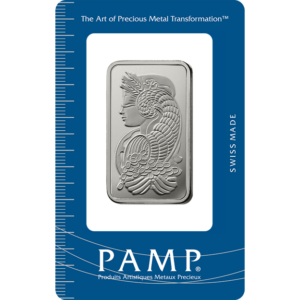
PAMP Suisse platinum bar featuring the iconic Lady Fortuna design, sealed in assay packaging
Source: PAMP Suisse
Johnson Matthey
Johnson Matthey is a British refiner with a long history as one of the world’s leading precious metals processors and catalyst manufacturers. The company no longer produces retail bullion bars, having exited that market in the early 2010s, but JM bars are deeply embedded in the secondary market and remain widely recognized and readily accepted by dealers globally. Their straightforward, no-frills design reflects the company’s industrial heritage.
Engelhard
Engelhard built its reputation over decades as a major American precious metals refiner before being acquired by BASF in 2006, after which retail bullion bar production ceased. Engelhard platinum bullion bars now trade exclusively on the secondary market, where they retain strong dealer acceptance and a degree of collectible appeal that other secondary market bars do not always command. Among bullion investors who follow the market closely, Engelhard is a trusted and sought-after name.
Comparing Platinum Coins and Bars: Cost, Liquidity and Strategy
For investors choosing between platinum coins and bars, the decision comes down to three factors: cost, liquidity, and purpose.
Cost Comparison
Bars carry lower premiums over spot than coins. Government-minted platinum coins, like the American Platinum Eagle, involve higher production costs, legal tender status, and design complexity that all feed into the premium. For investors focused purely on accumulating platinum efficiently, bars are the more economical vehicle. That cost difference compounds meaningfully when building a larger position: the premium saving per ounce across multiple bars adds up to a material difference in total outlay.
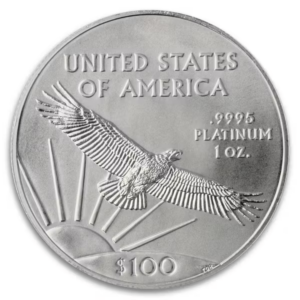
Reverse side of a 1 oz American Platinum Eagle coin showing a bald eagle in flight, with .9995 platinum purity and $100 face value inscriptions
Liquidity Trade-offs
Coins hold a marginal liquidity advantage in retail channels. Government backing and wider public recognition mean coins are slightly easier to sell quickly, particularly to buyers outside the specialist dealer network. That said, bars from reputable refiners are readily accepted by dealers. Both formats are typically verified through visual inspection and weighing, with more detailed testing reserved for cases where authenticity is in question.
Strategic Allocation
The bars-versus-coins question is not always either/or. Many investors hold a combination of both: bars as the cost-efficient core of their platinum position, and coins for their broader recognition and, in some cases, collector appeal. Investors with a pure bullion focus and a longer time horizon tend to favor bars; those who value flexibility or wider recognizability tend to mix in coins. The right approach depends on how much platinum you are accumulating, over what timeframe, and how quickly you may need to liquidate.
Authentication and Security
Platinum’s value makes it a target for counterfeiters, though gold and silver are more frequently targeted given their higher liquidity. Investors should still know how to spot fake platinum bars before completing any purchase.
Verifying Genuine Platinum Bars
Several methods exist for confirming authenticity, ranging from simple checks an investor can perform at home to professional testing used by dealers.
Weight and Dimensions
The most basic check is weight. A genuine platinum bar should match its stated specifications precisely, with even small discrepancies being a red flag. Unlike gold, platinum’s exceptionally high density of 21.45 g/cm³ makes it difficult to fake convincingly with common substitute metals, but weight verification remains a sensible first step regardless.
Specific Gravity Testing
Water displacement testing measures a bar’s actual density against platinum’s known value. It is more involved than simple weighing but provides a higher degree of confidence without specialist equipment.
Professional Testing
X-ray fluorescence (XRF) testing is the industry standard for purity verification, used routinely by dealers and refiners. It confirms metal composition without damaging the bar and is the most reliable method available for retail bullion transactions.

A handheld XRF analyzer being used to test precious metals including gold bars, coins, and jewelry
Source: Evident
Counterfeit Prevention
Buying from established dealers and sticking to bars from reputable refiners with built-in security features significantly reduces counterfeit risk. While PAMP’s VeriScan is among the most advanced authentication systems available, other refiners like Argor-Heraeus incorporate their own proprietary security technologies as well. Sealed assay packaging that shows no signs of tampering is another important indicator.
Storage and Handling
Physical platinum requires secure storage. The right solution depends on the size of your holding and how quickly you may need to access it.
Home Storage
For smaller holdings, a quality home safe offers convenience and immediate accessibility. It should be fire-resistant, heavy enough to resist removal, and ideally bolted to the structure of the building. Standard homeowner’s insurance policies typically do not cover precious metals adequately – investors holding platinum at home should arrange a specialist rider or separate policy, and keep documentation including photographs, receipts, and serial numbers where available, stored securely in a separate location from the metal itself.
Professional Vault Storage
For larger holdings, professional vault storage is worth considering. Allocated storage – where specific bars are registered to you and held separately from other clients’ metal – is preferable to unallocated arrangements, where you hold a claim on a pool of metal rather than identifiable bars, which introduces counterparty risk. Reputable vault facilities include insurance as part of their fee structure and offer clear retrieval protocols for when you need to sell or transfer your holdings.
Portfolio Integration Strategy
Platinum bars sit most naturally within a precious metals portfolio as a complement to a core gold position, adding industrial demand exposure and scarcity value that gold alone does not provide.
Building a Position
For investors new to platinum, starting with 1 oz is the most practical approach when you first buy platinum bars. They are liquid, straightforward to store, and allow investors to build familiarity with the market before committing to larger formats. From there, dollar-cost averaging, i.e. adding to the position incrementally over time rather than deploying capital all at once, reduces exposure to short-term price volatility and is well suited to a metal whose price can move sharply in either direction.
Position Sizing
Platinum is typically held as a satellite position within a broader precious metals allocation rather than a core holding. The appropriate size depends on individual risk tolerance, time horizon, and existing portfolio composition, but most advisors suggest keeping any single commodity position within a range that does not create outsized concentration risk.
PGMs as a Pair
Investors who hold both platinum and palladium gain exposure to the full platinum-group metals complex, with each metal responding differently to shifts in automotive demand, industrial activity, and geopolitical risk. Owning both reduces metal-specific exposure and allows for rebalancing as the price relationship between the two evolves – a strategy that has historically rewarded investors who pay attention to relative value within the PGM complex.
Conclusion
Platinum bars offer a cost-efficient entry point into one of the rarest and most industrially essential metals on the planet. The investment case rests on genuine scarcity, a diversified demand base, and a price relationship to gold that remains anomalous by historical standards. Bars from established refiners deliver that exposure at lower premiums than coins, in formats flexible enough to suit a range of portfolio sizes and investment horizons. For investors looking to add a hard asset with both industrial fundamentals and mean-reversion potential, these bars are worth serious consideration. Explore Blanchard’s selection of platinum bars from recognized refiners to add this undervalued precious metal to your investment portfolio.
FAQs
1. What are platinum bars?
Platinum bars are investment-grade bullion products made from .9995 fine platinum, produced by refiners and stamped with their weight, purity, and hallmark.
2. How much are platinum bars worth?
Platinum bars price is determined by their weight and the current spot price of platinum, plus the dealer’s premium over spot.
3. Are platinum bars a good investment?
Platinum bars offer exposure to a genuinely scarce metal with diversified industrial demand, currently trading below its historical relationship to gold, which many analysts view as a compelling value case.
4. What size platinum bars should I buy?
For most investors, the 1 oz bar is the best starting point. It offers the best balance of liquidity, accessibility, and premium efficiency, with larger formats worth considering as a position grows.