British Sovereign Gold Coin: Mint Marks and Monarchs Through 200 Years of History
Posted on — Leave a commentThe British Sovereign gold coin struck in 2025 carries the exact weight, purity, and gold content of one minted in 1817, an almost unmatched continuity in global coinage. This 22-carat gold classic has moved through multiple monarchs, two world wars, and the full arc of the British Empire, all while maintaining its specifications with remarkable precision. Yet this uniformity disguises a surprisingly complex series. Differences in mint marks, monarch portraits, and production periods mean that coins which appear identical at first glance can vary dramatically in rarity and value. This guide outlines how to identify Sovereigns across eras, the role of worldwide mint locations, and what separates standard bullion pieces from the numismatic coins that command meaningful premiums.
What Is a British Sovereign Gold Coin?
The British Sovereign represents one of history’s most enduring gold coins, combining consistent specifications with evolving designs that reflect two centuries of British monarchy.
Historical Context
The modern British Sovereign emerged in 1817 during Britain’s Great Recoinage, a comprehensive reform of the nation’s currency system following the Napoleonic Wars. The name itself references earlier English gold sovereigns minted from the late 15th through the 17th centuries, connecting the new coin to centuries of British monetary tradition. Created as legal tender with a face value of one pound sterling, the Sovereign became a cornerstone of the British Empire’s monetary system, circulating throughout territories from London to the furthest colonial outposts.
Specifications That Never Changed
The physical characteristics of the British gold Sovereign coin were established in 1817 and have remained constant for more than 200 years. Each coin weighs exactly 7.98 grams with a diameter of 22.05mm. The gold content is 7.32 grams of pure gold – equivalent to 0.2354 troy ounces – achieved through 22-carat purity (91.67% gold alloyed with copper). This copper addition provides durability for circulation while maintaining substantial gold content.
These specifications remained fixed for practical reasons: consistency enabled international trade, as merchants and banks worldwide could rely on the Sovereign’s exact gold content without testing individual coins. The standardization also facilitated the coin’s role in the gold standard system that dominated international finance through the 19th and early 20th centuries. A Sovereign from 1820 could circulate alongside one from 1920 with identical intrinsic British Sovereign gold coin value, creating remarkable continuity across a century of political, technological, and social transformation.
Watch this video for an accessible introduction to the British Sovereign gold coin.
The Iconic Design: St. George and the Dragon
The Sovereign’s enduring visual identity stems from designs that balance consistency with monarchical evolution.
Benedetto Pistrucci’s Masterpiece
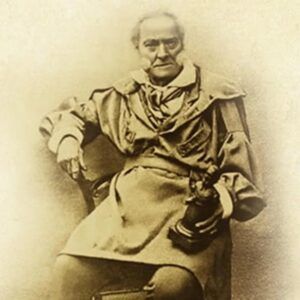
Image: Benedetto Pistrucci, the Italian engraver who designed the iconic St. George and the Dragon reverse.
Source: The Royal Mint
An Italian engraver working at the Royal Mint created what would become Britain’s most recognizable coin image. Benedetto Pistrucci’s 1817 design depicts St. George mounted on horseback, slaying a dragon with a sword, a scene symbolizing the triumph of good over evil and, by extension, British strength and virtue. The composition’s classical style and fine detail established an artistic standard that has defined the British gold Sovereign coin for two centuries.
While Pistrucci’s St. George reverse became the default design, not all Sovereigns feature it. Victorian issues from 1838 to 1887 used a shield reverse displaying the royal arms, and occasional commemorative or special releases have featured alternative heraldic designs. These variations create distinct collecting categories within the broader Sovereign series.
Obverse Portraits Across Monarchs
The obverse carries the reigning monarch’s portrait, evolving with each succession and sometimes within a single reign. Long-reigning monarchs like Victoria and Elizabeth II appeared in multiple portrait styles – young head, jubilee, and veiled/old head versions reflecting their aging and different artistic approaches across decades. Each portrait change from George III through Charles III captures period-specific artistic conventions, creating visual markers that help collectors instantly identify a coin’s era even before checking the date.
The Monarchs of the Modern British Gold Sovereign Coin
Since 1817, nine British monarchs have appeared on Sovereigns, each reign creating distinct collecting opportunities based on production span, mintage levels, and historical circumstances.
George III (1817-1820)
George III Sovereigns represent the series’ inaugural issues, struck during the final years of his reign. Their status as first modern Sovereigns gives them inherent collector appeal, though the short production window and two-century age create natural scarcity that commands premiums over later common dates.
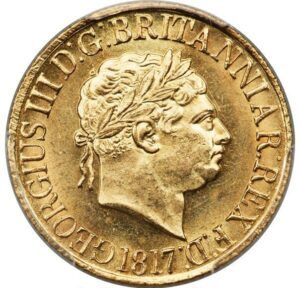
Image: 1817 George III Sovereign showing the first modern Sovereign design.
Source: Heritage Auctions
George IV (1820-1830)
George IV appears in two portrait styles: bare head and laureate (crowned with laurel) head variations. Production remained relatively consistent through the decade, making these coins moderately available today, though still significantly scarcer than Victorian issues.
William IV (1830-1837)
William IV’s brief seven-year reign produced the scarcest mainstream British Sovereign gold coin monarch. Limited production years mean these coins command substantial premiums regardless of condition, with even worn examples valued well above gold content due to genuine rarity.
Victoria (1837-1901)
Victoria’s 64-year reign dominates vintage Sovereign availability. Three distinct portrait types – Young Head (1838-1887), Jubilee Head (1887-1893), and Old or Veiled Head (1893-1901) – reflect her aging across the era. The Young Head period used a shield reverse rather than St. George, creating a major design distinction. High production volumes, particularly in later decades, make Victorian Sovereigns the most accessible vintage issues for collectors today.
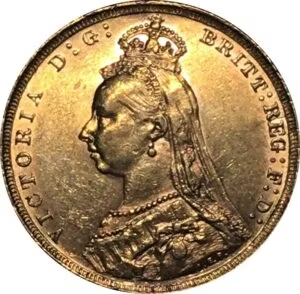
Image: Victorian Sovereign showing Queen Victoria’s Veiled Head or Old Head portrait design.
Source: Numista
Edward VII (1901-1910)
Edward VII’s nine-year reign created moderate scarcity – shorter than Victoria but longer than William IV. Consistent design throughout the period simplified production, though colonial mint output during this era holds particular significance for collectors focused on branch mint issues.
George V (1910-1936)
World War I dramatically impacted George V British Sovereign gold coin production. Pre-war mintages were substantial, but wartime demands reduced output significantly. The 1925 and later dates show particular scarcity as Britain moved away from gold circulation, making post-1920s issues notably harder to find.
George VI (1936-1952)
George VI Sovereigns are exceptionally rare. Only proof specimens were struck in 1937, followed by complete wartime cessation. Limited post-war resumption means any George VI Sovereign represents a significant numismatic prize, with circulation strikes virtually nonexistent.
Elizabeth II (1952-2022)
Elizabeth II’s 70-year reign saw British Sovereign gold coin production resume as bullion rather than circulating currency. Brief output in 1957-1959 preceded regular annual production from 1974 forward. Five different portrait designs across her reign reflect evolving artistic styles. Modern production volumes make these the most common Sovereigns available, serving both bullion investors and collectors.
Charles III (2022-Present)
Charles III Sovereigns debuted in 2022 with strong collector interest in first-year issues. The design maintains St. George and the Dragon on the reverse while introducing the new monarch’s portrait, continuing two centuries of Sovereign tradition into a new reign.
Understanding Mint Marks: Where Was Your Sovereign Made?
A tiny letter on the reverse can multiply British Sovereign gold coin value several times over, as mint marks identify which facility across the British Empire struck the coin.
London Mint: The Unmarked Standard
Sovereigns without mint marks originated at the Royal Mint in London, the default production facility. London historically produced the highest volumes, making unmarked Sovereigns generally the most available for any given date. While London coins don’t carry scarcity premiums based purely on origin, they remain the baseline against which branch mint issues are compared.
Branch Mint Production Across the Empire
Britain established colonial mints to convert locally mined gold into coinage, reducing shipping costs and supporting regional economies.
Sydney (S)
Australia’s first mint struck British Sovereign gold coin pieces from 1855 through 1926, spanning the gold rush era and beyond. High production volumes make Sydney Sovereigns relatively available, though strong collector demand from the Australian market supports premiums over London issues.
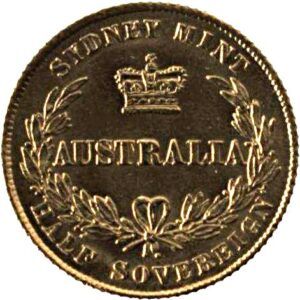
Image: Victorian era Australian Sovereign showing the distinctive shield reverse design used before St. George.
Source: Numista
Melbourne (M)
Operating from 1872 to 1931, Melbourne produced substantial quantities with notable year-to-year variation. Certain dates command significant premiums due to lower mintages, making Melbourne mint marks worth careful examination.
Perth (P)
Perth’s 1899-1931 production span makes it the latest-starting Australian mint. Generally lower volumes than Sydney or Melbourne create inherent scarcity, with Australian collectors particularly focused on completing Perth date runs.
Bombay (I)
India’s mint produced Sovereigns in 1918 only, making any Bombay-marked coin extremely rare. These command premium multiples reaching five to ten times comparable London examples.
Ottawa (C)
Canadian production from 1908 to 1919 created limited-year scarcity that appeals to both British and Canadian collectors, with premiums reflecting genuine rarity rather than speculative demand.
Pretoria (SA)
South Africa’s Pretoria Mint struck Sovereigns from 1923 to 1932. Most issues carry the “SA” mint mark, though a few early pieces can be identified by subtle design features rather than a visible mark. Production volumes were moderate, giving collectors accessible branch-mint options without extreme premiums.
Key Dates and Rare Sovereigns
Specific years and mint combinations create significant value premiums based on mintage levels and historical circumstances, with British Sovereign gold coin price varying dramatically depending on date and mint mark.
Victorian Era Rarities
Several Victorian Sovereigns stand out for exceptionally low mintages or unique production circumstances. The 1841 London issue remains one of the rarest circulation Sovereigns ever struck, while the 1863 London coin without a die number represents another major rarity due to its extremely limited surviving population. The 1879 Sydney Sovereign is the great Australian key date of the era, produced in very small quantities and highly prized by collectors.
Edwardian Through George VI Keys
Moving into the early 20th century, Edward VII’s 1902 Matte Proof is a special striking with a distinctive satin finish. George V wartime issues – particularly the 1917 London Sovereign – show sharply reduced mintages, while 1920 London continues the trend of post-war scarcity. The one-year 1918 Bombay issue and select low-mintage Ottawa dates command strong premiums. For George VI, only the 1937 Proof was struck; no circulation issues exist, making any genuine specimen a significant numismatic piece.
Modern Rarities
Elizabeth II’s era includes certain low-mintage dates and special proof issues, especially from the 1980s and 1990s, though none approach the scarcity of pre-1953 key dates.
British Half Sovereign Gold Coin: The Smaller Alternative
Half Sovereigns offer an accessible entry point into British gold coinage while maintaining the full Sovereign’s design integrity and historical continuity.
Specifications and Design
Weighing 3.99 grams, i.e. precisely half the full Sovereign, and measuring 19.30mm in diameter, the British Half Sovereign gold coin maintains the same 22-carat purity and proportional gold content. Designs mirror their full-sized counterparts: the St. George and the Dragon reverse (with the same exceptions, such as Victorian shield issues) and the corresponding monarch portraits across the same reigns.
Production and Collecting Appeal
Half Sovereigns were struck in parallel with full Sovereigns, following the same portrait changes and mint mark variations. Production volumes were often significantly lower, creating inherent scarcity that is sometimes overlooked by collectors. This relative neglect can create opportunities: Half Sovereigns frequently trade closer to bullion value despite comparable (or occasionally greater) rarity, making set-building or era-focused collecting far more achievable on modest budgets.
British Sovereign Gold Coin Collecting Strategies
Collectors approach Sovereigns through multiple pathways depending on budget, interest, and goals.
By Monarch
Assembling one British Sovereign gold coin from each reign creates a focused collection that spans more than two centuries of British history. This approach offers a clear structure: Victoria and Elizabeth II provide abundant affordable options, while earlier monarchs such as William IV and later figures like George VI present significant challenges due to scarcity and corresponding premiums. Collecting by reign delivers historical breadth without the cost or complexity of pursuing complete date runs.
By Mint
Pursuing all mint marks creates a geographically diverse collection reflecting the British Empire’s extent. Alternatively, focusing exclusively on branch mints or limiting to London production narrows scope while maintaining coherent themes.
By Date Run
Complete date runs require commitment and capital. Victorian sets span decades but remain feasible given high production volumes. Edward VII’s short reign makes complete runs achievable for dedicated collectors. Modern Elizabeth II collections from 1974 forward offer completable goals without confronting 19th-century scarcities.
Type Collecting
Focusing on major design types, such as Victoria’s three portrait styles, shield versus St. George reverses, or significant portrait changes across monarchs, creates visually distinct collections without exhaustive date pursuit.
Investment Grade
Concentrating on common dates in exceptional grades combines bullion value with numismatic appreciation potential, with the current price of British gold Sovereign coins in high grades offering accessible entry points for quality-focused collectors. Modern proof sets offer pristine examples with presentation packaging, appealing to collectors seeking quality over historical depth. Sovereigns fit within a broader precious metals investment strategy that can include both bullion and numismatic pieces across different asset categories.
Conclusion
The British Sovereign’s two-century consistency in weight, purity, and gold content creates a collecting landscape where specifications remain unchanged, yet historical context, monarch portraits, and mint locations generate remarkable variety. From George III’s inaugural 1817 issues to the modern strikes of Charles III, Sovereigns blend intrinsic gold value with deep numismatic significance across multiple reigns and seven historic mints. The value of British sovereign gold coin pieces depends on both precious metal content and numismatic premiums from scarcity and historical importance. Explore Blanchard’s Royal Mint gold selection to add coins to your portfolio where centuries of history combine with enduring gold value.
FAQs
1. How much is a British Sovereign gold coin worth?
Common-date Sovereigns trade close to their gold content value, while scarce dates, rare mint marks, and key monarchs command substantial premiums above British Sovereign gold coin melt value. Value depends on the specific year, mint location, monarch, and condition.
2. What is the weight of British gold sovereign coin pieces?
British Sovereign gold coin weight is 7.98 grams total, containing 7.32 grams of pure gold at 22-carat purity. These specifications have remained unchanged since 1817.
3. What is the difference between a Full Sovereign and Half Sovereign?
A Half Sovereign contains exactly half the gold content and weight of a full Sovereign while maintaining the same 22-carat purity and proportional design. Half Sovereigns offer a lower-cost entry point with similar historical significance.