The Fascinating Story of the $4 Stella Gold Coin
Posted on — Leave a commentAn Ambitious Experiment in U.S. Coinage
Among the rarest and most captivating coins in American numismatics is the $4 Stella. Produced only in 1879 and 1880, this short-lived gold piece was never meant for mass circulation. Instead, it represented an ambitious experiment by the U.S. Mint to create an international trade coin that could compete with Europe’s widely used gold standards, like the French 20 Franc and the British Sovereign.
The name “Stella” comes from the star motif that appears on the coin’s reverse, symbolizing its intent to shine as a guiding light in global commerce. Though the project never advanced beyond a few hundred trial pieces, the $4 Stella remains one of the most desirable treasures in American coinage.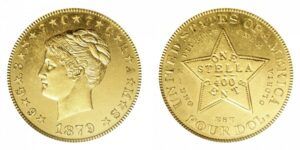
Image: USACoinBook
Two Distinct Designs: Flowing Hair and Coiled Hair
The Stella comes in two stunning design types, each carrying its own allure for collectors.
-
Flowing Hair (1879 & 1880): Designed by Charles Barber, this version features Lady Liberty with long, flowing hair and is the more commonly seen variety.
-
Coiled Hair (1879 & 1880): Created by George T. Morgan, the famed designer of the Morgan Silver Dollar, this rarer version depicts Liberty with braided, coiled hair.
Both varieties are breathtaking examples of late 19th-century engraving artistry, but the Coiled Hair version, with fewer survivors, commands even greater prestige and rarity.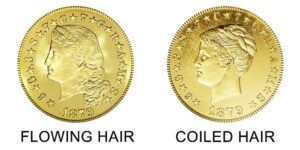
Image: USACoinBook
Why the Stella Never Took Hold
Despite its elegant design and practical purpose, the $4 denomination proved awkward for commerce. The coin’s weight and gold content were carefully calibrated to align with international equivalents, yet Congress ultimately rejected the proposal. As a result, only a handful of these coins—roughly 400 Flowing Hair and an even smaller number of Coiled Hair pieces—were ever struck.
This minuscule mintage ensured the Stella’s status as an ultra-high rarity from the moment of its creation. Today, the coin serves as a reminder of America’s attempt to assert itself on the global monetary stage during the late 19th century.
A Collector’s Dream: Rarity and Prestige
The $4 Stella is coveted not only for its rarity but also for its rich backstory. Collectors prize it as a symbol of American innovation, artistry, and ambition. Owning a Stella means holding a tangible piece of an era when the United States was expanding its global reach.
Because of their scarcity, Stellas seldom appear on the open market, and when they do, they command six-figure prices. Their beauty, combined with their historic significance, makes them a cornerstone of advanced numismatic collections.
Blanchard and the $4 Stella: A Legacy of Trust
For over 50 years, Blanchard has been proud to offer collectors access to ultra-rare coins like the $4 Stella. Our firm has built its reputation on helping clients acquire some of the most exclusive treasures in numismatics, guiding generations of collectors in building portfolios that combine history, artistry, and tangible wealth.
When you see a Stella in a Blanchard offering, you’re not just encountering a coin—you’re experiencing a legacy of trust, expertise, and access that few firms can match. Our long-standing relationships in the numismatic community ensure that clients can confidently pursue even the rarest opportunities.
The Enduring Allure of the Stella Gold Coin
The story of the $4 Stella reminds us that not all coins were created merely for everyday use. Some, like this extraordinary piece, were born from visionary ideas that sought to redefine America’s role in the world. Though the experiment never succeeded, its legacy lives on in the form of one of the most coveted rarities in U.S. coinage.
At Blanchard, we know that these coins aren’t just collectibles, they’re tangible links to history. The Stella captures the spirit of American ingenuity, and its rarity ensures that it will remain one of the most talked-about treasures in the world of numismatics.
Frequently Asked Questions About the $4 Stella Gold Coin
Why is the $4 Stella gold coin so rare?
The $4 Stella was struck only in 1879 and 1880 as an experimental international trade coin. With fewer than 500 examples surviving today, its rarity is built into its history, making it one of the most coveted U.S. coins.
How much is a $4 Stella gold coin worth today?
Values for the Stella vary depending on condition and design type, but they regularly achieve six-figure prices at auction. Exceptional examples, such as the Coiled Hair variety, can command even higher premiums due to their extreme scarcity.
Where can I buy a $4 Stella gold coin?
Because of its rarity, the Stella is rarely available on the open market. Blanchard has been proud to offer collectors access to ultra-high rarity coins like the $4 Stella for more than 50 years, making it one of the most trusted firms for acquiring this numismatic treasure.
Begin Your Rare Coin Journey Today
If you’re ready to add an extraordinary piece of history to your collection, the $4 Stella gold coin represents the pinnacle of rarity and prestige. For over 50 years, Blanchard has connected discerning collectors with treasures like the Stella, backed by unmatched expertise and trust. Contact us today to explore current opportunities and secure your place among the few who own this legendary coin.
1922 Silver Dollar Value: What it’s Worth and Why
Posted on — 11 CommentsFew coins can claim to embody peace and historical triumph quite like the Peace dollar. Aptly named to honor America’s victory and the restoration of global peace after World War I, this iconic coin was first issued in 1921. The following year saw the Peace dollar reach its production pinnacle with over 84 million coins minted. Today, collectors and investors recognize 1922 as a pivotal year, marking the Peace dollar’s transition from symbolic debut to widespread circulation. This article explains what determines 1922 silver dollar value, how to identify key features, and what to look for when evaluating your coin.
What is the value of a 1922 Peace Silver Dollar: Background and History
The 1922 Peace dollar marked a key shift in American coinage, shaped by wartime policy, public pushback, and design challenges that led to distinctive varieties and enduring collector interest.
Historical Context and Design
The Peace dollar’s origins trace back to World War I and the Pittman Act of 1918. When Britain needed silver to stabilize currency in India and counter German destabilization efforts, Congress authorized melting over 270 million Morgan silver dollars to sell the metal to Britain. The Pittman Act required the Treasury to eventually replace these melted coins with new silver dollars struck from domestically mined silver.
By 1921, the Mint began fulfilling this requirement using the old Morgan dollar design. However, numismatists led by Frank Duffield and Farran Zerbe had been lobbying since 1918 for a new design commemorating America’s victory and the peace that followed. Their persistence paid off when they convinced Treasury officials that a peace-themed coin would be both appropriate and popular, symbolizing America’s hope for lasting peace after WWI. The Treasury announced a design competition in late 1921, inviting established sculptors including previous U.S. coin designers. Anthony de Francisci, at 34 the youngest competitor, won unanimously with his design featuring Liberty modeled after his wife Teresa.
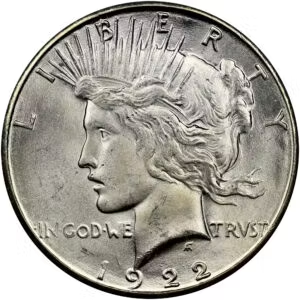
Image: Lady Liberty’s profile on the Peace dollar.
Source: NGC
However, controversy over the design erupted almost immediately. De Francisci’s original reverse design included a broken sword beneath the eagle, symbolizing the end of war. When news leaked to the public, newspapers like the New York Herald attacked the imagery, arguing that a broken sword represented defeat, not victory.
Under intense pressure, Treasury officials hastily ordered the sword removed just days before the scheduled December 28, 1921 first strike. Chief Engraver George Morgan used extremely fine engraving tools to carefully carve the sword from the existing coinage hub, extending the olive branch to cover the modification. Morgan’s precision work was so skillful that numismatists didn’t discover this hand-engraving technique until over 85 years later, having assumed the Mint had created entirely new dies. It’s this level of craftsmanship and historical intrigue that has led some examples to be considered the “holy grail” of Peace dollars.
To see how 1922 Peace silver dollar value can skyrocket for rare examples, watch this nationally televised appraisal.
Mint Mark Variations and Rarity
1922 silver dollar value largely depends on where it was minted, with each facility producing coins bearing distinct characteristics:
Philadelphia Mint (no mint mark)
The Philadelphia facility produced approximately 51.7 million coins, making these the most common 1922 Peace dollars. While abundant, 1922 silver dollar value (no mint mark) can be significant for exceptional examples in high grades.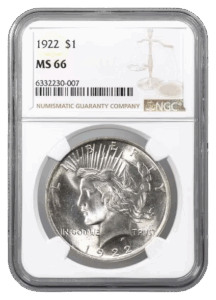
Image: A high-grade example of a Philadelphia Mint 1922 Peace silver dollar, certified MS66 by NGC.
Source: Blanchard Gold
Denver Mint (“D” mint mark)
The Denver Mint struck roughly 15.1 million pieces, making the 1922-D considerably scarcer than Philadelphia issues. As such, 1922 D silver dollar value is typically higher than the more common Philadelphia examples. Denver coins often exhibit weaker strikes due to die spacing issues, making well-struck examples particularly valuable. The “D” mint mark appears on the reverse below the eagle.
San Francisco Mint (“S” mint mark)
San Francisco produced about 17.5 million coins, falling between Philadelphia and Denver in terms of rarity. Despite this middle position in mintage numbers, 1922 S silver dollar value often surprises collectors because San Francisco coins are notorious for weak strikes and bagmarks from rough handling during transport and storage, making pristine examples exceptionally rare and valuable.
These production differences create a clear rarity hierarchy that directly impacts modern 1922 silver dollar value, with Denver and San Francisco examples typically commanding higher prices than their Philadelphia counterparts.
Enduring Market Appeal
The 1922 silver dollar continues to attract both collectors and investors for several reasons. Firstly, its role in commemorating post-World War I peace gives it strong historical appeal. Secondly, its substantial silver content offers intrinsic value tied to precious metals markets. Moreover, its accessibility makes it a popular starting point for new collectors, while seasoned numismatists can seek out high-grade examples and elusive varieties. This blend of historical significance, bullion value, and varying scarcity across mint marks ensures enduring demand.
What Determines 1922 Silver Dollar Value Today?
What a 1922 silver dollar is worth comes down to a mix of condition, mint mark, scarcity, and silver prices. Common examples are valued under $50, but rare varieties and top-grade coins can command five figures.
Condition and Grading Impact on Price
Condition plays a critical role in the value of a 1922 silver dollar, with even slight differences in grade leading to dramatic price variations. Heavily circulated examples in Very Fine condition typically trade near bullion value, while Mint State coins in the MS-63 range command modest premiums. The real appreciation begins at MS-65, where prices increase substantially, and MS-66 examples can reach four-figure values. MS-67 1922 Peace dollars are considered extreme condition rarities, with documented auction sales demonstrating their significant collector premium over lower grades. Learn how professional grading affects the value and collectibility of coins like the 1922 silver dollar.
Mint Mark Influence on Value
As mentioned previously, mint marks create clear value hierarchies. Philadelphia coins (no mint mark) remain most affordable due to their 51.7 million mintage. Denver “D” examples typically sell for 25-50% premiums over Philadelphia coins in similar grades, while San Francisco “S” coins command even higher premiums due to their notorious quality issues, making high-grade examples genuinely scarce.
Special Varieties and Error Coins
Beyond grading and mint marks, certain varieties and errors of the 1922 silver dollar carry substantial premiums due to their rarity and visual distinctiveness. These minting anomalies, caused by production issues such as die cracks and breaks, are highly sought after by advanced collectors. One such example is the “Die Break in Reverse Field,” marked by a noticeable blob of raised metal beneath the eagle, clearly visible without magnification. Another is the so-called “Ear Ring” variety, where a die crack creates a striking metal arc across Liberty’s ear. Even more valuable are high-relief strikes from early 1922 production, issued before the Mint lowered the relief for mass production. When authenticated, these coins can greatly increase the value of a 1922 silver dollar. 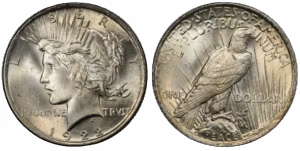
Image Description: The highly recognizable and sought-after variety “Ear Ring” 1922 Peace silver dollar variety.
Source: PCGS
Current Market Trends
Silver content also plays a fundamental role in 1922 Peace dollar values, as each coin contains roughly 0.77 ounces of silver. When silver trades at $25 per ounce, the coin’s melt value alone approaches $20. However, 1922 silver dollar value today extends beyond bullion prices: collector demand, interest in certified high-grade coins, and increased recognition of rare varieties all contribute to upward pressure on values.
How to Assess 1922 Peace Silver Dollar Value
Identifying a valuable 1922 silver dollar means looking beyond the date. It involves carefully checking design details, spotting known counterfeits, and knowing when expert authentication is worth the investment.
Checking Key Features and Mint Marks
Evaluating 1922 Peace silver dollar value starts with examining a coin’s key physical characteristics. Authentic examples measure exactly 38.1mm in diameter, weigh 26.73 grams, and feature reeded edges. The obverse displays Lady Liberty in left profile wearing a spiked crown, with “LIBERTY” above, “IN GOD WE TRUST” in smaller text, and “1922” at the bottom. The reverse shows a bald eagle perched on a rock clutching an olive branch, with “UNITED STATES OF AMERICA” and “E PLURIBUS UNUM” above, “ONE DOLLAR” below, and “PEACE” inscribed on the rock.
Strike quality separates valuable examples from common ones. Well-struck coins show distinct hair strands in Liberty’s hair above her ear and crisp lettering throughout. The eagle’s breast feathers and wing details should display clear definition – weak centers are particularly problematic on Denver and San Francisco issues, making sharp examples more valuable.
For mint marks, examine the reverse below the word “ONE” and above the eagle’s tail feathers. Philadelphia coins bear no mint mark and represent the most common variety. Denver coins display a “D” while San Francisco pieces show an “S” – both command premiums over Philadelphia examples. The mint mark should appear sharp and properly centered; weak or misaligned marks may indicate striking problems that affect value. 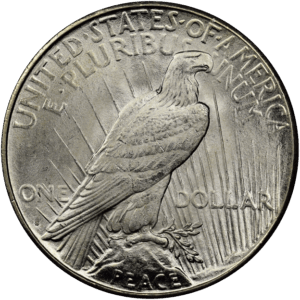
Image Description: The reverse side of a 1922 Peace silver dollar minted in San Francisco.
Source: NGC
Spotting Counterfeits and Common Fakes
With 1922 Peace dollars being popular targets for counterfeiters, collectors need to recognize warning signs of fake coins. Chinese-made counterfeits represent the most common threat, often identifiable by poor striking details and incorrect silver content. Authentic Peace dollars ring with a clear, sustained tone when gently tapped, while fakes typically produce a dull thud due to different metal composition. Examine the lettering closely – genuine coins display sharp, well-defined text, while counterfeits often show mushy or poorly formed letters. Many fakes exhibit a greasy or artificial luster rather than the natural cartwheel effect of genuine silver. Weight discrepancies are another red flag, as authentic coins maintain consistent specifications.
When Professional Appraisal Becomes Necessary
While many collectors can handle basic identification, certain situations call for expert evaluation. Seek professional authentication for high-grade coins (MS-65 and above), any coin where authenticity seems questionable, and pieces you suspect might be valuable varieties or errors. Professional grading services like PCGS or NGC provide authentication along with condition certification, adding credibility for resale. Consider professional evaluation for coins with unusual characteristics, potential errors, or when significant money is at stake.
Investment Potential: What is the Value of a 1922 Silver Dollar Coin?
The 1922 Peace silver dollar offers both historical appeal and tangible value, making it a compelling option for collectors and investors alike, especially when sourced through trusted dealers like Blanchard.
Investment Pros and Cons
The 1922 silver dollar has several notable investment advantages. Its substantial silver content provides intrinsic value and a degree of protection against inflation. Even 1922 silver dollar ‘no mint mark’ value benefits from this precious metal backing, while the coin’s historical importance and widespread recognition support strong liquidity, making it easier to buy and sell than many less familiar collectibles. What’s more, common-date examples remain relatively affordable, making them ideal for collectors getting started in collecting rare coins on a budget while becoming familiar with the market.
However, investing in 1922 silver dollars also comes with challenges, including storage and insurance costs for physical assets. Additionally, market volatility, impacting both silver prices and numismatic demand, means that realizing strong returns often requires a long-term, patient approach.
Historical Market Performance
Peace dollars have shown consistent resilience through various market cycles since their withdrawal from circulation. During the silver boom of the 1970s, they gained value from both rising bullion prices and renewed collector interest. The coin market surge in the 1980s brought significant appreciation, particularly for higher-grade examples. In the 1990s, the rise of third-party grading services introduced greater transparency and liquidity, further strengthening the market. In recent decades, values for well-preserved coins and rare varieties have continued to rise, consistently outperforming common circulated issues.
Reliable Access to Authenticated Peace Dollars
When investing in Peace dollars, working with a reputable dealer is essential to ensure authenticity, fair pricing, and long-term value. Blanchard offers Peace dollars that are professionally graded and certified by leading third-party services, combining expert authentication with the backing of a trusted name in the industry. In a market where counterfeits are increasingly common, explore Blanchard’s collection of rare and collectible coins, including Peace Dollars and other historic pieces, for the level of assurance that helps protect buyers from costly mistakes.
Frequently Asked Questions
1. What is the value of a 1922 silver dollar?
Most 1922 silver dollars fall into two general categories: those valued primarily for their silver content, and those prized by collectors for their preservation or rarity. While not considered rare overall, certain coins, especially those in exceptional condition, can be highly sought after.
2. What factors affect 1922 silver dollar value?
Several variables determine a 1922 silver dollar’s worth. These include the coin’s grade, mint mark (Philadelphia, Denver, or San Francisco), eye appeal, strike quality, and the presence of die varieties or minting errors. Broader market forces, such as silver prices and collector demand, also play a role, especially for lower-grade coins.
3. What’s the difference in value between 1922 Liberty and Peace silver dollars?
While it’s a common mistake to refer to “1922 Liberty silver dollar value,” it is important to note that there are no 1922 Liberty silver dollars. The Liberty (Morgan) dollar series ended in 1921 when it was replaced by the Peace dollar design. All 1922 silver dollars are Peace dollars, which do feature Liberty’s portrait but represent a completely different design from the earlier Morgan Liberty dollars.
4. How can I identify a valuable 1922 silver dollar coin?
Start by checking the mint mark on the reverse below “ONE” – Denver “D” and San Francisco “S” coins are worth more than Philadelphia examples (no mint mark). Examine strike quality by looking at Liberty’s hair details and the eagle’s feathers for sharp definition. Verify the coin weighs 26.73 grams and measures 38.1mm for authenticity. Look for original luster and minimal bagmarks, as well-preserved coins command significant premiums over worn examples.
5. Can a 1922 silver dollar be a good investment today?
Yes. When it comes to value, 1922 silver dollar coins provide both silver content and numismatic potential. High-grade examples and scarce mint marks have shown consistent appreciation, though common circulated pieces primarily track silver prices.
Conclusion
Assessing the value of a 1922 silver dollar means understanding how condition, mint marks, and scarcity combine to drive prices from simple bullion value to the upper tiers of numismatic demand. With a massive mintage of 51.7 million, Philadelphia coins are the most common and affordable. In contrast, Denver (“D”) and San Francisco (“S”) issues command premiums due to their significantly lower production numbers. The highest premiums emerge in MS‑65 and above, where exceptional strike quality and preservation elevate value far beyond silver content alone.
Accurate identification is essential for determining 1922 silver dollar value. Key steps include checking strike sharpness, confirming mint mark placement, and verifying physical specifications. For advanced collectors, recognizing production anomalies and rare die varieties can reveal pieces with significant added value, though expert authentication is crucial for these high-stakes finds.
Because of the prevalence of counterfeits, buying from a trusted dealer is critical. Blanchard’s expertise in sourcing, authenticating, and certifying Peace dollars provides the assurance collectors and investors need to build meaningful, risk‑managed holdings in these historic coins.
Ready to add authenticated 1922 Peace dollars to your collection? Explore Blanchard’s inventory of Peace dollars and large selection of rare coins to discover opportunities that combine historical significance with long-term value potential.
New U.S. Home Sales Skid: Gold Climbs to 3-Week High
Posted on — Leave a commentAsk any homebuyer these days about how their home search is going, and you are likely to hear a whole lot of frustration. The summer of 2025 turned out to be challenging not only for homebuyers, but home sellers and homebuilders. Call it a perfect storm for the U.S. housing market, and that in turn helped to boost gold.
In July, new home sales skidded 0.6% to a seasonally adjusted rate of 652,000, the Commerce Department said. Economists had forecast new home sales to climb.
Gold climbed to a 3-week high, boosted by the weaker housing news, concerns over Federal Reserve independence, and ongoing safe-haven buying amid geopolitical and economic uncertainty.
So, why has the housing market stalled? What does it mean for gold and for the U.S. economy? Let’s dig deeper. 
Homebuyers: High Mortgage Rates, High Home Prices
First-time homebuyers face big challenges when it comes to signing on the dotted line and hiring movers to move into a new home. These include high mortgage rates and high home prices.
In June, the median price for a U.S. existing home soared to a record high of $435,300, according to the National Association of Realtors. That’s up 2% from a year ago and marked the 24th straight month of annual price increases. Add rising mortgage rates into the mix at around 6.70% and that means new homebuyers must pay above $1,200 per month more for a median-priced home than in 2022.
Sellers: Starting to Delist Instead of Lowering Prices
Frustrated home sellers are pushing back against price cuts, and that’s another factor resulting in the stalled housing market. The longer homes sit, the more likely sellers are to delist their homes for sale, Realtor.com said. The rise in delisting has also coincided with a slower pace of new listings.
Builders: Cautious amid Weak Demand and High Prices for Building Materials
It turns out there’s a national shortage of about 4 million homes. Yet, builders are cautious in the current environment, and new single-family construction has slowed. Building permits dropped 4.4% year-over-year in June. Builders point to high financing costs, weak buying demand, and rising prices on building construction materials as factors holding them back. Since 2022, single-family home starts are down 10% while new homes under construction are down 15%.
Big Picture: Home Buying is an Important Engine for U.S. Economic Growth
When the housing market slows, that has a spillover negative impact on the U.S. economy. After all, when you buy a new home, you often buy new furniture, appliances, and start to spend on things like landscaping and maintenance. This has a ripple effect throughout the economy, increasing demand for goods and services, which creates jobs and boosts economic growth.
A slowdown in the housing market has the opposite effect, and that’s what we are seeing now.
Why Gold Climbs on Signs of a Weaker Housing Market
As we saw in late August, when gold climbed to a 3-week high, precious metals benefit from weaker housing market data because it reveals broader economic stress, increased uncertainty about the labor market, and even concerns about a recession, which increases safe-haven demand for gold.
Economists remain sour on the outlook for the housing market ahead, which creates favorable conditions for gold to continue to climb. The worrisome housing data is only one of many reasons investors are piling into gold in 2025, with the precious metal soaring to a record high in the first half of the year. Gold is trading quietly now, but firms from Fidelity to Goldman Sachs and J.P. Morgan forecast a new leg higher with the price of gold expected to exceed $4,000 an ounce. That makes today a great time to consider increasing your allocation to precious metals. Get started with a complimentary portfolio review with a Blanchard portfolio manager today.
Krugerrand: Why This Coin Still Matters in 2025
Posted on — Leave a commentThe South African Krugerrand didn’t just enter the gold market in 1967: it created the modern bullion coin industry. By 1980, this coin commanded 90% of the global gold coin market. Today, the Krugerrand maintains its dominance through unmatched global liquidity and recognition. This article examines the technical specifications, investment advantages, and historical significance that keep the Krugerrand competitive in an increasingly crowded bullion market.
What Is a Krugerrand?
Before exploring its investment potential, here are the basics of what makes a Krugerrand. For additional insights into the fascinating history of the Krugerrand coin, watch this expert discussion from South African numismatic specialists.
Historical Origins
South Africa created the Krugerrand in 1967 to solve its very specific problem of marketing the country’s abundant gold reserves to private investors. At the time, South Africa produced 70% of the world’s gold, but private gold ownership was heavily restricted in most countries, and investors had limited options beyond bars and ingots. The solution was ingenious: create a coin with legal tender status that governments couldn’t easily ban, unlike gold bars which were often prohibited for private ownership.
The South African government, working with Rand Refinery and the South African Mint, designed the Krugerrand as the world’s first modern bullion coin. It was legal tender that could be easily bought, sold, and transported without the regulatory hurdles facing other gold investments. This timing proved perfect, as countries were abandoning the gold standard, where currencies were backed by gold reserves. This left individual investors seeking new ways to own gold directly rather than through government-backed paper money.
Design Significance
The Krugerrand’s visual design was carefully planned to represent South African identity while ensuring global recognition. The coin’s name itself combines “Kruger” (honoring Paul Kruger, the former president of the South African Republic from 1883 to 1900) with “rand” (South Africa’s currency unit). Kruger’s portrait on the obverse aims to represent South African heritage and political independence, while the reverse features a pronking springbok, South Africa’s national animal. 
Image: A black and white historical portrait of Paul Kruger
Source: Kapstadt.de
The coin’s designer, Coert Steynberg, wasn’t starting from scratch with the springbok – he had already used this imagery on earlier South African coins, including the five shillings and 50 cents pieces. By adapting this familiar national symbol for the bilingual (English and Afrikaans) Krugerrand coin, it gained instant recognition both domestically and internationally.
Manufacturing Process
The Krugerrand’s manufacturing required several innovative decisions that would influence bullion coin production worldwide. Most importantly, the decision to use 22-karat gold (91.67% pure gold with 8.33% copper) was revolutionary for its time. While pure gold was traditional for bullion, the Krugerrand’s copper alloy made it significantly more durable than pure gold coins, which scratch and dent easily during handling and transport. The copper content also gave the Krugerrand its distinctive orange-reddish hue, making it instantly recognizable. To maintain exactly one troy ounce of pure gold content despite the alloy metals, manufacturers made the total weight slightly higher at 33.93 grams. This approach prioritized practicality without sacrificing the gold content that determines Krugerrand coin value for investors.
Global Impact
The Krugerrand’s success fundamentally changed the precious metals industry. By 1980, it accounted for 90% of global gold coin sales, proving there was massive demand for accessible gold investment vehicles. This success inspired other nations to create their own bullion coins: Canada’s Gold Maple Leaf (1979), China’s Gold Panda (1982), America’s Gold Eagle (1986), and Britain’s Britannia (1987). Each borrowed elements from the Krugerrand model: legal tender status, fractional sizes, and investor-friendly marketing. The Krugerrand’s pioneering role helped establish the modern bullion coin market, which has continued evolving alongside broader changes in global gold markets over recent decades. Even today, with dozens of competing bullion coins available, the Krugerrand’s first-mover advantage and widespread recognition keep it among the most liquid gold investments worldwide.
South African Krugerrand Specifications and Technical Details
The Krugerrand’s precise specifications have remained consistent since 1967, ensuring reliability for investors and dealers worldwide.
Physical Characteristics
The standard one-ounce Krugerrand measures 32.77mm in diameter and 2.84mm thick, with a total weight of 33.93 grams. The coin’s copper content makes it heavier and more durable than pure gold coins, while also creating the distinctive orange-gold color that sets Krugerrands apart from other bullion coins. The edge features 160 fine ridges – called reeded serrations – that help prevent counterfeiting and provide texture for handling. Proof versions have 220 serrations for enhanced detail. The matte finish of the Krugerrand coin helps conceal minor handling marks that would be more visible on highly polished coins.
Gold Content Breakdown
Each Krugerrand contains exactly one troy ounce (31.1 grams) of pure gold within a 22-karat gold alloy composition of 91.67% gold and 8.33% copper. To accommodate the copper while maintaining the full ounce of pure gold, the total coin weight increases to 33.93 grams.
Manufacturing Standards
The Krugerrand’s reputation for reliability stems from the South African Mint’s rigorous manufacturing standards, established over decades of precious metals production. The process begins with the Rand Refinery, one of the world’s largest gold refineries, which supplies gold that undergoes extensive purity testing before reaching the mint. During production, the South African Mint implements multiple quality control checkpoints, including precise weight verification and gold content analysis for every batch. This systematic approach ensures each South African Krugerrand meets exact specifications, which is crucial for maintaining investor confidence and global acceptance.
Size Variations
Beyond the standard one-ounce coin, the gold Krugerrand is available in fractional sizes. The half-ounce weighs 16.97 grams (15.55 grams pure gold), the quarter-ounce weighs 8.48 grams (7.78 grams pure gold), and the tenth-ounce weighs 3.39 grams (3.11 grams pure gold). All fractional sizes maintain the same 22-karat composition and proportional design scaling.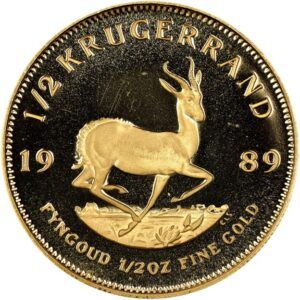
Image: A gold Krugerrand coin reverse showing a leaping springbok
Source: NGC
Understanding Krugerrand Variations
Not all Krugerrands are created equal. Understanding the different types helps investors determine Krugerrand gold coin value today and make informed choices.
Standard vs. Proof Versions
Production Differences
Standard bullion Krugerrands are struck once using regular dies in a mass production process focused on efficiency and metal content accuracy. Proof Krugerrands undergo a completely different manufacturing approach: they’re struck multiple times with specially polished dies that create mirror-like surfaces. The proof production process involves polishing both the coin blanks and the dies to achieve a frosted design against a mirror-smooth background, requiring significantly more time and labor per coin. Since 1995, proof Krugerrands have come with original presentation boxes and certificates of authenticity, adding to their premium positioning.
Visual Distinctions
The most obvious difference between standard and proof versions lies in surface finish. Bullion coins have a standard matte appearance designed for handling and stacking, while proof coins feature highly reflective, mirror-like surfaces with frosted design elements that create a dramatic visual contrast.
Another way to distinguish them is by counting edge serrations: bullion Krugerrands have exactly 160 reeded edges, while proof versions have 220 serrations.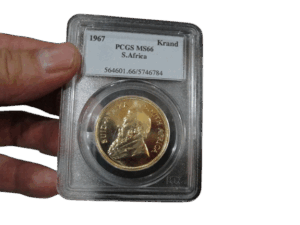
Image: A 1967 proof Krugerrand in a PCGS graded holder with distinctive mirror-like finish and 220 edge serrations.
Source: PCGS
Mintage Numbers
Proof Krugerrands are produced in strictly limited annual quantities, typically ranging from a few thousand to tens of thousands depending on the year and denomination. These small production runs create natural scarcity that appeals to collectors.
In contrast, bullion Krugerrand production fluctuates dramatically based on global gold investment demand, with annual mintages ranging from as low as 24,000 in quiet years to over six million during peak demand periods like the late 1970s. This production flexibility means bullion coins from high-mintage years trade closer to gold spot price, while low-mintage years can command slight premiums even among bullion versions.
Fractional Krugerrands
Introduction Timeline
Fractional Krugerrands were introduced in 1980 in three sizes: half-ounce, quarter-ounce, and tenth-ounce denominations. This expansion aimed to make gold ownership accessible to investors who found the full ounce financially challenging. The smallest tenth-ounce size proved especially popular for gift-giving and as an affordable entry point into gold investing. Due to their accessibility, fractional sizes often achieved substantial mintages, with the tenth-ounce frequently recording some of the highest production numbers in given years. All three fractional sizes helped democratize gold ownership during a period when precious metals investing was gaining mainstream appeal.
Technical Specifications
As mentioned previously, fractional Krugerrands maintain precise proportional weights (the half-ounce at 16.97 grams total, quarter-ounce at 8.48 grams, and tenth-ounce at 3.39 grams), while preserving the exact 22-karat gold-to-copper ratio of the original. This consistency ensures that all sizes share the same durability and distinctive orange hue that makes Krugerrands instantly recognizable. Unlike some coin series where fractional versions compromise on composition, Krugerrands maintain identical characteristics regardless of size, ensuring consistent Krugerrand value today across all denominations.
Design Adaptations
All fractional sizes feature identical designs to the one-ounce coin, with careful scaling to preserve detail clarity even on the smallest 1/10-ounce version. The South African Mint’s precision scaling techniques ensure that Paul Kruger’s portrait and the springbok design remain sharp and recognizable across all denominations.
Krugerrand Investment Potential in 2025
The Krugerrand’s investment appeal in 2025 mainly comes down to proven liquidity advantages versus the practical costs of physical ownership.
Advantages
Global Liquidity and Recognition
The Krugerrand’s 58-year track record has created unmatched worldwide recognition among precious metals dealers. Unlike newer bullion coins that may require verification or face regional acceptance issues, Krugerrands can be bought and sold easily in virtually any gold market globally. This liquidity advantage becomes particularly valuable during economic uncertainty when quick asset conversion may be necessary.
Privacy and Regulatory Benefits
A key advantage of owning physical Krugerrands is the privacy they provide compared to other gold investment options. Physical Krugerrand purchases below certain thresholds typically don’t trigger government reporting requirements in most jurisdictions, unlike gold ETFs or mining stocks that automatically generate tax documents and paper trails. This allows investors to build gold positions privately without the regulatory paperwork that accompanies many financial instruments.
Proven Inflation Protection
Historical data shows Krugerrands have successfully preserved purchasing power during inflationary periods. From 1970 to 1980, when U.S. inflation averaged over 7% annually, gold prices rose from $35 to over $800 per ounce – a gain that far outpaced inflation and protected investors’ real wealth. Krugerrands, containing one full ounce of gold, delivered these same protective returns to holders. As a physical investment, the gold Krugerrand provides direct exposure to gold’s inflation-hedging properties without the management fees or tracking errors that can affect gold-based financial products.
For more details on why gold serves as an ideal portfolio complement and its performance compared to traditional investments, explore Blanchard’s gold investment insights.
Considerations
Storage and Security Requirements
Physical ownership requires secure storage solutions, whether through safe deposit boxes, home safes, or professional vault services. Insurance and security add ongoing costs that don’t exist with other gold investments like ETFs, making storage planning crucial for larger collections.
Market Timing and Premium Cycles
Premium levels fluctuate based on global demand, political uncertainty, and supply constraints. Buying during high-premium periods can reduce returns, making market awareness crucial for optimal entry and exit timing.
How to Buy and Sell Krugerrands
Krugerrands are available through various channels, with established precious metals dealers offering the most reliable combination of authenticity guarantees and competitive pricing. These dealers provide proper documentation and buyback policies, while online auction sites and unverified sellers present higher counterfeit risks.
Authentication Essentials
Authentic Krugerrands have specific specifications: 33.93 grams weight, 32.77mm diameter, and the correct edge serrations (160 for bullion, 220 for proof). The distinctive orange-gold color from copper alloy should appear consistent throughout. Professional dealers can verify authenticity using precision scales and testing equipment.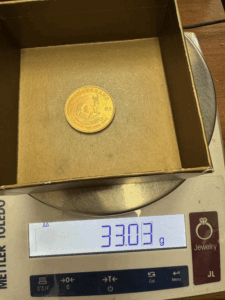
Image Description: A 1983 Krugerrand on digital scale showing 33.03 grams, demonstrating underweight coin that may indicate wear or authenticity concerns.
Source: Reddit
Selling Strategy
Krugerrands maintain strong global liquidity, making them relatively straightforward to sell when needed. Local coin shops, precious metals dealers, and established online platforms all provide viable selling options. Market timing during periods of high Krugerrand price appreciation or increased uncertainty can help maximize returns.
Professional Advantage
Blanchard’s decades of experience in precious metals ensures authenticity verification, competitive pricing, and reliable access to both buying and selling markets. With established relationships throughout the industry and comprehensive market knowledge, Blanchard offers investors the confidence that comes from working with a trusted precious metals specialist.
Conclusion
The Krugerrand’s enduring success stems from practical advantages that remain relevant in 2025: unmatched global liquidity, proven durability through its 22-karat gold composition, and a 58-year track record of market acceptance. Its distinctive design featuring Paul Kruger and the springbok, combined with specific technical specifications like weight and edge serrations, makes authentication straightforward for investors.
For modern portfolios, Krugerrands offer direct gold exposure without the complexities of ETFs or mining stocks, while maintaining the privacy and inflation protection that physical precious metals provide. Whether in standard one-ounce or fractional sizes, Krugerrands continue to represent one of the most liquid and widely recognized gold investments available.
Explore Blanchard’s selection of authentic Krugerrands and other world gold coins and discover how these iconic coins can strengthen your precious metals portfolio.
FAQs
1. How much is a Krugerrand worth today?
Krugerrand value fluctuates daily based on gold spot prices plus a small premium for the coin itself. You can track current gold spot prices to understand the base value of your Krugerrand’s gold content. For the most accurate pricing, contact Blanchard directly.
2. How much does a Krugerrand weigh?
A standard one-ounce Krugerrand weighs exactly 33.93 grams total, containing 31.1 grams of pure gold. The additional weight comes from copper alloy that makes the coin more durable. Fractional sizes maintain proportional weights: half-ounce at 16.97 grams, quarter-ounce at 8.48 grams, and tenth-ounce at 3.39 grams. Verifying these precise weights helps confirm authenticity.
3. What factors affect Krugerrand value?
Krugerrand values are primarily driven by gold spot prices, which fluctuate based on economic conditions, inflation expectations, and global demand. Additional factors include the coin’s condition, size, whether it’s bullion or proof, and current market premiums. Rarer years or special editions may command higher premiums, while standard bullion versions typically trade closest to gold content value.
How To Store Silver Coins
Posted on — Leave a commentSilver coins serve as both valuable investments and prized collectibles, but a single storage mistake can destroy decades of careful collecting. Without proper storage and handling, silver coins face serious threats from tarnishing, humidity damage, and scratches or surface wear. Improper methods can permanently reduce a coin’s value, sometimes by hundreds or thousands of dollars. This comprehensive guide provides proven solutions for how to store silver bullion coins, preserve your collection’s condition and maximize its long-term value.
Why Proper Storage Matters
Understanding silver’s unique chemical properties is essential for any serious collector or investor. Silver behaves differently to other metals when exposed to air and moisture, requiring specific storage approaches to maintain its condition and value.
Does silver rust or just tarnish?
A common misconception is that silver can rust like iron or steel. The question “Does silver rust?” has a clear answer: no. Silver does not rust because it contains no iron, which is required for the oxidation process that creates rust. However, the question “Does silver tarnish?” is a different matter entirely. Silver undergoes a process called tarnishing when it reacts with sulfur compounds in the air to form silver sulfide. This chemical reaction creates the characteristic dark, discolored coating that can dramatically affect a coin’s appearance and market value. Pure silver is less prone to tarnishing than sterling silver, but even the finest silver coins will eventually show signs of sulfur exposure without proper protection.
Impact of Environmental Factors
Humidity, air exposure, and temperature all play important roles in silver tarnishing. High humidity can accelerate tarnishing by creating conditions that allow sulfur compounds in the air to react more readily with silver surfaces. Air exposure is equally problematic, as everyday air contains sulfur compounds from pollution, household products, and natural sources. However, research shows that temperature plays a more significant role than humidity alone – sulfur vapor pressure increases at higher temperatures, accelerating the tarnishing process.
Contact with non-archival materials poses another serious threat. Cardboard, certain plastics, rubber, and adhesives release sulfur compounds that can concentrate around stored coins. Even materials like wood and paper can contain chemicals that promote tarnishing. Fingerprints and skin oils transfer salt and moisture that create localized corrosion, leaving permanent marks on coin surfaces.
Best Methods for Storing Silver Coins
Protecting your silver coin investment requires choosing the right storage methods and materials. The key is creating barriers between your coins and the environmental factors that cause tarnishing while ensuring easy access for viewing and handling when necessary.
Click here to see how one collector safely stores his silver collection using proven methods.
Airtight Containers and Capsules
Airtight storage represents the gold standard for silver coin preservation, ideal for preventing air exposure that leads to tarnishing. The most effective approach involves creating sealed environments that block sulfur compounds from reaching your coins, whether through individual capsules or specialized coin storage boxes designed for airtight protection.
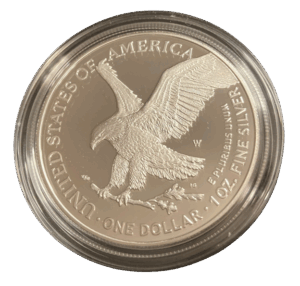
Image: Silver coin stored in protective airtight capsule
Source: NGC
Individual coin capsules offer the highest level of protection for valuable pieces. These clear, hard plastic containers come in specific sizes to fit different coin dimensions snugly, preventing movement that could cause scratches. The airtight seal creates a controlled microenvironment around each coin, significantly reducing oxidation and tarnishing risks.
For bulk storage or multiple encapsulated coins, larger airtight coin storage containers provide an additional layer of protection. These storage systems work particularly well when combined with silica gel packs, which absorb residual moisture and maintain optimal humidity levels. Storage cubes represent another popular option, featuring secure, rotatable lids and transparent designs that allow viewing without breaking the protective seal.
Archival-Grade Materials
The materials you choose for coin storage can make or break your collection’s long-term value. Archival-grade materials are specifically designed to remain chemically stable over decades, preventing the release of harmful compounds that damage silver coins.
What storage materials should be avoided with silver?
PVC-based plastics represent a major threat to coin collections and should be avoided entirely, as polyvinyl chloride breaks down over time and releases corrosive gases that permanently damage coins. Mylar flips made from inert polyester film offer superior protection with excellent clarity and chemical stability. Acid-free paper and cardboard provide safe alternatives for labeling and organizing without introducing acidic compounds that could damage coins.
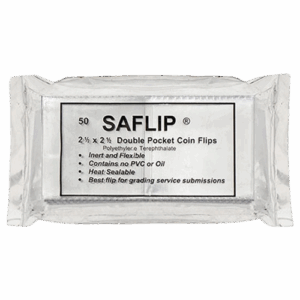
Image: Mylar coin flips for safe archival storage of silver coins
Source: PCGS
Beyond material selection, collectors must also consider the format that best suits their coin collection storage needs. Storage tubes have both advantages and drawbacks. They efficiently store multiple coins of the same size while protecting edges from damage, but coins can shift and scratch against each other during handling. Albums provide excellent organization and display capabilities for series collections, though they increase handling risks and may not offer airtight protection. Flips offer the best balance of protection and accessibility, allowing individual coin storage with clear visibility, but require careful selection to ensure they’re made from archival-safe materials.
Storing at Home
Home storage offers convenience and immediate access to your collection while allowing you to maintain complete control over storage conditions. Understanding how to store silver coins at home requires balancing security, environmental protection, and accessibility.
For maximum protection, fireproof safes represent the ideal solution for valuable collections. Quality safes protect against both theft and fire damage, with models specifically designed for documents and valuables maintaining lower internal temperatures during fires. Whether you’re protecting newly acquired silver bullion or established collections, proper safe selection ensures your investment remains secure.

Image: Flames from a fire
Source: Cullan Smith
Some collectors prefer distributing their holdings across multiple secure locations within their home rather than concentrating everything in one safe. This approach can reduce risk but requires meticulous record-keeping to track locations and inventory.
Regardless of your storage method, monitoring environmental conditions remains crucial. Digital hygrometers help track humidity levels, with optimal conditions maintaining relative humidity below 50 percent. Collectors should steer clear of problematic areas like basements and attics where temperature and humidity fluctuate significantly.
Protecting your collection also requires attention to security measures. Installing security systems and maintaining discretion about your collection’s existence provide essential protection against theft.
Long-Term Storage
For collectors with substantial holdings or those seeking maximum security, the question of how to store silver coins long-term points toward professional storage facilities that offer advantages home storage cannot match.
What is the best way to store silver coins long-term?
Bank vaults and safety deposit boxes provide trusted, cost-effective storage with established security protocols. Banks offer robust physical security with surveillance systems and controlled access, though availability is limited to banking hours. However, bank insurance policies rarely cover the contents of safety deposit boxes, requiring collectors to arrange separate coverage for their holdings. Additionally, banks may restrict access during emergencies or economic disruptions.

Image: Professional bank vault with secure storage facilities for precious metals
Source: rc.xyz NFT gallery
Private depositories specialize in precious metals storage and typically provide comprehensive insurance as part of their service. Top facilities offer state-of-the-art security measures, 24/7 monitoring, and full insurance coverage against theft, damage, and natural disasters. For long-term investors seeking tax advantages alongside secure storage, a Gold and Silver IRA offers another professional storage solution with additional retirement benefits.
For all above options, documentation is critical. Maintaining detailed inventories with photographs, grades, and serial numbers protects against loss and supports insurance claims. Regular independent audits verify your holdings and provide accountability, whether stored in bank vaults or private facilities.
Tarnish Prevention Tips
Effective tarnish prevention combines controlling environmental factors with proper handling practices to keep your silver coins in pristine condition.
What causes silver coins to tarnish?
Silver tarnishing occurs when silver reacts with sulfur compounds in the environment to form silver sulfide. Primary sources include air pollution, household products, certain plastics, cardboard, and rubber materials.
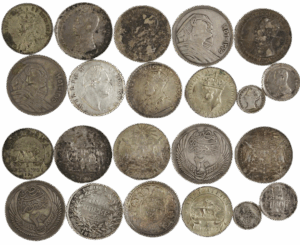
Image: Tarnished silver coins
Source: Numista
How do you store silver coins without them tarnishing?
To avoid tarnishing when storing silver coins, use airtight containers combined with anti-tarnish strips containing activated carbon that absorb sulfur compounds. Keep coins away from materials like wood, cardboard, and certain plastics that release harmful compounds into the air.
Storage Environment Conditions
Optimal environmental conditions significantly slow tarnishing reactions, which is crucial knowledge for collectors learning how to store silver coins to prevent tarnishing. Humidity levels below 50 percent work best, with silica gel packets helping maintain this level when replaced periodically. Coins stored away from direct sunlight and fluorescent lighting experience less damage, as UV rays can accelerate chemical reactions and damage protective storage materials.
Storage locations away from heat sources like furnaces, water heaters, and sunny windows provide more stable conditions. Temperature fluctuations stress both coins and storage materials, potentially compromising protective seals. Basements and attics present particular challenges due to varying conditions and are generally unsuitable for coin storage.
Proper Handling Techniques
Proper handling techniques significantly reduce tarnishing risks and physical damage to silver. Learning how to store silver bullion so it doesn’t tarnish starts with using cotton or nitrile gloves to prevent skin oils, salts, and acids from transferring to surfaces, while holding pieces by their edges rather than touching the faces protects against fingerprint damage and localized tarnishing.
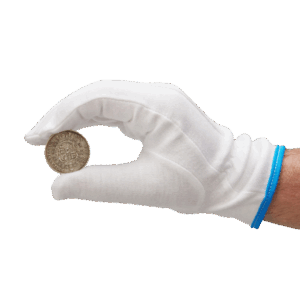
Image: Silver coin handling using cotton gloves
Source: Royal Mint
Experienced collectors minimize direct handling by using magnifying glasses or photography for detailed examination, reducing potential damage from repeated physical contact. When handling becomes unavoidable, working over soft surfaces provides protection against accidental drops. Regular visual inspections help detect early signs of tarnishing, though limiting examinations to sight-only checks without touching proves most effective for long-term preservation.
Special Cases
Certain types of silver coins require modified storage approaches due to their unique characteristics, historical significance, or physical dimensions. Collectible and rare silver coins especially demand careful preservation to maintain their investment potential and numismatic value.
Storing old or historical silver coins
Historical and old silver coins present unique preservation challenges that require extra care and consideration. Decades or centuries of exposure have often left these coins more fragile, requiring gentler handling and more stable environmental conditions.
When it comes to how to store old silver coins properly, the focus should be on preservation rather than restoration. Individual storage in archival-quality holders prevents movement while allowing viewing, and climate-controlled environments help protect these already-weathered pieces from further environmental stress. Collectors should resist any cleaning attempts, as many historical pieces have developed natural patina over time, and removing this patina can destroy both historical significance and market value.
Storing silver dollar coins
Silver dollars require special consideration due to their larger size and weight compared to standard coins. Knowing how to store silver dollar coins effectively requires selecting appropriately sized storage containers, as standard coin holders may not accommodate their dimensions properly.
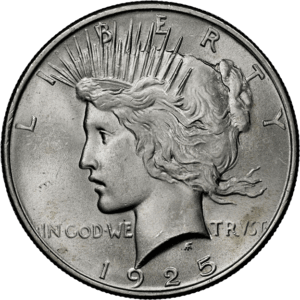
Image: 1925 Peace silver dollar showing larger size requiring specialized storage
Source: Numista
Their increased surface area also makes silver dollars more prone to tarnishing and environmental damage. Airtight capsules designed specifically for dollar-sized coins provide optimal protection while ensuring snug fits without excessive movement that could cause edge damage. Storage tubes work well for multiple silver dollars of the same type, but require careful handling to prevent coins from sliding against each other.
Common Storage Mistakes to Avoid
Even experienced collectors sometimes fall into storage traps that can damage their investments over time. Recognizing these common errors helps prevent costly mistakes that could affect your collection’s value and condition.
Storing silver coins in PVC flips
Using PVC flips to store silver coins is one of the most dangerous mistakes collectors make. These inexpensive holders break down over time, releasing chlorine gas that creates permanent green stains on silver coins known as “PVC damage”. This chemical reaction cannot be reversed and significantly reduces coin values.
Using damp basements for storage
Many collectors turn to basements for storage as they offer space and security away from daily household activity. Unfortunately, these areas frequently suffer from moisture issues that create problematic environments for silver coins. High humidity accelerates tarnishing while temperature fluctuations stress both coins and storage materials, potentially compromising protective seals. Basement storage also increases exposure to flooding risks and typically lacks the consistent climate control essential for long-term coin preservation.
Lack of labeling and organization
Poor organization can have a significant effect on silver coins that many collectors don’t consider. When collections lack proper structure, collectors must dig through and repeatedly move coins while searching for specific pieces. This excessive handling increases scratch risks and exposes coins to skin oils, which is why proper organization matters when considering how to store silver bullion.
Conclusion
Knowing how to store silver coins properly protects both your investment value and coin condition for generations. The key principles include using airtight storage, choosing archival-grade materials, and maintaining controlled environments. These storage fundamentals work best when combined with proper handling techniques that minimize damage and avoid common storage mistakes. Environmental control through humidity management and sulfur-free conditions completes the preservation strategy. Ready to protect your silver investment? Explore Blanchard’s secure storage options and other premium products.
FAQs
How do you store silver coins at home safely?
Safe home storage requires climate control with humidity below 50%, avoiding basements and attics, security systems, and proper archival materials.
Can you store silver coins in plastic?
Yes, but only in archival-grade plastics like Mylar. Avoid PVC plastics entirely as they release corrosive gases that permanently damage coins.
Is it OK to store silver coins in Mylar flips?
Yes, Mylar flips are excellent for silver storage. They’re made from inert polyester film that provides clarity and chemical stability.
Can silver coins be stored in a regular safe at home?
Fireproof safes work best for valuable collections. Choose models rated for paper protection to ensure low internal temperatures during fires.
Are safe deposit boxes good for storing silver coins?
Yes, they provide security and controlled access, but bank insurance rarely covers contents, requiring separate coverage for your holdings.
Fed Report Reignites Talk of Gold Price Reset
Posted on — Leave a commentRemember the gold price reset talk from earlier this year? It’s back. In February, U.S. Treasury Secretary Scott Bessent said, “We’re going to monetize the asset side of the U.S. balance sheet,” which triggered a wave of speculation about what valuing gold at the current market price could mean. 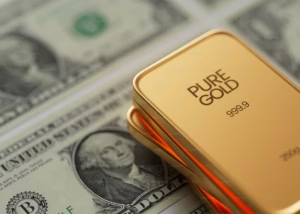
Now, a brand new Federal Reserve report issued on August 1 reignited that speculation.
You probably know the United States of America owns a huge amount of gold bullion—over 261 million troy ounces stored in vaults at Fort Knox, West Point, and the Denver Mint. Officially, our nation values our total gold reserve at around $11 billion. But, that’s at the 1930s official gold price of $42.22 an ounce—a far cry from the $3,300 an ounce at today’s market prices.
If the government marked our gold reserves at today’s market prices, suddenly our gold reserves would be worth around $861 billion. What if the government marked gold prices at $8,000 an ounce? Suddenly, our gold reserves are worth $2.1 trillion.
Why would the government do this? It’s a method to increase the federal balance sheet through an accounting adjustment – that suddenly creates new money for the government to spend, without outright money printing. Call it a technical accounting update, and presto, the government has more money on its books without raising taxes or cutting spending. This could be achieved fairly simply by Executive Order, no act of Congress needed.
One of the benefits of gold revaluation for the government is that it would instantly add money into the U.S. financial system without having to issue new Treasury bills, notes or bonds. For politicians struggling over the deficit, it would mean the Treasury has more money to pay the government’s bills, as the revaluation would, in a sense, create new money out of thin air.
The August Fed report, called: Official Reserve Revaluations: The International Experience reveals that economists at our nation’s central bank are seriously studying the gold price revaluation question.
“With public debt at high levels, some governments have begun to explore financing additional expenditures without raising taxes while also not increasing public debt outstanding,” the Fed report said. “One possibility is using proceeds from valuation gains on gold reserves, as has been floated in the U.S. and Belgium recently. For the U.S., this would involve revaluing the government’s 261.5 million troy ounces in gold reserves—the largest gold reserves globally— from a statutory price of $42.22 per troy ounce to current market prices, which stand around $3300 per troy ounce.”
In the research note, the Federal Reserve analyzes the five times in the past 30 years that nations revalued their gold and foreign exchange reserves to realize gains. This was done in Germany, Italy, Lebanon, Curacao and Saint Martin, and South Africa, the Fed said.
In one of the cases in Lebanon in December 2002, their central bank transferred unrealized profits on its gold and foreign exchange reserves to the central government. The proceeds were used to retire $1.8 billion of treasury bills, equivalent to around 11 percent of Lebanon’s GDP at the time.
While the Fed report doesn’t offer a conclusion, the study appears to reveal that the revaluation of even a significant portion of a country’s gold reserves delivers only a one-time boost to the balance sheet of either the central bank or the central government.
What could a revaluation mean for the price of gold? It would likely spike higher. Under Basel III, after the post-2008 reforms, monetary gold is now considered a Tier 1 asset, which means it is as good as cash on bank balance sheets. That means that a revalued gold price would also be a big boost and strengthen the banking sector’s capital positions.
A gold revaluation is expected to result in a further relative decline in the purchasing power of fiat currencies. Some on Wall Street warn this would be an inflationary move.
Will the government revalue gold? It’s an open question. With debt-to-GDP ratios climbing into uncharted territory, something will need to change. It’s just one more reason that central banks, wealthy individuals, family offices and pension funds are buying physical gold today—it’s the ultimate form of wealth protection.
Image by Planet Volumes
The Saint-Gaudens Double Eagle: America’s Most Beautiful Coin and the Story It Tells
Posted on — Leave a commentWhen you hold a Saint-Gaudens Double Eagle in your hand, you’re not just holding a piece of gold—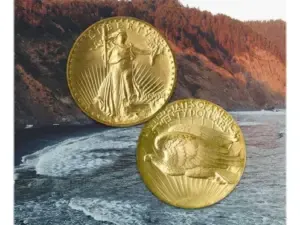 you’re holding a masterpiece born from ambition, artistry, and a pivotal era in American history. It’s not hyperbole to say this coin changed everything. Some call it the most beautiful coin the U.S. has ever produced. But what’s the story behind this legendary gold piece? And why has it captivated collectors and investors for over a century?
Let’s take a walk through history to discover what makes the Saint-Gaudens Double Eagle a true American treasure.
A President’s Vision: Theodore Roosevelt’s “Pet Crime”
At the dawn of the 20th century, President Theodore Roosevelt wasn’t content with America’s coinage. He thought U.S. coins looked uninspired, even boring. And he was right. Compared to the classical coins of ancient Greece, American coins lacked artistry. So Roosevelt set out on a mission to change that.
In 1905, he reached out to Augustus Saint-Gaudens, one of the most celebrated sculptors of the era, and asked him to redesign America’s gold coins. Roosevelt famously called the project his “pet crime,” and he was deeply involved in seeing it through. The result was the Saint-Gaudens Double Eagle, a $20 gold coin that redefined American coinage forever.
The Artist Behind the Icon
Saint-Gaudens was no ordinary artist. He was already famous for his monuments and sculptures, like the Robert Gould Shaw Memorial in Boston and the Standing Lincoln in Chicago. But he had never designed a coin before. That didn’t stop him.
Saint-Gaudens took inspiration from ancient Greek coinage and classical sculpture to design a gold coin that embodied liberty, strength, and optimism. He wanted the coin to reflect the spirit of America at its peak, a young, growing nation bursting with energy.
The result? A breathtaking obverse featuring Lady Liberty striding forward with a torch in one hand and an olive branch in the other. Her flowing robes and commanding stance evoke both classical beauty and national power. Behind her, rays of sunlight explode across the background, while the U.S. Capitol building sits at her feet.
The reverse side of the coin is just as stunning. A bold American eagle soars across the sky at sunrise, symbolizing freedom and flight toward a bright future.
A Coin Like No Other
The Saint-Gaudens Double Eagle wasn’t just a visual triumph. It was also a technical challenge.
Saint-Gaudens originally designed the coin in ultra high relief, which made the design stand out in near-sculptural detail. The problem? It was nearly impossible to mass-produce. Each ultra-high relief coin required multiple strikes to bring out the full depth of the design. While a few dozen of these magnificent pieces were struck in 1907, they proved too impractical for regular use.
The U.S. Mint had to modify the design to lower relief versions, which still maintained incredible beauty but could be produced more efficiently. The first circulating Saint-Gaudens Double Eagles were minted in 1907, and production continued with some design tweaks until 1933.
The 1933 Mystery: The Coin That Wasn’t Meant to Be
Here’s where the story takes a dramatic turn.
In 1933, during the Great Depression, President Franklin D. Roosevelt issued Executive Order 6102, effectively outlawing private gold ownership in the U.S. The government wanted to stabilize the economy and pull gold out of circulation.
Although over 445,000 Saint-Gaudens Double Eagles were struck at the Philadelphia Mint that year, none were officially released for circulation. The coins were supposed to be melted down, and most were.
But somehow, a few 1933 Double Eagles slipped through the cracks.
For decades, they became the stuff of legend, popping up in private collections and sparking legal battles between the U.S. government and collectors. One of these coins made headlines in 2002 when it sold at auction for $7.59 million. Another broke records again in 2021, selling for an astounding $18.9 million, becoming the most expensive coin ever sold.
These 1933 Double Eagles are more than rare. They’re iconic, mysterious, and wrapped in controversy. And they’ve only added to the legend of the Saint-Gaudens design.
A Favorite Among Collectors and Investors
The Saint-Gaudens Double Eagle isn’t just a pretty face. It’s also a favorite for gold investors and numismatists alike. Containing nearly one full ounce of gold (0.9675 troy oz), the coin has intrinsic value tied to the price of gold.
But unlike modern bullion coins, Saint-Gaudens Double Eagles also carry historic and collectible premiums. Their value isn’t just based on gold weight. It’s shaped by the coin’s condition, mint year, and rarity. That’s why a circulated example might fetch a modest premium over melt value, while a rare date or mint state piece can command thousands or even millions of dollars.
Why the Saint-Gaudens Double Eagle Still Matters
What makes this coin so special, even today?
It’s more than beauty. More than gold. The Saint-Gaudens Double Eagle tells a uniquely American story. It’s a story of art pushing boundaries, of presidents with bold visions, of economic upheaval and recovery. It’s a coin that came from a golden age, both literally and figuratively, and continues to shine more than 100 years later.
Collectors chase it for its design. Investors seek it for its gold content. Historians admire it for what it represents: a moment in time when America set out to elevate even the smallest objects, like pocket change, into something extraordinary.
Final Thoughts
Whether you’re a seasoned collector or just starting your journey into rare coins and precious metals, the Saint-Gaudens Double Eagle deserves a spot on your radar. It’s the kind of coin that doesn’t just sit in a display case. It starts conversations, inspires awe, and connects you to a pivotal chapter in American history.
If you’re looking to add this iconic coin to your collection or want to explore other rare gold coins, reach out to a reputable dealer with experience in high-grade numismatics. At Blanchard, we’ve helped clients secure exceptional pieces like the Saint-Gaudens for over 50 years. Let us help you find yours.
Which Way Will Gold Break Out Of Its Range? Fidelity Says Gold Could Hit $4,000
Posted on — Leave a commentThe lazy hot days of summer are upon us. Gold has settled into a sideways holding pattern, after climbing over 25% in the first half of the year. With hamburgers sizzling on the backyard barbeque grill, making portfolio moves might not be on the top of your to-do list. Consider this: taking action today to add physical gold to your portfolio gives you the opportunity to trade fewer dollars for more gold before the next up leg begins.
Fidelity joined Goldman Sachs with a forecast for gold to reach $4,000 an ounce. Fidelity pointed to expected Federal Reserve interest rate cuts, a weakening U.S. dollar and more central bank gold buying as factors driving gold to new record highs ahead.
Fidelity fund managers noted that some funds had doubled their 5% allocation to gold, in line with moves that affluent gold investors are increasing their allocations to the precious metal also.
While the U.S. stock market has been unnerved by the sweeping shifts to global trade policy in recent weeks, warnings are rising that a sharp pullback in stocks or even a crash could lie ahead.
“I expect an 80% crash when this is over. I just don’t think this is it. This is a trap,” Mark Spitznagel is the founder and chief investment officer of hedge fund Universa Investments, told MarketWatch.
CNBC host Jim Cramer warns of ‘Black Monday’ market crash over Trump tariffs rivaling record 1987 collapse –New York Post
Cantor Fitzgerald warns of a market pullback as S&P 500 flashes overbought signal—Seeking Alpha
2 big warning signs a correction in stocks may be looming, according to Goldman Sachs—Business Insider
From Wall Street to Main Street Stressors Are Showing
As corporate America reports its latest batch of earnings, cracks are already showing in profits due to protectionist tariff impact. General Motors reported a $1.1 billion profit hit from the tariffs. GM said it earned $2.53 per share, down from $3.06 a year ago.
Dow Inc. reported that the chemical company reported its first quarterly loss in five years as tariff uncertainties pressured the business.
PayPal Holdings stock fell the most in six months after executives reported slower growth in payment volume that the company said was a result of U.S. tariff policy.
Shifting to Main Street, new reports show that even Americans with high incomes are falling behind on credit card and car payments. Delinquencies on credit card and auto loan debts from upper income Americans climbed nearly 20% in the past two years, VantageScore said.
As financial stress and growing debt extends to even top earners, that leaves the U.S. economy more vulnerable in the months ahead.
What’s more, the U.S. economy is already slowing. U.S. Gross Domestic Product (GDP) grew at 1.9% in the first quarter of 2025, down from 2.9% in the final three months of 2024. The Atlanta Fed GDPNow forecast predicts that growth will slow to around 1% in the second quarter.
Bottom Line
Corporate profits are weakening. The stock market is vulnerable to a correction. Protectionist U.S. tariff rates are now at their highest levels since the 1930’s. The economy is slowing.
Gold is trading quietly, sideways right now. Don’t let the warm summer breeze lull you into complacency. Take action to protect your wealth with an increased allocation to physical gold now. In a few weeks or months, today’s gold price will seem like a bargain. Don’t kick yourself for not buying more today. Get started and explore your physical gold options here.
Photo from Unsplash
Fed Policymakers Reveal Cracks in Consensus
Posted on — Leave a commentThe Federal Reserve held its key interest rate steady today at 4.25-4.50% for the fifth meeting in a row. What wasn’t expected were dissents from two Fed Board Governors, which hasn’t happened in over 30 years.
Fed policymakers typically try to show a united front for its monetary policy decisions. Yet, heightened uncertainty over the impact of protectionist trade policies on our economy is beginning to divide them. Today’s meeting was the first time since 1993 that more than one Board Governor voted against the policy decision. Fed Board Governors Michelle Bowman and Christopher Waller voiced support for an interest rate cut.
Why is the central bank holding back on lowering interest rates? The Fed repeated today that uncertainty about the economic outlook “remains elevated” and that it is appropriate to hold interest rates at current levels since inflation remains above target.
In his press conference after the meeting, Fed Chair Jerome Powell said that keeping rates on hold was “appropriate to guard against inflation risks” as the tariff impact begins to appear in rising consumer prices. Some economists say that it takes time for the impact of protectionist policies to work their way through supply chains and onto store shelves. The Fed has stated it wants to continue to monitor the data in the weeks ahead.
There was little reaction to the Fed news, with stocks trading marginally higher and gold trading slightly lower in afternoon trading.
Gold has settled into a quiet, sideways holding pattern in recent months, after climbing to a record high above $3,400 back in April. Strong central bank buying, uncertainty over the economic impact from shifts to the global trading order, still-high inflation, and wars on several fronts drove safe-haven demand for the metal.
What’s Next for Gold?
Demand for gold remains strong. Central banks continue to diversify away from the U.S. dollar and are increasing their allocation to physical gold. In May, the latest data available, central banks bought 20 tonnes of gold, up from 11 tonnes in April, according to the World Gold Council. And, according to a recent HSBC survey, affluent investors have doubled their allocation to gold from 4%-11%. Finally, Fidelity has released a new forecast, echoing Goldman Sachs, that projects gold will reach $4,000 an ounce.
Gold is expected to break out of its holding pattern and climb to new record levels. The orderly and quiet summer markets create opportune buying periods for long-term investors who want to increase their wealth protection through a bigger allocation to physical gold.
The Fed next meets on September 16-17 and all eyes will remain on the central bank for its next moves. Don’t wait until then to make your next gold move. Consider buying more gold today, while prices are still low.
Photo by Joshua Woroniecki on Unsplash
Affluent Investors Double Allocation to Gold in 2025
Posted on — Leave a commentOne of the biggest investment trends in 2025 is that buying physical gold has gone mainstream. No longer is owning gold viewed as an exotic alternative; gold has become the standout asset class among affluent investors and has become a mainstream portfolio component for diversification.
Wealthy investors more than doubled their allocation to gold from 5% to 11% this year, according to a new HSBC survey.
The HSBC Affluent Investors survey revealed that among wealthy investors, allocations to cash and cash equivalents fell by 13 points, while gold saw the biggest jump, increasing by 6 points. Real estate investment allocation increased 3 points, while equities lost 2 points and private equity gained 3 points.
It’s not just the affluent who are buying gold; high net worth individuals are also shifting more heavily into gold. There has been a noticeable uptick among high-net-worth U.S. clients who want to diversify from the depreciating U.S. dollar, which has dropped 10% this year, Stephen Jury, J.P. Morgan Private Bank’s global commodity strategist, said.
Investors aren’t just buying more gold; they are shifting how and where they store it.
Some high-net-worth American investors are shifting geography for where they store their physical gold, diversifying their gold holdings across multiple countries like Switzerland and Singapore.
Investors looking for the utmost in security are choosing military bunkers turned vaults. Swiss Gold Safe has built two of these vaults deep in the Swiss Alps, according to COO Ludwig Karl. “Most of our clients are from first-world countries,” Karl said. “However, our clients have lower trust in government or financial systems or are trying to build a backup or insurance plan by holding precious metals outside of the banking system in a neutral and safe country.”
In a fast-changing and increasingly complex world, physical gold offers investors a degree of control and privacy that is unparalleled in today’s highly regulated and tracked financial system.
Unlike stock, bond, or real estate investments that are tied to a specific location or fiat currency, gold is universally accepted and can be converted into local currency in every country on the globe. It carries a standardized and recognized value for a one-ounce coin, no matter whether you are in Tokyo, London, New York or Sao Paulo.
The record price of gold this year reveals the heightened uncertainty around what could lie ahead, but owning physical gold provides a proven ballast to portfolios and the safety and security that only an asset with a 5,000-year track record can provide. Have you considered if it is time to increase your allocation to gold—do you own enough?