Economic Data Shows Cracks in Growth Picture. Gold Up 22% YTD
Posted on — Leave a commentThere are growing signs the U.S. economy has entered a slow patch in the first half of the year. From a negative growth reading in the first quarter to a sharp increase in Americans collecting unemployment checks, uncertainty about what lies ahead is showing up in the data. In the midst of it all, gold is the top-performing asset of the year with a 22% year-to-date gain.
The case for gold ownership remains strong, and in a late May report, Goldman Sachs urged investors to buy gold and oil to reduce portfolio risk. “Following the recent failure of U.S. bonds to protect against equity downside and the rapid rise in U.S. borrowing costs, investors seek protection for equity-bond portfolios. During any 12 months when real returns were negative for both stocks and bonds, either oil or gold have delivered positive real returns,” Goldman said.
Let’s dive into the economic picture.
Gross Domestic Product (GDP) Growth
In the first quarter of 2025, the U.S. economy went into reverse. After growing in 2024, economic growth turned negative in the first three months of 2025, shrinking by 0.2%, the Bureau of Economic Analysis said in its revision to the government data. Slowing consumer spending, a downturn in government spending, and an 11.3% decline in corporate profits were to blame. With profits slowing, there is probably little incentive for businesses to boost hiring.
Americans Collecting Unemployment Checks Hit 3 1/2 Year High
The number of Americans filing new applications for jobless benefits increased more than expected in late May. Initial claims for state unemployment benefits rose 14,000 to 240,000 for the week ended May 24, the Labor Department said. The number of Americans collecting unemployment checks in mid-May hit the largest number in 3 1/2 years.
This raises the risk that the overall unemployment rate could tick up to 4.3% in the May employment report, from 4.2% in April.
Spring Home Sales on Ice
Just as the spring home-selling season is supposed to be kicking into high gear, pending home sales dropped by 6.3% in April, the National Association of Realtors reported. Pending home sales fell in all four U.S. regions, NAR said.
“At this critical stage of the housing market, it is all about mortgage rates,” said NAR Chief Economist Lawrence Yun. Despite an increase in housing inventory, we are not seeing higher home sales. Lower mortgage rates are essential to bring home buyers back into the housing market.”
As of May 29, interest rates for a 30-year fixed-rate mortgage stood at 6.89%, the third weekly increase, according to Freddie Mac.
Next Stop: Gold at $4,000
Amid the signs of economic weakness, investors are turning to the safety of gold. For those investors wondering if it’s too late to buy gold given the big jump already this year, the short answer is no. Gold is in a strong bull market, and precious metals continue to climb. Goldman Sachs targets additional gains in gold prices to the $4,000 area by 2026, but the firm said that even a small move away from the U.S. bond market could drive gold far beyond the $4,000 level. Don’t wait to increase your allocation to gold; make your move today.
Photo by Aidan Tottori on Unsplash
Florida Governor Signs Bill Making Gold and Silver Legal Tender
Posted on — Leave a commentThis week, Florida Governor Ron DeSantis signed a bill to begin the process of making gold and silver legal tender in that state. Why? “This is our ability to give you the financial freedom to be able to protect yourself against the declining value of the dollar,” said DeSantis. The new state law will go into effect July 1, 2026.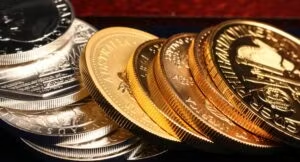
Sound Money Laws Gain Momentum in the States
Florida isn’t alone. There is a growing movement across a number of states to recognize gold and silver as legal tender. As of mid-2025, a number of states have enacted legislation officially recognizing gold and silver coins as legal tender, while many other states have bills up for consideration.
Here are just a few of the states that currently recognize gold and silver coins as legal tender, which allows for these coins to be used for payments of debts and in commerce:
- Utah: The Utah Legal Tender Act, enacted in 2011, recognizes U.S.-mint gold and silver coins as legal tender.
- Louisiana: The state currently has a law on the books stating that gold and silver is legal tender. Currently, there is new legislation that proposes a modification to the language to state that any gold or silver coin, specie, or bullion must be recognized by the U.S. government, rather than issued by it, to be considered legal tender in the state. This modification replaces the term “issued” with “recognized” and removes the requirement for state issuance.
- Oklahoma: In 2014, the Oklahoma Senate Bill 862 recognized gold and silver U.S.-minted coins as legal tender and exempt from taxation.
- Wyoming: In 2018, Wyoming established a law that eliminated the taxation of gold and silver bullion.
- South Carolina: In 2013, the South Carolina House of Representatives passed a bill declaring gold and silver legal tender.
- Kansas: In 2013, the Kansas Committee on Taxation passed a bill declaring U.S.-minted coins as both of legal tender and tax-exempt.
A Constitutional Foundation for Gold and Silver as Money
Why is this movement growing across our nation today? Supporters of sound money point to the U.S. Constitution’s specific reference to gold and silver as money, arguing that returning to these standards upholds the nation’s founding legal framework.
The U.S. Constitution in Article 1, Section 10, says: “No State shall… make any Thing but gold and silver Coin a Tender in Payment of Deb
ts.” This clause is often cited by sound money advocates as the constitutional basis for states to recognize precious metals as money.
While, federal policy has favored the use of paper currency, states do have the authority to recognize gold and silver as legal tender within their own jurisdictions.
Other Reasons State Legislatures Are Focusing on Gold and Silver
The sound money movement to restore gold and silver as legal tender across states is being driven by a desire for economic stability in a currency. Unlike paper money (fiat currency), which governments and central banks can print in unlimited quantities, gold and silver are naturally scarce. For example, the annual increase in the global gold supply is generally only about 1.4% to 2.2%.
But, the supply of paper money can grow rapidly. During the Global Financial Crisis and the Covid Pandemic, the government printed new paper money to flood the financial system with liquidity. In 2020 alone, U.S. money supply, as measured by M2, grew by 27%.
More supply devalues the purchase power of paper money over time.
Over 5,000 years of history, gold and silver have held and increased in value. Meanwhile, there are numerous examples in history where paper currencies have been devalued, destroyed and made nearly worthless by hyperinflation or monetary policy changes. Precious metals offers a stable store of value and a hedge against currency devaluation.
Proponents of the sound money movement also point to benefits including financial privacy and freedom. Unlike digital payments which are track
ed and can even be frozen by governments, using physical gold and silver can offer privacy and autonomy in financial transactions.
Last but not least, concerns about the rising United States government debt is creating concerns about a potential currency crisis, devaluation or a period of significantly higher inflation in our nation.
The Bottom Line
Gold and silver have served as currencies for over 5,000 years and have stood the test of time. In today’s modern world, investors big and small still put their faith into precious metals. Central banks around the globe have been adding to and stockpiling new gold reserves in recent years at a record pace. It’s not just central bankers. Demand for gold bars and coins has been surging among individual investors too, with some dealers experiencing temporary shortages.
At Blanchard, we are committed to helping you protect and preserve your wealth. We have an extensive inventory of gold and silver bullion available to ship today. It’s easy to increase your wealth protection if you act now. Explore our gold coin or silver coin inventory now.
Want to read more? Subscribe to the Blanchard Newsletter and get our tales from the vault, our favorite stories from around the world and the latest tangible assets news delivered to your inbox weekly.
The 1896 Barber Quarter Proof: A Tangible Connection to the Gilded Age
Posted on — Leave a commentThe Barber Quarter is a perennial favorite among collectors for its historical significance and the exciting challenge that comes with trying to assembling a complete set, including coins from all mint facilities.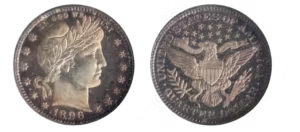
In their era, Barber Quarters primarily went immediately into circulation and stayed there. They were heavily used and today survivors in high grades are scarce. In 1896, a mere 762 Barber proofs were minted. Today, high-quality 1896 Barber proof quarters are hard to come by. There’s only an estimated 250 survivors in grades 65 or better.
To hold a 1896 Barber Quarter in your hand is a direct connection to one of the most economically vibrant periods in our nation’s history. This coin was minted towards the end of the Gilded Age.
The rapid growth of heavy industry, like factories, railroads, and coal mining, drove economic growth forward at a furious pace in these years. The Gilded Age era featured storied wealthy industrialists and financiers like John D. Rockefeller, Andrew Carnegie, J.P. Morgan, and Cornelius Vanderbilt, who are well-remembered today. Many of their Gilded Age fortunes were turned to good use through philanthropy, and they continue to impact people’s lives today through universities, hospitals, museums, and libraries.
Barber quarters were minted from 1892 to 1916. The striking coin is named after its designer, United States Bureau of the Mint Chief Engraver Charles E. Barber. The Barber quarter is part of a series of coins, which today collectors refer to as the “Barber coinage.” This includes a dime, quarter and half dollar.
Today, collectors strive to own a collection of Barber quarters minted at all the different U.S. Mint facilities, including Philadelphia (no mint mark), New Orleans (O mint mark), San Francisco (S mint mark), and Denver (D mint mark).
The Barber quarter was introduced as part of a modernization effort of our nation’s coinage, and it replaced the Seated Liberty quarter, which had been in circulation since 1838. The Barber quarter has earned a revered place in the numismatic world as it represents the changing coinage during the late 19th century.
Minted with 90% silver and 10% copper, the obverse features a bust of Liberty facing right. She wears a Phrygian cap, which is a symbol of freedom, and is surrounded by the words “IN GOD WE TRUST.” The date is located below the bust of Liberty. The reverse highlights a memorable heraldic eagle with outstretched wings. The eagle holds an olive branch and arrows in its talons, symbolizing peace and strength.
This coin was minted during an extraordinary period of American history—the Gilded Age. Other memorable events in 1896: Utah was admitted as the 45th state to the United States of America, in May 1896, a group of 12 industrial stocks was chosen to form the Dow Jones Industrial Average, and in November 1896, Republican William McKinley won the U.S. presidential election, defeating William Jennings Brian. Take a look at the artistry of the 1896 Barber Quarter Proof here and imagine holding it in your hand as a way to connect to this historic time in America.
America Loses Its Last Sterling “AAA” Credit Rating Due to Rising Debt
Posted on — Leave a commentAmerica’s credit isn’t as good as it used to be. In a surprise announcement, Moody’s Ratings downgraded the U.S. government’s credit in mid-May. Moody’s Ratings was the last of the three major ratings agency that had given America access to the exclusive Triple-A club. No more.
Moody’s downgraded its credit rating of the United States to “Aa1” from “AAA.” The firm pointed to rising debt and interest “that are significantly higher than similarly rated sovereigns.”
“Successive U.S. administrations and Congress have failed to agree on measures to reverse the trend of large annual fiscal deficits and growing interest costs,” Moody’s said. “We do not believe that material multi-year reductions in mandatory spending and deficits will result from current fiscal proposals under consideration.”
What Is a Credit Rating?
When you apply for a new credit card, the financial institution looks at your credit score. For a nation, a credit rating is an assessment of the government’s ability to repay its debt, like the Treasury bonds and notes that it sells.
The highest rating is AAA, and then ratings move lower indicating default risk from AA to BBB to C and lower. For governments, a high credit rating signals strong fiscal health and a high likelihood of repaying debts on time, while a lower rating suggests increased risk for lenders and investors.
Why Does the U.S. Credit Rating Matter?
The U.S. credit rating is important because it directly impacts the cost of borrowing for the government. When our nation carried an AAA rating, it could borrow money at the lowest possible interest rates, as investors saw our debt as virtually risk-free.
A downgrade signals to investors that lending to the U.S. is slightly riskier, prompting them to demand higher interest rates to compensate for that risk.
Bottom line? A lower credit rating means higher borrowing costs when the U.S. government auctions off Treasury bond and notes to pay our national debt. This can also lead to higher borrowing costs for consumers since U.S. Treasury yields serve as a benchmark for many other interest rates throughout the economy.
What Does a Downgraded Credit Rating Mean for the U.S. Economy and You
Looking ahead, this news could have real-life consequences for our government and everyday Americans including:
Higher Borrowing Costs: The U.S. government may have to pay more to borrow money, which can increase the federal deficit over time
Rising Interest Rates: As Treasury yields rise, so do rates on mortgages, auto loans, and corporate debt, making borrowing more expensive for households and businesses
Market Volatility: Downgrades can unsettle financial markets, causing volatility in stocks, bonds, and currencies as investors reassess risk
The 2011 U.S. Credit Downgrade and Its Impact on Gold
Looking back, the first-ever downgrade of the US credit rating occurred in August 2011, when Standard & Poor’s lowered the U.S. from AAA to AA+
This downgrade unfolded amid intense political standoffs in Congress over the U.S. debt ceiling and sent shockwaves through the stock market and gold soared to record highs. Investors turned to the safety of gold as the U.S. government’s credit-worthiness was questioned, which led to bigger questions about the stability of the U.S. financial system.
What Could the Latest Downgrade Mean for Gold Now?
In August 2023, Fitch lowered its US credit rating from AAA to AA+. And, now Moody’s has also lowered theirs. The news underscores the stability and security of gold in a world racked with government debt.
For gold investors, this helps underscore that gold is in a structural bull market. Analysts at JP Morgan issued a new research note in mid-May outlining a scenario that could take gold 80% higher to $6,000 by 2029. They said this could occur if just 0.5% of U.S. assets held by foreign investors was reallocated gold.
Do You Own Enough?
Never before in history has there been such a strong case for gold ownership. With rising government debt, political brinksmanship, and concerns about fiscal sustainability, gold acts as a safe haven, a store of value and a vehicle to grow your wealth. It’s easy to increase your wealth protection with an increased allocation to gold. Why not do it today?
Want to read more? Subscribe to the Blanchard Newsletter and get our tales from the vault, our favorite stories from around the world and the latest tangible assets news delivered to your inbox weekly.
1915-S Panama Pacific Coins Celebrate One of the Greatest Engineering Feats in History
Posted on — Leave a commentThe opening of the Panama Canal in 1914 represented one of the greatest engineering feats in the history of the world at that time. Throughout the 1800s,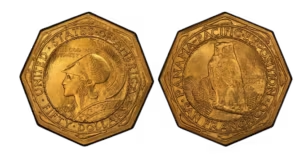 businessmen around the globe wanted to ship goods quickly and cheaply between the Atlantic and Pacific coasts—and the long-awaited opening of the Panama Canal transformed global trade.
It had been a long time coming. In 1881, the French tried, and failed, to build a pathway to connect the Atlantic and Pacific oceans. When the United States took it over in 1904 and took the project to completion in 1914, it cemented the technological prowess and growing influence of America on the world stage.
In January 1915, Congress authorized the production of five commemorative coins for the Panama-Pacific International Exposition, to be held that year in San Francisco. The legislation authorized a silver half dollar, a gold dollar, a gold $2.50, and two $50 gold pieces (one round and one octagonal). The octagonal version was the first and only time that the U.S. Mint produced a non-round coin.
The U.S. Mint, however, faced challenges during the production of the 1915-S Panama-Pacific coins. First, there was the tight timeline. The authorizing legislation for the coins was passed in early January 1915, yet the Panama-Pacific International Exposition opened on February 20, 1915!
The law required coins to be ready by the exposition’s opening, which proved impractical due to the short time frame between the law’s passage and the fair’s start. The Mint tried to act quickly, but coins were not available for sale at the opening of the exposition.
Then there was also the mint mark controversy. A major production hiccup emerged when the first dies for the gold dollar and half dollar arrived at the San Francisco Mint without the customary “S” mint mark!
The Philadelphia Mint Superintendent had thought the mint mark was unnecessary since all coins were being struck in San Francisco, but Mint Director Robert W. Woolley disagreed, fearing confusion with Philadelphia issues and local backlash. As a result, all dies had to be returned to Philadelphia for reworking to include the mint mark, which caused even more delays.
Today, the 1915-S Panama–Pacific commemorative coins are among the most storied and sought-after issues in American numismatics, in part due to the remarkable achievements they commemorate.
Between February and December 1915, over 18 million people from around the world visited the Panama-Pacific International Exposition, which sat on over 600 acres in San Francisco’s Marina District.
The Exposition celebrated the completion of the Panama Canal, and also showcased San Francisco’s remarkable recovery from the devastating 1906 earthquake and fire. The World Fair also promoted technological and motor advancements, including a demonstration of a transcontinental telephone call, and events to promote the use of automobiles.
Minted to celebrate a pivotal moment in U.S. history, these coins embody both artistic achievement and historical significance. Charles Keck designed the 1915-S Panama-Pacific $1 gold coin. The obverse features the head of a man representing a Columbian laborer. On the reverse, two dolphins encircle ONE DOLLAR.
Charles E. Barber designed the 50c silver commemorative, which showcases Lady Liberty scattering flowers on the obverse and an eagle perched on a Union shield on the reverse.
The 1915-S Panama-Pacific commemorative coins are enduring symbols of American engineering prowess and resilience. Their origins in a world’s fair celebrating the Panama Canal and San Francisco’s rebirth, combined with their low mintage, artistic beauty, and deep historical significance, cemented their place among the most treasured U.S. commemoratives.
Want to read more? Subscribe to the Blanchard Newsletter and get our tales from the vault, our favorite stories from around the world and the latest tangible assets news delivered to your inbox weekly.
Civil War Hoarding Created a Need for the Nickel Three Cent Piece
Posted on — Leave a commentThe Civil War impacted nearly every aspect of Americans’ lives. Amid the military battles, food shortages, and economic chaos, people hoarded any precious metals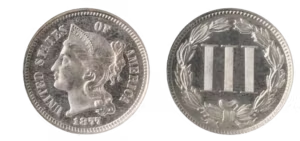 they could get their hands on. That included the three-cent silver piece, the smallest silver coin produced at that time by the U.S. Mint. This created a currency shortage for daily commerce and trade.
In an effort to ease the currency shortage, the U.S. Treasury issued small-denomination paper notes, ranging from three cents up to fifty cents. These paper notes became known as fractional currency. But the public distrusted and disliked paper currency.
A Distrust of Paper Currency Opened the Door to Using Nickel in Coins
In 1865, Congressman John Kasson, widely known for being against using nickel in coins, sponsored a bill to authorize a new three-cent coin made of nickel and copper. The reason Kasson changed his mind? He liked fractional currency even less than he liked nickel coins. The bill passed, and a new three-cent nickel coin was born.
The Philadelphia Mint struck nickel three-cent coins from 1865 through 1889. The public instantly embraced them, finding nickel three-cent pieces extremely convenient because they could be used to buy postage stamps, which cost three cents at the time.
1877 Nickel Three Cent Piece: A Key Date with a Tiny Proof Only Mintage
Collectors typically acquire the nickel three-cent piece as a type coin. However, within the series, there is a prominent and highly desirable proof-only mintage. In 1877, the Philadelphia Mint produced 900 proofs of the nickel three-cent piece, the lowest number of the entire series. Survivors are scarce.
Today, only 350 of the 1877 key date three-cent nickels are shown in grades 65 or better. See a prized 1877 Nickel three-piece coin here.
Coin Design
The original design adopted in 1865 remained unchanged for the 24 years the coin was produced. Chief Engraver James Longacre created the crisp and clean design. The obverse featured the head of Liberty facing left. She wears a beaded coronet carrying the word: LIBERTY. The date and UNITED STATES OF AMERICA encircle the obverse. The reverse is an impactful and simple design highlighting the Roman numeral III in the center, surrounded by a delicate wreath.
Cargo Ship Traffic from China to U.S. Drops 40%: What It Means For Gold
Posted on — Leave a commentWhen you shop at Target, Walmart, or Costco, you probably don’t think much about the journey the items you buy have taken.
It turns out that things made in China can travel up to 10,000 nautical miles to arrive on U.S. soil. Cargo ships carry everything from laptops, smartphones, furniture, lamps, clothing, toys, sports equipment, shoes, and more to the U.S., eventually landing in your neighborhood stores.
Since early April, when the U.S. added a 145% tariff on goods imported from China, cargo ship traffic has slumped. About 40 cargo ships are en route from China to the U.S., but that number is down by about 40% just before the tariffs were instituted. Those ships carry about 320,000 containers, according to Bloomberg. That’s about a third fewer than just before the 145% tariff was set.
Looking ahead, cargo ship traffic could slow even more. In late April, Hapag-Lloyd AG, the world’s fifth-largest container carrier, stated that approximately 30% of bookings from China to the United States have been cancelled.
While the trade war is still young, and although the U.S. has said the tariff rate on China will come down, trade is slowing now.
What does this mean for you, the economy, and gold?
By the middle of May, thousands of American companies, even giant retailers like Target and Walmart, will need to replenish inventories. Experts predict we may begin seeing empty shelves at some of your favorite stores in a couple of weeks.
The U.S. is a consumer-led economy. By some accounts, consumer spending creates roughly 70% of our gross domestic product. For the economy, the math is simple. Fewer goods to sell means less spending, slowing economic growth.
What about gold? The precious metal has soared almost 30% since the start of the year, at least partly fueled in large part by safe-haven buying amid stock market volatility, concerns over a recession, and the impact of the tariffs on the economy.
The price of gold keeps hitting record after record, recently surpassing $3,400 an ounce, and it’s still climbing. Many on Wall Street, including J.P. Morgan and Goldman Sachs, expect gold to hit $4,000 by 2026. However, given how fast gold has been climbing, $4,000 could come even earlier.
While many Americans haven’t yet seen firsthand the impact of the trade war, it could be coming within a few weeks. Logistics experts warn that springtime is when retailers begin placing orders for back-to-school and Christmas inventory. In a typical year, the first holiday shipments would be hitting the water and starting that journey by mid-May. For now, many of those orders have been canceled or are on hold.
While the jury is still out on any tariff deal between China and the U.S., fewer goods are coming to our country now. While that may put a crimp in back-to-school shopping, it will continue to support the historic climb in gold prices. Do you own enough?
Want to read more? Subscribe to the Blanchard Newsletter and get our tales from the vault, our favorite stories from around the world and the latest tangible assets news delivered to your inbox weekly.
Fed Issues Stark Warning on Economy
Posted on — Leave a commentThe Federal Reserve kept its key interest rate steady at 4.25-4.50% when it met on Wednesday. Nonetheless, Fed officials issued an unusually frank warning about what could lie ahead.
“Uncertainty about the economic outlook has increased further,” Fed officials said. “The committee… judges that the risk of higher unemployment and higher inflation have risen.”
How markets reacted
Gold traded sideways following the Fed’s meeting, while stocks traded lower. Gold has climbed over 26% since the start of 2025 as world investors have piled into the safety of gold.
The trend for gold points higher with major banks projecting big gains ahead for the precious metal. In a new research note today, Bank of America said it sees growing potential for gold to hit $4,000 an ounce in the second half of this year because of global trade-induced geopolitical uncertainty.
Quick primer: How the Fed uses interest rate policy
One of the main tools in the Fed’s toolbox is raising and lowering its key interest rate.
- Lowering interest rates helps boost an economy that is slowing down
- Raising interest rates helps tamp down inflation
The Fed’s dilemma Today, the Fed says the U.S. economy is staring at both of those risks ahead – the potential for economic slowdown or even a recession, and the risk that consumer prices and inflation could rise from the tariff policy. The U.S. economy is already slowing as first quarter Gross Domestic Product (GDP) growth declined by 0.3%.
What’s next? Stock investors are betting on interest rate cuts in the second half of 2025. By July, the CME FedWatch tool reveals that the market is pricing in 55% odds of a 0.25% interest rate cut.
Yet, the Fed is stuck between a rock and hard place, as economists worry that rate cuts could make inflation worse.
View from the Street on Economy and Stocks
In a new Barron’s Big Money poll, Wall Street money managers see risks for the stock market ahead.
- Sixty-five percent say the stock market will suffer a decline of 20% or more.
- Only 26% of money managers are bullish on the stock market over the next 12 months.
- Twenty-four percent say the biggest risk for the stock market over the next 6 months is an economic slowdown
- Nineteen percent say a recession is the biggest risk for the market over the next 6 months
Will You Act on the Fed’s Warning?
The Fed is warning of big economic risks ahead. Money managers are warning of a bear market in stocks this year. Is your portfolio positioned for what lies ahead? Central banks, pension funds, family offices and individual investors are turning to the safety of physical gold and silver. It’s easy to buy more portfolio protection with an increased allocation to gold. Why not do it today?
Protectionist Trade Policies Shine Spotlight on Gold As World Dumps Dollars and Treasuries
Posted on — Leave a commentGovernments and investors worldwide appear to be losing confidence in the U.S. dollar and U.S. Treasury bonds. The start of a new global trade war has rattled the world as the rules around the global economic order have starkly changed in a matter of weeks. America’s move toward highly protectionist policies has triggered a stock market crash, a 9% decline in the U.S. dollar this year, and U.S. Treasury bonds are down too.
As the world’s financial faith in the U.S. has been rattled, global investors are pulling out of U.S. assets. Why is this significant?
In the past, during times of economic and financial crisis, investors around the globe bought the U.S. dollar and U.S. Treasury bonds as safe-haven investments. Now, they are selling the U.S. dollar and selling U.S. bonds.
Gold has now moved to the top step as the world’s ultimate safe-haven asset. In April, gold set new all-time highs above $3,400 an ounce as the flight to safety poured into the precious metals markets.
It’s worth considering that the U.S. policies are changing at a time when our nation owes a lot of money. The U.S. national debt tops $29 trillion. In fiscal year 2025, the Congressional Budget Office forecasts a budget deficit totaling $1.9 trillion. To fund our deficit and debt, our nation relies on capital inflow from foreign governments and investors.
In a new economic world order where the U.S. isn’t seen as a reliable partner, it makes sense for foreign investors to diversify their holdings away from U.S. assets, experts say. Indeed, it’s already starting to happen. According to Bank of America, foreign investors accounted for a smaller share of buyers at March Treasury auctions.
Foreigners own roughly 20-30% of the U.S. stock and bond markets, totaling about $19 trillion of U.S. equities, $7 trillion of Treasuries, and $5 trillion of U.S. corporate bonds, according to Apollo Management. A wholesale reversal of capital inflows to American markets could cause significant economic pain, fresh stock market losses, and significantly higher interest rates.
In the meantime, gold is increasingly seen as the only safe haven game in town. Goldman Sachs Group now projects that gold could climb to $3,700 by the end of this year. If the U.S. economy slips into recession, the firm projects gold hitting $3,880 this year. Looking into the middle of next year, Goldman expects gold to climb to $4,000 an ounce.
The U.S. economy isn’t out of the woods yet. The dust hasn’t even begun to settle. In closed-door meetings at the White House, the chief executives of Walmart and Target privately warned the President that tariff policy could result in empty shelves in their stores in the weeks ahead. If you are looking to take steps to protect your hard-earned assets, explore our gold inventory now. Gold at $4,000 may be here faster than you expect.
Want to read more? Subscribe to the Blanchard Newsletter and get our tales from the vault, our favorite stories from around the world and the latest tangible assets news delivered to your inbox weekly.
1862 Indian Head Cent: James Longacre’s Civil War Masterpiece
Posted on — Leave a commentJames B. Longacre, Chief Engraver of the U.S. Mint, is best remembered today for his creation of the iconic Indian Head cent.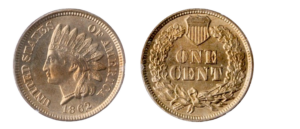
The 1862 Indian Head cent was struck during a pivotal phase of the Civil War, which saw a shift in momentum and strategic gains for the Union Army. Major battles included the Battle of Shiloh in Tennessee, the Union capture of New Orleans, and the Seven Days Battles outside Richmond. The bloody Battle of Antietam in September 1862 had no clear winner. But this significant Civil War battle opened the door for President Lincoln to announce the Preliminary Emancipation Proclamation.
Indian Head cents are a classic early American coin coveted by collectors due to their design, historical significance, and rarity. Minted from 1859 through 1909, Indian Head cents were produced in large numbers in most years.
In 1862, against the backdrop of a war-torn nation, the Philadelphia Mint produced 28,075,000 Indian Head cents. The production met huge demand for small change in the cash-starved economy. Amid the chaos of wartime, citizens were hoarding precious metals.
While the 1862 cents’ mintage was substantial, survival rates tell a different story. Most coins circulated heavily, leaving few in pristine condition.
Today, a mere 400 survivors are estimated in grades 65 or better.
In 1909, the Indian Head cent was replaced by the Lincoln cent, designed by Victor D. Brenner, closing this important era in U.S. numismatic history.
Longacre’s vivid design features a representation of Liberty wearing an Indian headdress, blending classic artistry with frontier imagery. The obverse includes the word “LIBERTY” on the Native American headdress, encircled by “UNITED STATES OF AMERICA” and the date “1862″ at the bottom.
The reverse features an intricately beautiful oak wreath encircling the coin’s denomination “ONE CENT.” A small shield sits at the top, symbolizing victory. The 1862 Indian Heads are known for being usually well-struck and with excellent luster. The 1862 Indian Cent was struck with an alloy of 88% copper and 12% nickel, creating the coin’s pale hue. It clocks in with a substantial weight at 4.67 grams.
Today, collectors interested in Civil War history and early American coinage jump at the opportunity to own an Indian Head cent, a tangible piece of early American history. Whether you desire to acquire a coin like this as a standalone treasure or part of a larger collection, this rarity is a testament to the enduring legacy of early American coinage. Blanchard has one of these magnificent coins on offer now. See it here.
Read more
Copper Shortage Paves Way for Small Flying Eagle Cent
Top 5 Rare Coins You Should Collect
Want to read more? Subscribe to the Blanchard Newsletter and get our tales from the vault, our favorite stories from around the world and the latest tangible assets news delivered to your inbox weekly.