$10 Indian XF (Dates/Types Vary)
Price
$2,986.00
(3434 reviews)
Daniel Howell
2026/03/10
The support Team is great to work with. Specially, Ryan.
Richard Appen
2026/03/10
Paainless order. Fast delivery.
Kevin D Evans
2026/03/09
just fine.
ROBERT OSKIN
2026/03/09
BLANCHARD IS ALWAYS EXCELLENT TO DEAL WITH
William Calame
2026/03/08
quick and easy as always. if you can get more stock at the low to mid range that would be great... i give them to my grandkids for college
Timothy Wolfe
2026/03/08
Very nice company
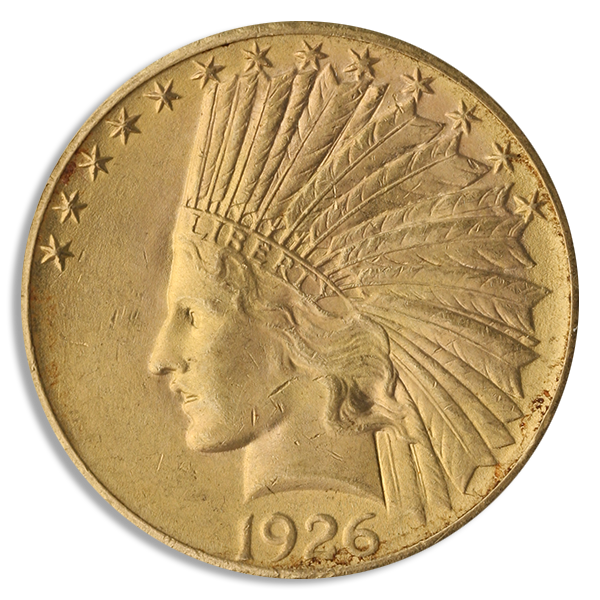
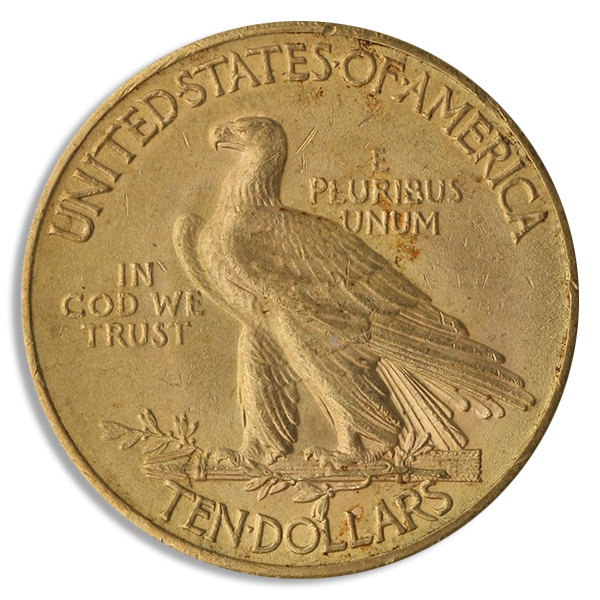
| President Theodore Roosevelt was driven by a desire to rejuvenate American coinage, which he saw as lacking in artistic value. Aiming to match the exquisite craftsmanship of ancient Greek coins, Roosevelt brought in renowned sculptor Augustus Saint-Gaudens for this ambitious project. Among the coins redesigned was the distinguished $10 Indian Head Eagle gold coin. Saint-Gaudens, already a prominent figure in Washington's art circles, frequently visited Henry Adams, who introduced him to Roosevelt. The President and the sculptor shared a deep appreciation for ancient Greek coins, which they believed represented an unparalleled standard of beauty. Initially hesitant due to prior unsatisfactory experiences with the U.S. Mint, Saint-Gaudens was eventually convinced to undertake the project. His involvement marked a significant shift in American numismatics. He was the first non-Mint employee to design U.S. coins and infused them with the beauty of classical Roman and Greek art. The $10 Indian Head Eagle, minted from 1907 to 1933, showcases an impressive obverse design featuring Lady Liberty wearing a feathered headdress. Why a feathered headdress instead of the traditional Phrygian cap? As President Theodore Roosevelt wrote to the sculptor Saint-Gaudens: “Really, the feather head-dress can be treated as being the conventional cap of Liberty quite as much as if it was the Phrygian cap; and, after all, it is our Liberty [...] and we are entitled to a typically American head-dress for the lady.” The word "LIBERTY" is inscribed on the headband, and the year of minting appears below Lady Liberty’s neck. This design brought a new level of detail and artistic quality to American coins. On the reverse, Saint-Gaudens portrayed a powerful eagle standing on an olive branch and a bundle of arrows, symbolizing a harmonious balance between peace and military readiness. The inscriptions "UNITED STATES OF AMERICA" and "TEN DOLLARS" encircle the eagle. Each $10 Indian Head Eagle contains .48375 troy ounces of gold and is composed of 90% gold and 10% copper. The coin measures 2.03 mm in thickness, 27 mm in diameter, and weighs 16.718 grams. These coins were produced at the Philadelphia, San Francisco, and Denver mints. Production was sporadic between 1916 and 1933, enhancing the coin's rarity and appeal to collectors. The $10 Indian Head Eagle is a testament to Roosevelt's vision and Saint-Gaudens' artistic brilliance. It represents a significant moment in the history of American coinage, merging artistic excellence with numismatic value. The XF (Extremely Fine) coin grade denotes a coin with slight wear on the highest points but overall retaining much of its original detail. |
| Weight | 0.4838 |
|---|---|
| Metal | Gold |
Comparison Chart