1797 $10 Draped Bust Large Eagle NGC MS62 CAC


2026/11/03
Good price
2026/11/02
Longtime customer
2026/11/02
The phone call from office convinced me to buy
2026/11/02
1st order.. we we’ll see how it goes
2026/11/01
dependable and safe
2026/11/01
Great Experience
Introduction
The 1797 $10 Draped Bust Large Eagle is a rare early United States gold coin from the formative years of the federal Mint. Designed by Chief Engraver Robert Scot and struck at the Philadelphia Mint, this historic Eagle features the distinctive Heraldic Eagle reverse introduced to the denomination in 1797. This example is graded NGC MS62 and has received CAC approval, combining Uncirculated preservation with an additional assessment of quality within the assigned grade. Its early federal origins, historic design, and scarcity make it an important issue for collectors of classic American gold.
History
The United States Mint began producing $10 gold Eagles in 1795, making the denomination one of the first gold coins issued by the federal government. Authorized under the Coinage Act of 1792, the Eagle was the largest gold denomination established by the original federal coinage system. These early coins reflect the young nation's efforts to develop a stable and recognizable monetary system.
In 1797, the Philadelphia Mint introduced a new Heraldic Eagle reverse for the $10 denomination, replacing the smaller eagle design used on earlier issues. Inspired by the Great Seal of the United States, the new reverse featured a more elaborate representation of the American eagle with a shield, stars, and clouds. The Large Eagle design continued on the denomination through its final early production in 1804.
PCGS reports a traditional mintage figure of 10,940 for the 1797 Large Eagle, although early Mint records and the use of dated dies across multiple calendar years make precise production totals uncertain. Surviving examples are scarce, particularly in Mint State condition. The 1797 Large Eagle is also known through several specialized die varieties, making it an important issue for collectors studying early federal gold coinage.
Today, the 1797 Draped Bust Large Eagle is valued for its connection to the earliest years of the United States Mint, its distinctive Heraldic Eagle reverse, and its limited surviving population. An NGC MS62 example with CAC approval offers collectors a notable representative of this historic early American gold design.
Design
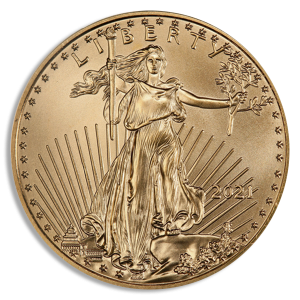
The obverse features Robert Scot's right-facing portrait of Liberty wearing a soft cap, with flowing hair and drapery at the neckline. LIBERTY appears above the portrait, while sixteen stars surround the design, reflecting the number of states in the Union at the time. The date 1797 appears below.
The reverse depicts a heraldic eagle with outstretched wings and a shield on its breast, holding arrows and an olive branch in its talons. A ribbon inscribed E PLURIBUS UNUM extends from the eagle's beak, while stars and clouds appear above. UNITED STATES OF AMERICA surrounds the design. Unlike later $10 gold Eagles, this early issue does not display its denomination on the reverse.
| Year | 1797 |
|---|---|
| Metal | Gold |
| Grade | MS62 |
| Mint | Philadelphia |
| Weight | .5158 |
| Fineness | 0.9167 |
| Diameter | 33 mm |
A LITTLE STICKER MAKES A BIG DIFFERENCE.
Within each number of the coin grading scale is a small range of condition from low-end to high-end. Certified coins of the same grade can be of varying quality. Many of today’s collectors want coins that are solid or premium quality for their assigned grade. CAC holds coins to a higher standard so you can be confident in the value of yours. We verify previously graded coins … and award our sticker only to those coins that meet the standard for today’s selective buyer.
WHAT THE CAC STICKER MEANS:
- Verified. Your coin has been verified as meeting the standard for strict quality within its grade.
- Guaranteed. CAC stands behind our verification.
THE CAC STICKER IS BACKED BY EXPERIENCE.
CAC was founded by leading members of the numismatic community, including John Albanese, a respected authority on coin grading and the rare coin market.