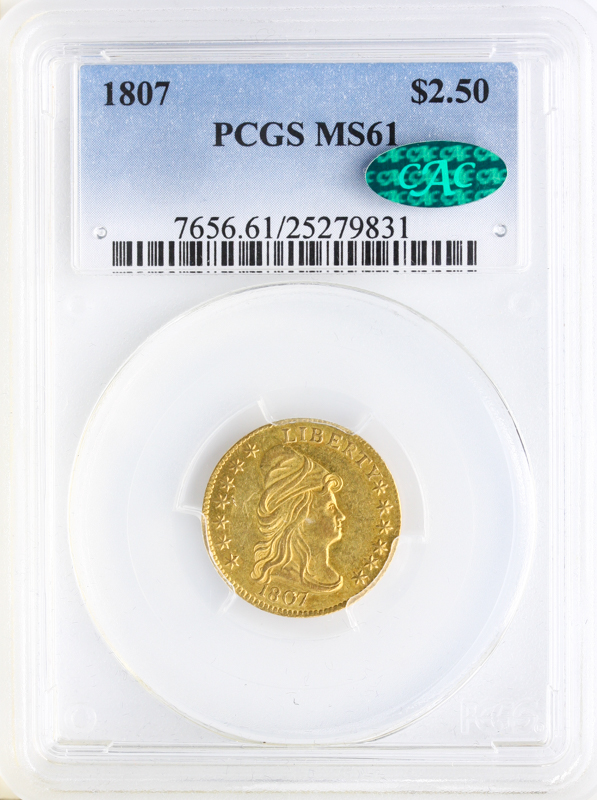
1807 $2 1/2 Draped Bust PCGS MS61 CAC
.
Blanchard prides itself on sourcing the highest quality numismatics available anywhere. If there is a coin that you are searching for, contact us today. Learn more
2026/10/07
Great company always quick to respond to any questions you have
2026/10/07
always have great service and product.
2026/10/05
too many misfires
2026/10/05
Excellent service and great prices.
2026/10/05
Nice transaction and easy
2026/10/02
again problems when checking out almost enough to make me stop
Introduction
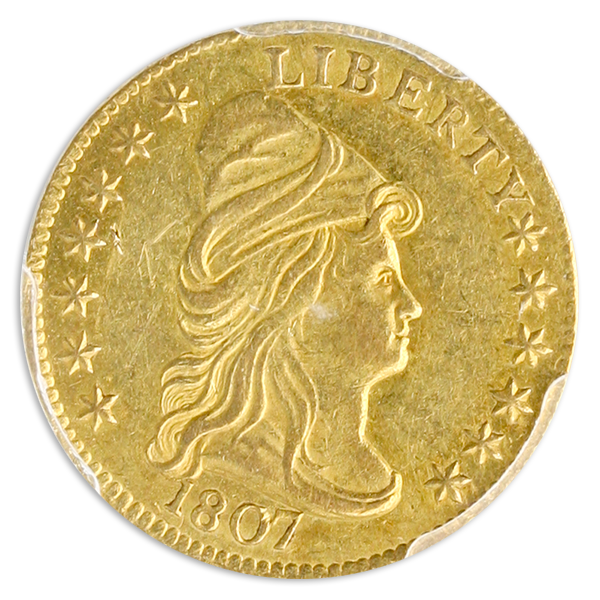
The 1807 $2.50 Draped Bust Gold Quarter Eagle graded PCGS MS61 CAC is a remarkable survivor from the formative years of the United States Mint. Certified Mint State 61 by Professional Coin Grading Service (PCGS) and approved by Certified Acceptance Corporation (CAC), this coin survives without the wear expected from circulation more than two centuries after it was struck. As the final-year issue of the Draped Bust Quarter Eagle, it captures the closing chapter of one of America’s earliest federal gold coin designs.
History
The Quarter Eagle was one of three original gold denominations authorized by the Coinage Act of 1792, alongside the $5 Half Eagle and $10 Eagle. Actual production began in 1796 at the Philadelphia Mint, where Chief Engraver Robert Scot’s Draped Bust Liberty became the face of the new $2.50 denomination. Struck in modest quantities during the early Mint era, these coins offer a direct connection to the development of America’s young monetary system.
The 1807 issue marked the final year of the Draped Bust Quarter Eagle. In 1808, the denomination received an entirely new design by Assistant Engraver John Reich, bringing Scot’s long-running Draped Bust type to an end. Early Quarter Eagles are scarce today across all grades, with Mint State survivors representing an even smaller group. A PCGS MS61 CAC example preserves this final-year design in uncirculated condition more than 200 years after its production.
Design
The obverse features Liberty facing right, her flowing hair tied with a ribbon and the word LIBERTY positioned above. Thirteen stars representing the original states surround the portrait, with the date below. Robert Scot’s neoclassical depiction of Liberty appeared across several denominations and became one of the defining images of America’s earliest federal coinage.
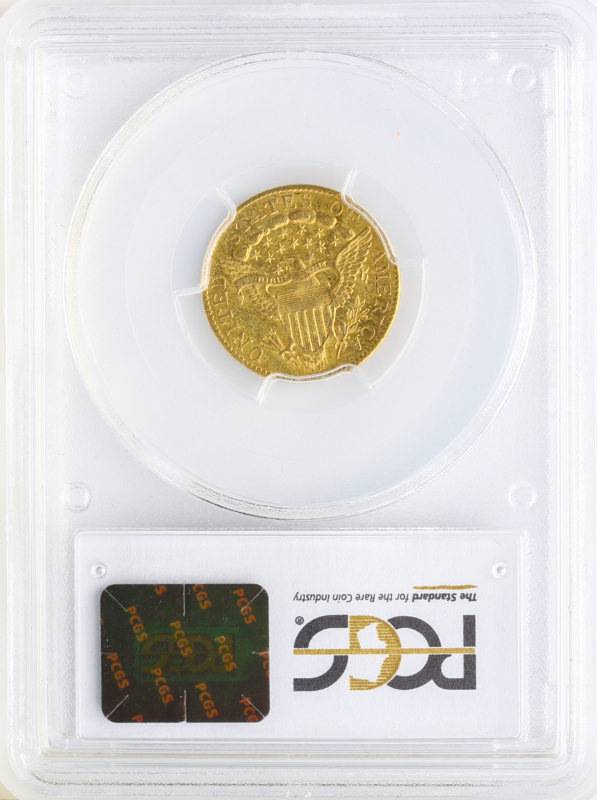
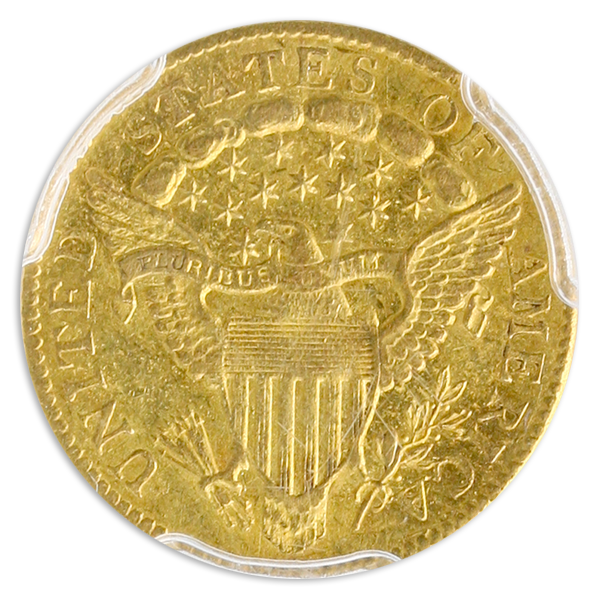
The reverse features a heraldic eagle adapted from the Great Seal of the United States, with a Union shield across its breast and an olive branch and arrows held in its talons. A ribbon bearing E PLURIBUS UNUM crosses the design, while stars and clouds appear above the eagle and UNITED STATES OF AMERICA surrounds the border. Notably, the coin carries no denomination on either side, a distinctive characteristic of these early Quarter Eagles that makes the design unmistakably rooted in the earliest decades of the U.S. Mint.
| Year | 1807 |
|---|---|
| Metal | Gold |
| Grade | MS61 |
| Mint | Philadelphia |
| Weight | .1210 |
| Fineness | 0.9167 |
| Diameter | 20 mm |
A LITTLE STICKER MAKES A BIG DIFFERENCE.
Within each number of the coin grading scale is a small range of condition from low-end to high-end. Certified coins of the same grade can be of varying quality. Many of today’s collectors want coins that are solid or premium quality for their assigned grade. CAC holds coins to a higher standard so you can be confident in the value of yours. We verify previously graded coins … and award our sticker only to those coins that meet the standard for today’s selective buyer.
WHAT THE CAC STICKER MEANS:
- Verified. Your coin has been verified as meeting the standard for strict quality within its grade.
- Guaranteed. CAC stands behind our verification.
THE CAC STICKER IS BACKED BY EXPERIENCE.
CAC was founded by leading members of the numismatic community, including John Albanese, a respected authority on coin grading and the rare coin market.