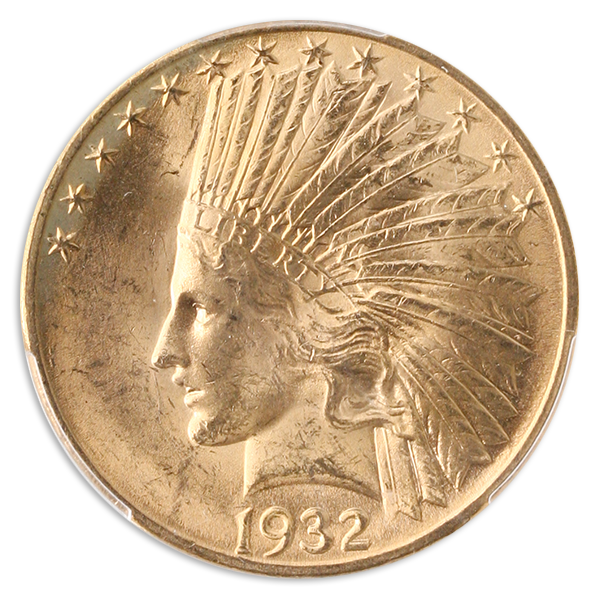
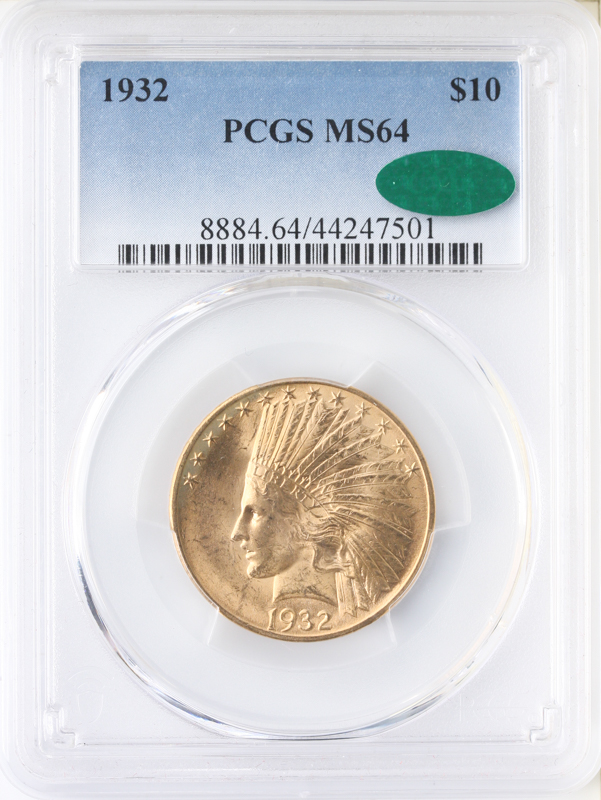
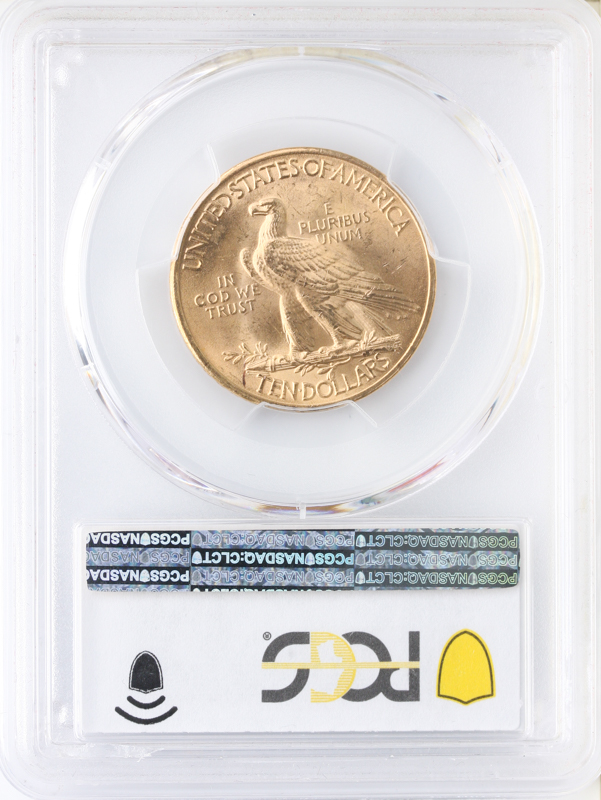
1932 $10 Gold Indian Head PCGS MS64 CAC
2026/10/07
Great company always quick to respond to any questions you have
2026/10/07
always have great service and product.
2026/10/05
too many misfires
2026/10/05
Excellent service and great prices.
2026/10/05
Nice transaction and easy
2026/10/02
again problems when checking out almost enough to make me stop
Introduction
The 1932 $10 Indian Head Gold Eagle graded PCGS MS64 CAC is a choice Mint State example from the penultimate year of one of America's most celebrated gold coin series. Designed by renowned sculptor Augustus Saint-Gaudens, the Indian Head Eagle combined bold classical artistry with an unconventional portrait of Liberty wearing a Native American feathered headdress. Certified MS64 by Professional Coin Grading Service (PCGS) and approved by CAC, this example offers strong Mint State preservation, classic pre-1933 gold, and the appeal of a significant late-series issue.
History
The Indian Head Eagle was introduced in 1907 as part of President Theodore Roosevelt's effort to elevate the artistic quality of American coinage. Roosevelt collaborated with Augustus Saint-Gaudens on new designs for the $10 Eagle and $20 Double Eagle, resulting in two of the most recognizable gold coin designs in United States history. The Indian Head Eagle series continued through 1933, although production became increasingly limited during its later years.
The Philadelphia Mint struck 4,463,000 Indian Head Eagles in 1932, the highest mintage of the series. Despite this substantial production, the issue represents the final year of the series that is readily available to collectors. The following year's 1933 Eagle had a dramatically smaller mintage and nearly the entire production was melted as the United States ended circulating gold coinage. As a result, the 1932 has become a popular choice for collectors seeking a high-quality representative of the final era of U.S. circulating gold coinage.
Design
The obverse features Saint-Gaudens' left-facing portrait of Liberty wearing a Native American feathered headdress. The word LIBERTY appears across the headdress, thirteen stars line the upper border, and the date 1932 appears below. The portrait combines classical imagery with a distinctly American interpretation that set the design apart from earlier U.S. gold coins.
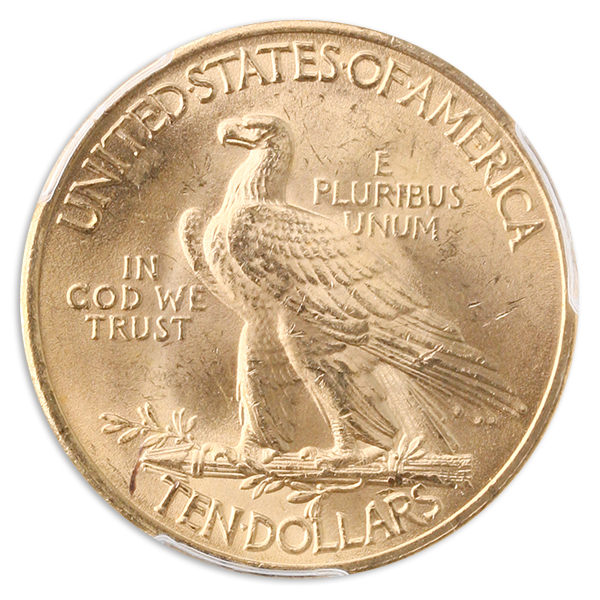
The reverse depicts a bald eagle standing on a bundle of arrows with an olive branch intertwined below, symbolizing military preparedness and peace. The inscriptions UNITED STATES OF AMERICA, E PLURIBUS UNUM, IN GOD WE TRUST, and TEN DOLLARS complete the reverse. Rather than a traditional reeded edge, the coin features raised stars around its edge, another distinctive element of Saint-Gaudens' design.
| Year | 1932 |
|---|---|
| Metal | Gold |
| Grade | MS64 |
| Mint | Philadelphia |
| Weight | 0.4838 |
| Fineness | .900 |
| Diameter | 26.8 mm |
A LITTLE STICKER MAKES A BIG DIFFERENCE.
Within each number of the coin grading scale is a small range of condition from low-end to high-end. Certified coins of the same grade can be of varying quality. Many of today’s collectors want coins that are solid or premium quality for their assigned grade. CAC holds coins to a higher standard so you can be confident in the value of yours. We verify previously graded coins … and award our sticker only to those coins that meet the standard for today’s selective buyer.
WHAT THE CAC STICKER MEANS:
- Verified. Your coin has been verified as meeting the standard for strict quality within its grade.
- Guaranteed. CAC stands behind our verification.
THE CAC STICKER IS BACKED BY EXPERIENCE.
CAC was founded by leading members of the numismatic community, including John Albanese, a respected authority on coin grading and the rare coin market.