Who Wins In A Currency War?
Posted on — Leave a commentDon’t look now, but the trade war is turning into a currency war.
This month, the United States labeled China a “Currency Manipulator,” turning the tensions between the world’s two largest economies to a boil.

U.S. Treasury Secretary, Steven Mnuchin, accused China of manipulating its currency “to gain unfair competitive advantage in international trade”. Now, the U.S. will turn to the International Monetary Fund to “eliminate the unfair competitive advantage created by China’s latest actions”.
Earlier this month, the Chinese currency – the yuan – tumbled below 7 per U.S. dollars, marking an 11-year low.
“The drop suggests that the central bank of China is willing to weaponize the currency in light of the trade war,” Andrew Collier, managing director of Orient Capital Research in Hong Kong said in news reports.
Countries benefit from weaker currencies as it makes the cost of their exports cheaper to foreign buyers, and thus stimulates demand for their goods and economic growth.
It’s not just China that wants a weaker currency.
President Trump has tweeted his demands for a weaker U.S. dollar and has publicly called for lower interest rates from the Fed, which does push the dollar lower.
While the value of a nation’s currency may seem a bit esoteric, this is a significant development.
Students of history may remember the last time we had a global competitive devaluation was in the 1930’s. Yep, the Great Depression.
As the global economy began slowing in 1930, countries began slapping tariffs on imports to protect their own country’s interests. The most famous, or infamous, is the Smoot-Hawley Tariff passed by the U.S. Congress which imposed tariffs on many imported goods.
“But each move – devaluations, tariffs, and other attempts to level the playing field – led to more retaliation. In the single year that elapsed between the third quarter of 1931 and 1932, world trade declined 16 percent. One historian described the series of events as an “uncoordinated break-up” of the global currency regime,” according to Bloomberg.
Sound familiar? Tit for tat rarely ends well.
You remember what happened next. The Great Depression.
Fast forward to today.
Britain is on the brink of moving out of the European Union, which will trigger a massive devaluation of the pound versus the euro.
The United States and China are already lobbing currency strikes, each government attempting to push its currency lower.
As all these major global currencies like the dollar, the yuan and the pound weaken, it will force other countries around the globe to join in the devaluation to avoid turning their exports into a standstill.
The United States and China trade war lit a match. That fire is getting bigger and harder to control.
As countries race to lower their currencies, the only winner is gold and investors who own gold.
Gold remains the world’s premier safe-haven asset. Gold is a global currency without any of the obligations, debts or deficits that come along with the U.S. dollar or any other currency.
While countries debase and manipulate their fiat currencies, gold is climbing – up nearly 20% this year. Goldman has a six-month forecast of gold at $1,600. Citi sees the same rise to $1,600 in six months to a year, and Bank of America Merrill Lynch sees prices climbing toward $2,000 within two years, topping the record of $1,921.17 reached in 2011.
The trade war and the developing currency war will get worse before they get better. While the U.S. Administration is beholden to two four-year limits on presidential power, the Chinese government has no constraints. They are in for the long game.
Consider increasing your allocation to gold, a hard asset that is climbing in value, not falling, and is safe from government or central bank manipulation.
The only winners in a currency war are those who own gold.
Call Blanchard today at 1-800-880-4653 to learn the optimal amount of gold you should hold in your portfolio.
Blanchard Built Steinbrenner Collection Results in $6.1 Million Total Sale
Posted on — Leave a commentNEW ORLEANS, LA, August 15, 2019 – – Blanchard and Company, the nation’s leading tangible asset firm, today affirms numismatic history was made with this week’s public auction of the Joan Zieg Steinbrenner coin set, which includes some of the finest gold type coins ever assembled.
Over a 25-year period, Blanchard advised Mrs. Steinbrenner and through its deep numismatic connections sourced for her a historic collection of U.S. gold coins.
Mrs. Steinbrenner is remembered for her active philanthropic contributions until her passing in December 2018. Her husband George purchased the New York Yankees in 1973.
This week, 44 lots from her collection were presented at public auction, all coins Blanchard placed with Mrs. Steinbrenner, which sold for a collective $6.1 million.
Blanchard originally placed in 2009 an 1843 $2.50, $5 and $10 three-coin gold proof set with Mrs. Steinbrenner that was pedigreed to legendary coin collector John Jay Pittman. This week’s auction broke up the set and the three coins sold for a cumulative total of $1,032,000.
Another notable sale included the finest ever to come to auction: MS68 1907 $10 Indian Wire Rim, which sold for $432,000 on August 14.
Commenting on the sale results, “It represents her belief that when you acquire the highest quality that fits within your budget, you can’t go wrong. That’s what paid off for her. It was a legacy she built for her family and they were able to do with it as they pleased,” David Zanca, senior portfolio manager at Blanchard.
Mrs. Steinbrenner originally consulted with Blanchard with a goal of diversifying in tangible assets. “She had no knowledge of numismatics. Over a 25-year period, through the relationship we built, my expertise and Blanchard’s deep connections in the numismatic community, she was able to build one of the finest collections ever created as a legacy for her family,” Zanca said.
“Some of these coins are once in a lifetime coins that we may never see hit the market again,” Zanca said.
The long-term relationship between Blanchard and her family spans over 40 years. Mrs. Steinbrenner’s father recommended his daughter work with Blanchard and she consulted exclusively with Mr. Zanca for 25 years.
Mrs. Steinbrenner began with a goal to diversify a portion of her portfolio in tangible assets due to concerns over world-wide debt and currency problems. “She wanted a portion of her investments in real and tangible, something she could see, touch and hold. Her father was a hard money guy. He had lived through the Depression and believed in real tangible assets,” Zanca said.
Through a trusted, personal relationship built over 25 years, Zanca listened, learned her individual goals and created numismatic recommendations based on exactly what she wanted to accomplish.
The one rule of thumb Mrs. Steinbrenner lived by was to always acquire the highest quality that fits in your budget and you will never be disappointed.
“She always wanted the finest available,” Zanca said. “She never second guessed anything because she knew she was acquiring the best.”
In addition to the diversification and legacy she built for her family, Mrs. Steinbrenner developed a true love for the beauty and wonder of numismatics. Her favorite coin was the 1907 $20 Saint Gaudens High Relief.
“It was absolutely her favorite coin. She owned multiples in varying grades. She had one made into a necklace because she loved it so much. She loved the beauty of these coins so much,” Zanca said.
Other outstanding coins included in this week’s auction of the Steinbrenner collection included the 1837 $2.50 PR66+ Deep Cameo, 1843 $5 PR66 Ultra Cameo, 1843 $10 PR64 Deep Cameo and 1843 $2 1/2 PR66 Ultra Cameo.
About Blanchard and Company
Founded in 1975, Blanchard and Company is the largest and most respected investment firm in the U.S. that specializes in precious metals and rare coins. Headquartered in New Orleans, Blanchard has owned and sold more than half of the published 100 Greatest U.S. Coins with over $1 billion in sales in the last three years alone. With over 450,000 customers to date, Blanchard has provided investors and collectors with the expert consultation they need to strategically acquire American numismatic rarities and gold, silver, platinum and palladium bullion.
David Zanca, with Blanchard since 1993, has handled some of the finest rarities in the world and works with any size collector and investor. Mr. Zanca is available at 1-800-880-4653 or via email at [email protected].
MEDIA CONTACT:
Sarah Munson
1-800-880-4653
A Good Gun, a Good Horse and a Good Wife
Posted on — Leave a commentBorn in 1734 near Reading Pennsylvania, Daniel Boone had all the ingredients for a happy life.
“All you need for happiness is a good gun, a good horse and a good wife,” Boone said.
Yet, the father of 10 children with his wife Rebecca, had a taste for adventure and wanted to explore the American frontier.
Boone, along with 30 woodsman blazed a 200-mile trail through rugged wilderness and into the area that became Kentucky and is most famous for his exploration and settlement of that area.
The Missouri Centennial half dollar features this American folk hero, who lived in Missouri for the last 25 years of his life, on both the obverse and the reverse of the coin.
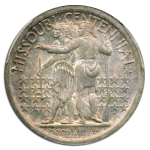
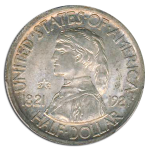
This handsome coin celebrates the 100th anniversary of Missouri’s admission into the Union in 1821.
The Missouri Exposition Committee planned a large Exposition and State fair in 1921 and wanted a commemorative coin to help fund the extravaganza. Congress authorized the striking of up to 250,000 Missouri Centennial silver half dollars.
Today, known simply as “Missouri’s” among collectors, these coins are the rarest of all the silver commemorative series and highly sought after.
Robert Aitken, the designer of the Panama-Pacific fifty dollar gold piece was chosen to craft the Missouri half dollar.
The obverse features a striking bust of famous frontiersman Daniel Boone wearing a buckskin shirt and a coonskin cap. The reverse reveals Boone with rifle and powder horn, and a Native American with the words “Missouri Centennial” encircling the top and “Sedalia”, the location of the 100th anniversary exhibition on the bottom.
The Philadelphia Mint struck only 50,000 Missouri half dollars in July 1921, yet many of these exquisite coins were melted down.
Increasing the interest to collectors, 5,000 of those added a star with 2 and 4 on either side to signify that Missouri was the 24th state to gain admittance to the Union.
The coin attracts high praise from Art historian Cornelius Vermeule who wrote that Aitken “became the first American medalist to apply the principles of Renaissance medallic design to a coin of the United States and the first such artist to make a frontiersman look like a Medici prince”
This is an ideal coin for numismatics working toward a complete type set of commemorative half dollar series, residents of Missouri or anyone with a love of early American history.
We have only one of each variety. If you are interested act fast, these gems aren’t expected to last long.
Enjoying our rare coin stories? Sign up for our newsletter here and get these, along with market news and investing advice straight to your inbox!
The History of Money Revolves Around Gold
Posted on — Leave a commentMoney makes the world go round.
But, what is money?
That $20 bill in your wallet is money. Throughout history, cowrie shells, barley, even peppercorns have been used as money. Do any of these things actually have intrinsic or real value? One could argue no.
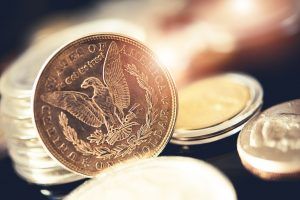
What gives things like paper money, the $5, $10, and $20 dollar bills you get from the bank value? It’s the backing and promises by the U.S. government that this has value. Essentially, American society is built around the agreement that this paper money has value.
For the vast majority of human history, however, people relied on gold and silver as money.
The traditional definition of money states that it is a:
- Store of value, which means people can save it and use it later
- Unit of account, which provides a common base for prices
- Medium of exchange, something that people can use to buy and sell with
“Precious metals seemed to serve all three needs: a stable unit of account, a durable store of value, and a convenient medium of exchange,” according to an International Monetary Fund blog post.
Precious metals are hard to obtain. There is a finite supply of them in the world. They stand up to time well. They are easily divisible into standardized coins and do not lose value when made into smaller units. In short, their durability, limited supply, high replacement cost, and portability made precious metals more attractive as money than other goods, the IMF said.
Gold coins were first created by King Croesus of Lydia, now part of Turkey, around 550 BC and circulated in many countries before paper money was created.
When paper money was first printed it was tied and backed by gold.
As the American economy developed, a strong tradition of gold as money unfolded.
In 1913, the Federal Reserve Act provided for the creation of Federal Reserve banks and a system overseen by the Federal Reserve Board. U.S. law required the Federal Reserve to hold gold equal to 40 percent of the value of the currency it issued. The Federal Reserve Notes were convertible into gold at the fixed price of $20.67 per ounce.
In 1933, a financial crisis spurred Americans to convert their paper money for gold, which sparked a massive outflow of gold from the Federal Reserve.
Individuals wanted real physical gold. Not paper money. A rush on the banks began.
In March 1933, the Federal Reserve Bank of New York could no longer honor its commitment to convert paper money to gold and President Franklin D. Roosevelt declared a banking holiday.
Ultimately, President Roosevelt issued an Executive Order requiring all Americans to surrender all gold owned by them to a Federal Reserve bank and prohibited the private holdings of all gold coins and bullion.
Blanchard and Company has deep roots in gold’s history in America.
Decades after President Franklin D. Roosevelt prohibited private U.S. citizens from owning gold, one of our company’s founders – Jim Blanchard – rose to prominence as a supporter of American’s right to own gold in the early 1970s.
He gained national attention when he arranged for a biplane to tow a banner proclaiming “Legalize Gold” over President Richard Nixon’s inauguration in January 1973.
His lobbying efforts were a success and after more than 40 years, Congress once again legalized private ownership of gold bullion effective Dec. 31, 1974. Once the gold restrictions were lifted, Blanchard founded our company in 1975 and helped build it into of the nations largest and most respected tangible asset investments firms.
Owning gold and other precious metals makes as much sense today as it did a thousand years ago, perhaps even more so given the changes that have occurred on a governmental and monetary policy level. Diversification in tangible assets makes sense for all investors for a small portion of their portfolio in order to preserve and grow wealth.
As history shows, gold was the world’s first currency and may remain the only true currency available today. Why own it? Check out this compelling research from Penn State University professors on how gold improves portfolio performance, download it free here.
One of the Boldest Campaigns in History
Posted on — Leave a commentIt was one of the boldest campaigns in history: the conquering of the mighty Inca Empire.
And who led it? An illiterate man born in poverty, the illegitimate son of a soldier and a servant. What drove him and his men was an insatiable desire for gold.
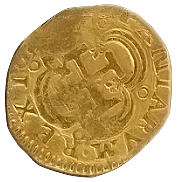
The Incas called gold “the tears wept by the sun,” and they used it for ornamentation. The golden temple of Coricancha, for example, was filled with gold, with one room containing a giant sun disc that reflected sunlight to illuminate the rest of the temple. The disc was even aligned so that during the summer solstice, it illuminated a place where only the emperor was allowed to sit. When the Spanish took Cusco, they destroyed most of Coricancha and melted down the gold plating and sculptures to send back to Spain.
From that and mints in the New World, the Spanish sent gold back to Europe in quantities the continent had never seen. And on those voyages, one of the treasures that pirates risked their lives for was the gold cob: coin of an empire.
All known examples of this coin came from the shipwrecks of the Santa Margarita and the Nuestra Señora de Atocha. Both sailed with the 1622 treasure fleet and sank off the coast of Florida.
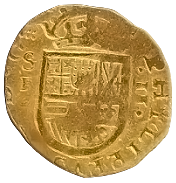
Today we bring you a beautiful specimen of one of those cobs: a 1622 gold escudo. This 1622 gold escudo was the first gold coin struck in the New World. Gold escudos were introduced by Spain in the 16th century and became the nation’s primary gold currency. They were minted in Madrid and Seville, as well as in several of Spain’s colonies.
Cobs are coins that were struck and trimmed by hand. When you handle a gold cob, you thus hold in your hand the handiwork of a 17th-century minter: someone who struck your coin 400 years ago.
Want to read more great rare coin stories? Sign up for our newsletter! In addition to numismatic news, you’ll get weekly updates with the latest market news and investment advice.
The Three Factors Influencing Gold Now
Posted on — Leave a commentAs we make our way through the second half of 2019 several factors are influencing gold. The World Gold Council has reported on these characteristics and in this post, we break down each one. We will examine why they are important and what they might mean for investors.
Global Monetary Policy and Interest Rates
Until recently interest rates were on the rise and expected to continue their increase. However, in just the past few days we have seen a reversal of this trend. The Federal Reserve cut interest rates for the first time in over ten years. Reserve Chairman Jerome Powell explained his reasons for the cut by citing growing trade tensions and a slowdown in global growth. As Gary Richard, professor of economics at the University of California, remarked “The Federal Reserve has generally better information about the economy than most of the public, and they have a lot of experts there – they’re trying to predict the future. And the Fed is acting now as if we’re in a recession.” For many, that is a frightening prospect.
Moreover, this fear of a contraction in the economy is shared abroad. The European Central Bank’s (ECB) President announced his intention to cut interest rates. Many expect the Bank of Japan to do the same. While a slowing global economy presents some problems it also presents some opportunities. As the World Gold Council remarks, “Our research indicates that the gold price was higher in the 12 months following the end of a tightening cycle.” They continue, “historical gold returns are more than twice their long-term average during periods of negative real rates – like the one we are likely to see later this year.”
Balancing Risk
This low interest environment has spurred a significant amount of the stock market’s rally in the last six months. This dynamic is a problem because it means that heightened valuations are the result of stimulus measures rather than strong underlying fundamentals. Additionally, equity growth from interest rate cutting cannot be sustained. At some point there will be nothing left to cut. Investors are entering a playing field in which they need to diversify risk. As the World Gold Council points out, bonds have traditionally served this need with their more favorable risk profile. However, as yields fall, prices are increasing and “70% of all developed market debt is trading with negative real yields with the remaining 30% close to or below 1%, according to their analysis.”
This scenario underscores the value of gold as a risk hedge when other traditional equity hedges, like bonds, become less attractive. As we have explored in previous posts, gold, as a universally accepted currency, has qualities not shared by asset classes like stocks and bonds.
Long-Term Structural Support
Gold demand in countries like China, and India will remain important to gold investors. While there are some signs that consumer demand will soften within the next several months, there are structural reforms in place in both countries which present a favorable long-term picture for gold. A broad ecosystem for trading gold is shaping this reform. With such systems in place it becomes easier, and more efficient to buy and sell gold. Moreover, economic policies that help broaden the middle class will drive gold purchases in the future as the precious metal becomes available to more citizens in some of the most populous countries in the world.
Interested in learning more? Sign up for our newsletter and get weekly updates on precious metals investing, rare coin news and great stories!
Four Factors That Can Drive Gold Higher In the Second Half
Posted on — Leave a commentFour Factors That Can Drive Gold Higher In the Second Half
Gold is on a tear, up 13% already in 2019. Many believe this rally is just getting started. Here are 4 reasons gold is expected to continue climbing in the second half of the year.

- Don’t Fight the Fed
There is an old saying – “Don’t Fight the Fed.” For precious metals investors, that translates into higher prices ahead. The Federal Reserve is expected to slash interest rates this week and with up to 100 basis points in rate cuts over the next year. Lower interest rates historically translate into higher gold prices.
In some countries – like Germany – government debt there now comes with a negative interest rate. Negative yields mean investors lose money on their investment. Not a great proposition. Negative interest rates boost interest in gold world-wide as a traditional store of value.
- Central Banks Buy Gold with a Vengeance
Last year, global central banks purchased more gold than at any time since the early 1970’s. This year? Central banks are still buying gold. Lots and lots of gold.
- “In 2018 alone, central banks bought 651 tonnes of gold, up 74% compared to 2017 and the highest level since 1971,” according to the World Gold Council’s Gold Hub.
Russia, China, Hungary, Poland, Egypt and India are a few of the countries who are consistently buying gold. In the first quarter of 2019, central banks added another 90 tonnes of gold to their coffers.
In late July, the World Gold Council published its 2019 Central Bank Gold Reserves (CBGR) survey. This survey revealed “continued robust central bank demand for gold in the short and medium term. 11% of emerging market and developing economy (EMDE) central banks surveyed say they intend to increase their gold reserves over the next 12 months.” That keeps a strong demand element in place for gold, which supports higher prices ahead.
- Investment Demand is Strong
Investors are piling into gold and momentum is strong. The yellow metal has climbed 13% since the close of 2018 and many Wall Street experts say the bull market is just getting started.
Individual investors are turning to gold because it is a well-documented safe-haven asset, with no counterparty risk when you buy physical bullion. It’s safe, easy to buy and sell and offers investors a return, especially during periods of financial market instability or crisis.
Billionaire investor Ray Dalio wrote in July in a LinkedIN post: “I believe that it would be both risk-reducing and return-enhancing to consider adding gold to one’s portfolio.”
“[W]e believe there is a very good chance that this marks the beginning of a new gold bull market,” Joe Foster, portfolio manager for the VanEck International Investors Gold Fund Foster told TheStreet in a July article. Foster says the gold run is “likely to last several years.”
- Geopolitical Uncertainty
Recent military and political tensions between the U.S. and Iran are only one cloud on the global geopolitical horizon, which could send gold shooting higher. The China – U.S. Trade War talks are still a big unknown for both the global economy and interactions between the world’s two biggest economies. Last but not least, while we’ve been hearing about “Brexit” for years now, the UK still could leave the European Union this fall which could trigger a major financial market upheaval. In uncertain times, investors pile into gold.
The Bottom Line
People buy life insurance, health insurance and car insurance. Gold is insurance for your portfolio, your assets and your wealth. Do you own enough?
Want to learn more about growing your wealth? You can take a look at our diversification strategy here and sign up for our newsletter. You’ll get great information on not only investments, but great rare coin stories, all delivered to your inbox.
The Second Life of the 1904-05 Lewis & Clark Exposition Gold Dollar
Posted on — Leave a commentThe United States expanded its reach in 1803 with the Louisiana Purchase. For $15 million the U.S. acquired 828,000 square miles from France. The additional land doubled the size of the country. Soon after, President Thomas Jefferson took the initiative to find out what awaited in that great wilderness. There were stories of mammoths, and towering salt mountains.
Jefferson tapped his private secretary Meriwether Lewis to mount an expedition into the region. Lewis solicited help from William Clark, a former Army lieutenant. Their journey from present day Pittsburgh to the Pacific Coast ended in 1806. Together the men were successful in mapping the topography of the terrain and collecting plant and mineral samples. They also discovered American Indian tribes and learned about their customs and language.
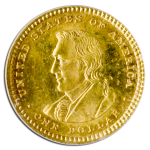
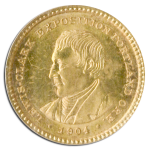
Nearly 100 years later citizens of Oregon made a proposal to honor the explorers. Their plans called for a fair to be held in the city of Portland which represented a portion of Lewis and Clark’s route. By 1904 the organizers were finally successful in securing Federal funding in the form of an appropriations bill which allocated $500,000 to the project. The bill also authorized minting a gold dollar to commemorate the fair. Charles E. Barber, the Mint Chief Engraver, was responsible for designing the coin.
It is believed that the inspiration for the profiles of both Lewis and Clark came from portraits of both men painted by Charles Willson Peale. Clark is on one side and Lewis is on the other. With each piece consisting of 90% gold, and 10% copper. The Philadelphia Mint struck approximately 60,000 pieces from 1904 to 1905, however, just over 40,000 were melted.
The fair began in the summer of 1905 drawing a total of two and a half million people. The coin was designed not only to commemorate the intrepid journey of Lewis and Clark, but also to finance the completion of a Sacagawea statue in Portland’s Washington Park. Unfortunately, the coins were unpopular with collectors at the time of their issuance. Over time, however, this lack of interest has made the Lewis and Clark Exposition gold dollar more valuable. For example, the 1904 coin can command a price anywhere from $900 to $10,000 depending on its condition according to A Guide Book of United States Coins. In fact, a near perfect 1904 coin claimed $57,500 in a 2006 auction. The 1905 coin is worth an estimated $1,200 to $15,000.
Many believe each of the two coins (1904, and 1905) only sold approximately 10,000 pieces each. The coins did, fortunately, sell well enough to successfully finance the completion of the Sacagawea statue. The story of the Lewis and Clark Exposition gold dollar is a reminder that commemorative coins often have a second life. In fact, those that are initially ignored later become rare, sought after pieces because of their scarcity. As with many coins that were unpopular, the Lewis and Clark gold dollar pieces were often incorporated into jewelry like broaches and stickpins. These uses for the coin only further diminished their availability in the secondary market.
The First Official U.S. Dollar Coin
Posted on — Leave a commentWhat an embarrassment.
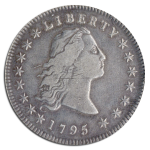
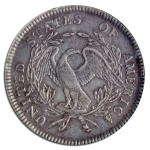
Americans used to use foreign money because we didn’t have our own.
In early America, we had no official coinage, and so we used a variety of foreign coins, including Spanish dollars.
In the 1780s, many prominent Americans began calling for the creation of a national mint. After the Constitution was ratified (giving Congress the power to coin money), Congress began reviewing the country’s monetary system and coinage and deciding what to do next. Treasury Secretary Alexander Hamilton recommended modeling our dollar on the Spanish dollar, and that’s what we went with.
In 1791, Congress authorized a mint. Three years later, engraver Robert Scot began working on the design for the dollar, which had Liberty on one side and an eagle on the other, as mandated by the Coinage Act. Extra care was taken with engraving the dollar compared to other denominations, because the U.S. knew this large coin would be heavily scrutinized when released and used abroad. This coin would represent our fledgling country, and we wanted it to do a good job.
However, the “Flowing Hair” design by Scot was short lived, as there were problems with the striking process … and a lack of enthusiasm for the design.
It’s actually kind of quaint. A relic of a bygone era, if you will (literally) …
The Flowing Hair Dollar was only minted for two years, making it quite rare.
Each coin in our catalog of rare coins tells its own story. If you want to read more, sign up for our newsletter here!
Silver Explodes To New 2019 High
Posted on — Leave a commentSilver soared to a new 2019 high last week as investors around the globe poured money into the metal.
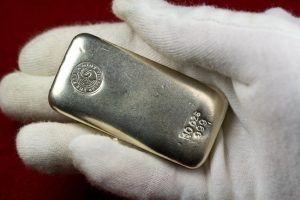
With gold prices up nearly 10% year-to-date, investors see opportunity in silver, which lagged gold in recent month.
Some Wall Street experts pointed to the recent swift decline in bitcoin, which sank from $12,647 on July 9 to a recent low at $9,575 on July 16, as a driving force for the huge up move into silver.
Both silver and gold, along with the Swiss Franc, are viewed by investors world-wide as a traditional safe-haven investments. They typically climb during periods of declining interest rates, political or military conflict or geopolitical tensions. Precious metals also typically gain sharply when stock market’s sell-off.
Some investors view bitcoin as another safe-haven alternative. But, recent volatility and swift dumping of bitcoin in July has many re-thinking that view. Bitcoin fell swiftly in part during Congressional hearings on Facebooks Libra project – another new cryptocurrency. Uncertainty around the future of cryptocurrency regulation sent Bitcoin sharply lower and in turn sent silver sharply higher, which is an important positive development for the metal.
As we’ve written about before, the Gold/Silver ratio has been historically out of whack this year.
In recent weeks, the gold/silver ratio hit 92.
Historically, readings above 65 revealed that silver is undervalued compared to gold.
The recent 92 readings show that silver has never been this cheap compared to gold. Last week’s rally in silver shows that investors are climbing on board.
Gold already broke out this year to new 6-year highs and the technical patterns project initial gains toward the $1,800 an ounce level in gold.
Now, silver is just starting its move higher, which makes it an incredible time to accumulate silver.
If you’ve been considering increasing your precious metals allocation, the recent move in silver signals a new rally phase is just beginning, which creates opportunity for potentially huge returns ahead. Silver is back above the $16 an ounce level. With silver’s all-time high above the $49 an ounce level, long-term investors see potential to triple their investment right now. Learn more about bulk silver investment opportunities here.
Want to get more investment and rare coin news, straight to your inbox? You can sign up for our newsletter here.